17 citations
,
May 2020 in “Forensic Science International Genetics” This study found that genetically variant peptides from human hair can reliably identify individuals despite differences in age and storage conditions, provided environmental and processing factors are controlled.
 May 2021 in “Pakistan Journal of Medical and Health Sciences”
 This study found that among Pakistani men with hair loss, the M type pattern was the most prevalent according to BASP classification.
 March 2025 in “Forum Dermatologicum”
 This case report highlights the importance of trichoscopy in diagnosing fibrosing alopecia in pattern distribution, distinguishing it from female pattern hair loss, and guiding effective treatment.
June 2022 in “Our Dermatology Online” In this study, researchers found that trichoscopy helps detect early signs of female-pattern hair loss before it is visible, highlighting its importance for monitoring and managing the condition.
 7 citations
,
January 1990 in “Eisei kagaku”
7 citations
,
January 1990 in “Eisei kagaku” This study suggests that analyzing hair care product components left on hair using GC and GC-MS may provide a more objective forensic comparison than morphological examination.
63 citations
,
December 1998 in “Biochimica et Biophysica Acta (BBA) - Protein Structure and Molecular Enzymology” The study improved understanding of keratin fiber structure by showing consistent microfibril diameter but varying distances and electron density profiles.
 January 2024 in “International journal of dermatology, venereology and leprosy sciences (Print)”
 The document's conclusion cannot be provided because the content is not accessible.
19 citations
,
April 1999 in “British Journal of Dermatology” This study shows that keratin 2e exhibits distinct temporal and regional expression patterns in fetal epidermis, suggesting different regulatory and functional roles from other epidermal keratins.
 10 citations
,
June 2005 in “The journal of investigative dermatology/Journal of investigative dermatology”
10 citations
,
June 2005 in “The journal of investigative dermatology/Journal of investigative dermatology” This study identified FP-1 as a highly specific extracellular matrix protein in follicular papilla cells, which may play a role in hair growth regulation during specific hair cycle phases.
45 citations
,
December 2004 in “Forensic Science International” This study reports that using laser microdissection to isolate telogen hair follicles significantly improves DNA extraction efficiency for STR typing, reducing contamination from keratin.
 30 citations
,
January 2020 in “Journal of The American Academy of Dermatology”
30 citations
,
January 2020 in “Journal of The American Academy of Dermatology” This review reports no new clinical results but discusses fibrosing alopecia in a pattern distribution as a distinct scarring alopecia with characteristics of both androgenetic alopecia and lichen planopilaris.
4 citations
,
April 2012 in “The journal of investigative dermatology/Journal of investigative dermatology” This study developed a mouse model lacking keratin 16 to replicate palmoplantar lesions, which may help uncover the molecular mechanisms driving these lesions in pachyonychia congenita and focal non-epidermolytic palmoplantar keratoderma.
 1 citations
,
May 2020 in “Journal of The American Academy of Dermatology”
1 citations
,
May 2020 in “Journal of The American Academy of Dermatology” This correspondence highlights existing research on pattern hair loss, discussing findings about immune deposits, lymphocytic infiltration, and responses to treatment, and calls for future well-controlled studies.

This study found considerable variation in hair shaft proteomic profiles among Caucasian, African-American, Kenyan, and Korean subjects, with individual and site-specific differences observed.
30 citations
,
May 2020 in “Forensic Science International Genetics” This study found that optimizing proteomic genotyping conditions from single human hair samples significantly improves the detection of genetically variant peptides, enhancing human identification with high precision across different biogeographic backgrounds.
2 citations
,
January 1990  6 citations
,
October 2019 in “Case Reports in Dermatology”
6 citations
,
October 2019 in “Case Reports in Dermatology” This report describes a case of fibrosing alopecia in a pattern distribution in a postmenopausal woman, highlighting its distinction from other forms of lichen planopilaris and pattern hair loss.
 2 citations
,
January 2000 in “Elsevier eBooks”
2 citations
,
January 2000 in “Elsevier eBooks” The document explains how hair is studied in forensics to identify its source and its role in criminal investigations.
December 1987 in “Pediatric Dermatology” This article describes a previously unreported hair anomaly associated with facio-genito-popliteal syndrome and does not present new clinical results.
1 citations
,
March 2012 in “Actas dermo-sifiliográficas/Actas dermo-sifiliográficas” Dermoscopy helps diagnose frontal fibrosing alopecia by identifying specific scalp features.
 4 citations
,
January 2020 in “Skin appendage disorders”
4 citations
,
January 2020 in “Skin appendage disorders” This case report describes a unique presentation of frontal fibrosing alopecia characterized by a hair loss pattern that resembles the Greek letter upsilon, supported by trichoscopic and histological findings.
28 citations
,
July 1993 in “The journal of investigative dermatology/Journal of investigative dermatology” 2 citations
,
January 2010  May 2025 in “Journal of Clinical Images and Medical Case Reports”
 The study observed that patterned fibrosing alopecia, a type of scarring hair loss, appears in some patients after hair transplants, facelifts, and other surgical interventions, sharing features with lichen planopilaris and androgenetic alopecia.
 7 citations
,
August 2018 in “The American Journal of Dermatopathology”
7 citations
,
August 2018 in “The American Journal of Dermatopathology” This study describes a newly observed "inflammatory vellus involvement" pattern in early frontal fibrosing alopecia, which may lead to misdiagnosis due to the absence of typical histological features.
January 2022 in “Clinical Cases in Dermatology” This case report describes a 47-year-old man diagnosed with fibrosing alopecia in a pattern distribution, treated with clobetasol propionate and oral minoxidil while advised to avoid hair transplantation.
277 citations
,
October 1982 in “The Journal of Cell Biology” This study found that the cytokeratin patterns in skin epithelia can distinguish between different types, with basal-cell epitheliomas showing a striking similarity to the pilosebaceous tract.
 5 citations
,
February 2015 in “Dermatologica Sinica”
5 citations
,
February 2015 in “Dermatologica Sinica” In this study, a computer-aided imaging system accurately measured the width of balding areas in female pattern hair loss, correlating strongly with clinical staging severity.
 16 citations
,
February 2010 in “Journal of the European Academy of Dermatology and Venereology”
16 citations
,
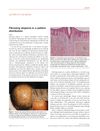
February 2010 in “Journal of the European Academy of Dermatology and Venereology” This article is a letter to the editor about fibrosing alopecia in a pattern distribution and reports no new research findings.