 35 citations
,
January 2013 in “Indian Journal of Dermatology, Venereology and Leprology”
35 citations
,
January 2013 in “Indian Journal of Dermatology, Venereology and Leprology” This study found that intralesional triamcinolone acetonide is effective for treating localized patchy alopecia areata, with dermoscopy aiding in early detection of clinical response and adverse effects.
This study found that sericin dressing containing collagen hydrolysate significantly reduced wound healing time and improved scar quality compared to commercial dressing in split-thickness skin graft donor sites.
 February 1996 in “International Journal of Dermatology”
 This article offers a summary of the Seoul International Dermatology Symposium held in May 1995, but reports no new clinical findings.
87 citations
,
August 1974 in “Journal of Investigative Dermatology”  December 2019 in “Buletin de psihiatrie integrativă”
 This article highlights the psycho-affective risks associated with aesthetic medical procedures and stresses the importance of interdisciplinary collaboration to improve care in this field, but reports no new clinical results.
January 2024 in “Updates in clinical dermatology” February 2023 in “Journal of Cutaneous Pathology” This case report describes an adult female with concurrent mycosis fungoides and papillary dermal elastolysis, highlighting the importance of considering rare presentations in differential diagnoses.
July 2023 in “Cosmoderma”  August 2023 in “ACS applied materials & interfaces”
 In this study, researchers developed an innovative wound healing patch combining electrical and chemical components, which effectively guided recovery in animal scald models by promoting collagen deposition and the regeneration of skin structures.
 1 citations
,
January 2002 in “Journal of Clinical Dermatology”
1 citations
,
January 2002 in “Journal of Clinical Dermatology” This study analyzed the prevalence and demographic distribution of common skin diseases among 17,039 outpatients at Wonju Christian Hospital from 1995 to 1999, noting a decrease in certain conditions over time.
In this study, chitosan hydrogels and delivery systems showed promise in supporting skin recovery post-laser procedures, enhancing topical treatments for acne and melasma, and improving hair density in scalp applications, but limited study sizes and formulation variability restrict generalizability.
November 2025 in “Journal of Investigative Dermatology” N,N-Dimethylglycine sodium salt may improve skin health and treat hair loss.
 1 citations
,
April 2022 in “JAAD case reports”
1 citations
,
April 2022 in “JAAD case reports” This case report describes a unique instance of IgG/IgA pemphigus in a Chinese woman, highlighting its distinct clinical and immunopathologic characteristics, including successful management with dapsone and prednisolone.
 April 2005 in “Aktuelle Dermatologie”
 This article reviews advancements in hair cosmetics, including "cosmeceuticals" and new dermocosmetic strategies, and reports no new clinical results.
 6 citations
,
September 2019 in “Skin pharmacology and physiology”
6 citations
,
September 2019 in “Skin pharmacology and physiology” This study found that RCS-01 cell therapy for aged skin was well tolerated and associated with increased gene expression related to extracellular matrix homeostasis, suggesting potential skin improvement.
 14 citations
,
July 2012 in “Journal of the American Academy of Dermatology”
14 citations
,
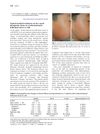
July 2012 in “Journal of the American Academy of Dermatology” This study found that topical tacalcitol improved roughness and scaling in erythromelanosis follicularis faciei et colli, although it was less effective for facial erythema.
 61 citations
,
June 2022 in “IEEE Journal of Biomedical and Health Informatics”
61 citations
,
June 2022 in “IEEE Journal of Biomedical and Health Informatics” This study introduced a novel deep clustering approach for melanoma detection from dermoscopic images, demonstrating improved performance over existing methods by mitigating class imbalance issues using a center-oriented margin-free triplet loss.
5 citations
,
January 1999 in “Journal of dermatological treatment” This study found that while Bioré pore strips effectively removed microcomedones and trichostatic bundles on the nose without causing irritation, they were less effective than cyanoacrylate extraction.
 December 2024 in “Media Dermato Venereologica Indonesiana”
 In this retrospective study at the USU Dermatology Cosmetic Clinic, researchers identified acne vulgaris and striae distensae as the most common skin conditions among 1,993 patient visits between 2020 and 2022, with patient numbers peaking in 2021.
This summary references various dermatological treatments and conditions but does not present new research findings or clinical results.
 March 2014 in “Journal of The American Academy of Dermatology”
 The document lists various dermatology topics, treatments, and diagnostic methods.
 2 citations
,
January 2016 in “Springer eBooks”
2 citations
,
January 2016 in “Springer eBooks” The book is a useful guide for dermatologists studying for their board exam, with clinical images and features of skin diseases.
 2 citations
,
June 2022 in “Cosmoderma”
2 citations
,
June 2022 in “Cosmoderma” This review discusses regenerative medicine's applications in dermatology, highlighting the need for quality clinical trials to optimize treatments like PRP, stem cells, and exosomes, and reports no new results.
 October 2021 in “Austin journal of biomedical engineering”
 In this study, researchers modified an acellular scaffold with different concentrations of eggshell membrane protein, finding that a 5% concentration effectively enhanced tissue regeneration in mice with excisional wounds, achieving complete healing within 14 days without causing immunogenicity or inflammation.
 43 citations
,
July 2019 in “Stem Cells International”
43 citations
,
July 2019 in “Stem Cells International” This review discusses advances and challenges in skin tissue engineering, focusing on developing 3D constructs for functional skin substitutes, and reports no new clinical results.
27 citations
,
March 2006 in “Dermatologic surgery” This review discusses the widespread acceptance of micropigmentation for cosmetic purposes and its various medical applications, but reports no new clinical findings.
 65 citations
,
March 2018 in “Journal of Dermatological Science”
65 citations
,
March 2018 in “Journal of Dermatological Science” This review discusses the role of mechanical forces in skin homeostasis and disease development, including their impact on conditions like keloids, androgenetic alopecia, and acral melanoma, and reports no clinical results; the authors propose modifying these forces as a potential therapeutic strategy.
6 citations
,
January 2014 in “Pediatric annals” This case report describes a 21-day-old infant with erythematous annular scaly plaques and pustules on the face and scalp, which did not improve with topical corticosteroid cream.