 August 2018 in “bioRxiv (Cold Spring Harbor Laboratory)”
 This study identifies diltiazem as a promising repurposed drug for treating influenza, supported by its antiviral activity and gene modulation effects, leading to a Phase II clinical trial authorization.
 April 2018 in “bioRxiv (Cold Spring Harbor Laboratory)”
 This study identified a specific genetic variant in the CCHCR1 gene that may contribute to alopecia areata through impaired keratinization, suggesting an alternative mechanism beyond autoimmune causes.
 April 2018 in “bioRxiv (Cold Spring Harbor Laboratory)”
 This study reported that small molecules such as α-ketoglutarate, α-ketobutyrate, rapamycin, and metformin may stimulate hair regeneration by activating autophagy pathways.
February 2018 in “bioRxiv (Cold Spring Harbor Laboratory)” This study found that distinct spiny hair morphologies in rodents arose independently multiple times but did not link the Ecdysoplasin A receptor gene mutation that affects human hair to these variations.
January 2018 in “bioRxiv (Cold Spring Harbor Laboratory)” This study found that the mutant hairless rhino bald protein in mice interacts with the vitamin D receptor but cannot repress its transactivation and shows abnormal cellular localization.
 January 2018 in “bioRxiv (Cold Spring Harbor Laboratory)”
 This study explored how root hairs integrate opposing growth signals but did not report new conclusive findings on the activation of known molecular players in polar growth.
 January 2018 in “bioRxiv (Cold Spring Harbor Laboratory)”
 This study identified a new cis-regulatory element in the mouse Hr gene that influences its expression in skin and brain cells, highlighting a complex molecular network involved in hair follicle formation.
 December 2017 in “bioRxiv (Cold Spring Harbor Laboratory)”
 This study found that Endoglin is crucial for proper hair follicle cycling and the activation of hair follicle stem cell niches, based on its role in the feedback crosstalk between Wnt/β-catenin and Bmp/Smad signals.
 May 2017 in “bioRxiv (Cold Spring Harbor Laboratory)”
 This study found that the peach gene CTG134, involved in auxin-ethylene interactions, plays a role in hormonal regulation during root hair formation in Arabidopsis and tobacco.
April 2017 in “bioRxiv (Cold Spring Harbor Laboratory)” This study introduced the dual-flow-RootChip platform to demonstrate that Arabidopsis roots exhibit non-autonomous adaptations, such as hair growth regulation, when subjected to varied environmental conditions on opposite sides.
 March 2017 in “bioRxiv (Cold Spring Harbor Laboratory)”
 This study found that auxin regulates reactive oxygen species-mediated root hair growth by activating transcription factors and enzymes that affect cell elongation.
April 2021 in “bioRxiv (Cold Spring Harbor Laboratory)” This study successfully isolated inner ear-specific exosomes from perilymph samples of sensorineural hearing loss patients using a novel immunomagnetic approach, enabling groundbreaking liquid biopsy diagnostics.
September 2020 in “bioRxiv (Cold Spring Harbor Laboratory)” This study found that finasteride reduced opioid self-administration in zebrafish and rats without affecting pain relief, suggesting steroidogenic pathways may offer new treatment avenues for opioid use disorder.
20 citations
,
March 2014 in “Molecular Endocrinology” This study suggests that NFIB and STAT5 work together to control cell-specific genetic programs in mammalian tissues, particularly in mammary and hair follicle stem cells.
 April 2017 in “The journal of investigative dermatology/Journal of investigative dermatology”
 This study identified intramembrane proteolysis as a key feature of Astrotactin2 maturation, providing insights into its role in planar cell polarity hair patterning.
 555 citations
,
July 2001 in “Genes & Development”
555 citations
,
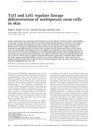
July 2001 in “Genes & Development” This study found that Tcf3 and Lef1 differently regulate cell differentiation in multipotent skin stem cells, with Tcf3 promoting follicle-like features and Lef1, when modified, promoting sebocyte differentiation.
 354 citations
,
February 2011 in “Genes & Development”
354 citations
,
February 2011 in “Genes & Development” This study found that abolishing H3K27me3 in mouse skin by targeting Ezh2 and Ezh1 affects hair follicle development and epidermal behavior, revealing functional differences between these tissues.
 301 citations
,
May 1998 in “Genes & Development”
301 citations
,
May 1998 in “Genes & Development” Ets2 gene is crucial for placental development in mice.
 245 citations
,
January 1998 in “Genes & Development”
245 citations
,
January 1998 in “Genes & Development” This study found that Hoxc13 mutations in mice cause defects in hair, nail, and tongue structures, with the most noticeable issue being brittle hair leading to alopecia.
 178 citations
,
October 2001 in “Genes & Development”
178 citations
,
October 2001 in “Genes & Development” This study found that the mammalian hairless gene encodes a corepressor protein that interacts with thyroid hormone receptors, providing insights into hair loss syndromes in humans and mice.
 169 citations
,
May 2006 in “Genes & Development”
169 citations
,
May 2006 in “Genes & Development” This study found that keratin 17 and TNFα play interdependent roles in regulating hair follicle cycling, with TNFα required for the anagen–catagen transition and its ablation partially rescuing hair cycling defects in K17-null mice.
 156 citations
,
January 1989 in “Genes & Development”
156 citations
,
January 1989 in “Genes & Development” This study found that keratin K14 expression occurs early in epidermal cell differentiation, while a hair-specific keratin is expressed later in hair matrix cells, suggesting developmental divergence between the two cell types.
 150 citations
,
August 1992 in “Genes & Development”
150 citations
,
August 1992 in “Genes & Development” This study reported that transgenic mice with targeted TNF alpha expression in keratinocytes showed impaired weight gain, retarded hair growth, and skin changes, leading to cachexia and necrosis.
 122 citations
,
June 2002 in “Genes & Development”
122 citations
,
June 2002 in “Genes & Development” This study found that K17 is crucial for the structural integrity and survival of hair-producing cells, with K17 null mice developing alopecia due to hair fragility and follicular alterations.
 47 citations
,
June 2012 in “Genes & Development”
47 citations
,
June 2012 in “Genes & Development” This study found that maternal consumption of a western diet in mice led to toxic milk production, causing inflammation and alopecia in nursing neonates due to Toll-like-receptor activation.
 667 citations
,
May 2008 in “Genes & Development”
667 citations
,
May 2008 in “Genes & Development” This review discusses the biochemical and biological functions of histone demethylases and their potential involvement in human diseases, including cancer, but reports no new findings.
 556 citations
,
September 2008 in “Genes & Development”
556 citations
,
September 2008 in “Genes & Development” This review summarizes how genetic studies using conditional β-catenin loss- and gain-of-function mice have advanced understanding of canonical Wnt signaling's role in embryonic development, adult stem cell maintenance, and cancer modeling.
 384 citations
,
June 2005 in “Genes & development”
384 citations
,
June 2005 in “Genes & development” This study found that stabilized beta-catenin is crucial for activating stem cell transition from quiescence to proliferation in hair follicles by influencing gene expression within the stem cell niche.
 218 citations
,
April 2008 in “Genes & Development”
218 citations
,
April 2008 in “Genes & Development” This research discusses how epithelial stem cells in the skin maintain normal homeostasis, contribute to wound repair, and highlights the importance of these processes, as defects can lead to skin diseases including cancers, but provides no new experimental results.
 212 citations
,
May 2012 in “Genes & Development”
212 citations
,
May 2012 in “Genes & Development” This study identified a set of wound-induced genes in planarians that play a role in regeneration initiation, with some genes specifically activating within regenerative cells called neoblasts.