71 citations
,
May 2006 in “The journal of investigative dermatology/Journal of investigative dermatology” In this study, researchers found that trichothiodystrophy hair brittleness is linked to abnormalities in sulfur content and structural organization, making it prone to breakage.
414 citations
,
August 2005 in “Nature” In this study, researchers discovered that activating TERT in mouse skin epithelium triggers dormant hair follicle stem cells, leading to rapid hair growth, through a pathway independent of telomere extension.
April 2025 in “Biomedical Journal of Scientific & Technical Research” This source does not report study results but describes the mission and peer review process of the Biomedical Journal of Scientific & Technical Research, emphasizing its focus on genetic, biomedical, and remedial research with technical knowledge integration.
59 citations
,
September 2003 in “Journal of steroid biochemistry and molecular biology/The Journal of steroid biochemistry and molecular biology” This study suggests that epitestosterone may play a role in regulating androgen-dependent processes like prostate growth and body hair distribution by counteracting testosterone's actions.
7 citations
,
March 2024 in “Biomedical Engineering Letters”  1 citations
,
July 2022 in “Pakistan biomedical journal”
1 citations
,
July 2022 in “Pakistan biomedical journal” This review discusses ethanol-based transethosome vesicles for drug delivery through the skin, but reports no new clinical results.
 1 citations
,
January 2013 in “International Journal of Trichology”
1 citations
,
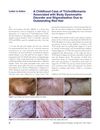
January 2013 in “International Journal of Trichology” A girl with red hair developed hair-pulling and body image disorders after being bullied for her hair color.
 156 citations
,
October 1996 in “Science of The Total Environment”
156 citations
,
October 1996 in “Science of The Total Environment” This study observed that tributyltin pollution induces imposex, reduces reproductive success, and leads to population decline in Ocinebrina aciculata, highlighting its sensitivity compared to other prosobranch species.
51 citations
,
January 1997 in “PubMed” This review outlines the genetic basis of GABEB, highlighting reduced type XVII collagen as a distinguishing marker from Herlitz JEB, and discusses potential therapeutic avenues without presenting new results.
8 citations
,
March 2022 in “Cancers” This study found that proton minibeam radiotherapy demonstrated a potential tissue-sparing effect in epidermis models by spatially confining DNA damage, suggesting reduced side effects in radiotherapy.
July 2024 in “Journal of Investigative Dermatology” ATR12-351 ointment safely delivers LEKTI protein to the skin, reducing enzyme activity in Netherton syndrome.
 18 citations
,
December 2009 in “Canadian Journal of Animal Science”
18 citations
,
December 2009 in “Canadian Journal of Animal Science” This study reports that BMP2 expression in goat skin is higher during late telogen and early anagen phases, indicating a potential role in hair follicle regeneration.
November 2025 in “Journal of Investigative Dermatology” KLHL24-mutant stem cells help understand skin and heart disease.
36 citations
,
August 2020 in “Polymers” The researchers developed semi-dissolving microneedle patches using TEMPO-oxidized bacterial cellulose nanofibers, which allow effective transdermal drug delivery by forming micro-channels for large drug quantities, overcoming traditional microneedles' low drug loading.
September 2017 in “BAUST Journal” December 2021 in “Figshare” This study found that BBS7 expression is crucial for maintaining Sonic hedgehog signaling and periodontal ligament homeostasis in occlusal hypofunctional conditions.
21 citations
,
May 2021 in “Materials & Design” This study developed a new multifunctional medical dressing using Bletilla striata polysaccharide and ethanol extract that demonstrated hemostatic, antibacterial, and significant wound healing effects, as evidenced by quicker healing rates and improved skin conditions in treated wounds compared to controls.
61 citations
,
August 1993 in “PubMed” This study found that solid basal cell epitheliomas and the outer root sheath of human hair follicles display nearly identical cytokeratin profiles, suggesting a potential origin connection.
June 2005 in “Journal of Investigative Dermatology” A bull with a gene mutation was asymptomatic, synthetic retinoids cause hair loss, and new therapeutic targets were identified for skin diseases.
This thesis presents the development of the Breast Utility Instrument (BUI), a new tool for assessing health-related quality of life specifically in breast cancer patients.
January 2019 in “Deleted Journal” This in vitro study suggests that Biofield Energy Healing Treatment may promote hair growth as evidenced by increased telogen formation in vibrissae hair follicle organ culture cells.
35 citations
,
July 2010 in “The FEBS journal” In this study, researchers identified a highly reactive, isozyme-specific sequence for TGase 3, contributing to understanding its distinct functional role and activity distribution in the mouse epidermis.
December 2025 in “Biomedicines” This source reviews the common skin-related side effects of tyrosine kinase inhibitors in treating endocrine cancers and emphasizes that proactive, multidisciplinary management can effectively control these adverse events without compromising cancer treatment efficacy.
101 citations
,
July 1985 in “Journal of the American Academy of Dermatology” In this study, oral biotin improved hair growth, strength, and combability in a child with uncombable hair syndrome, while hair in two others slowly improved without biotin.
 32 citations
,
November 2004 in “Journal of pharmaceutical sciences”
32 citations
,
November 2004 in “Journal of pharmaceutical sciences” This study quantifies the follicular uptake of tea tree oil in bovine udder skin, with microemulsion showing the highest concentration among different formulations tested.
4 citations
,
March 1999 in “International Journal of STD & AIDS” This report details a case of severe recurrent bacterial vaginosis in a woman with Netherton's syndrome.

This study achieved over 99% antibacterial efficacy against Staphylococcus aureus and Escherichia coli by modifying camel hair with Rose Bengal, allowing for color customization and strong mechanical properties under visible light, thus suggesting a high-value approach to diversifying camel hair textiles.

This study suggests that skin tumor cells in tuberous sclerosis complex may promote hamartoma morphogenesis by expressing and releasing higher levels of cathepsin B.
1 citations
,
March 2024 in “Genes & Diseases” EBF1 controls hair type and length.
1 citations
,
December 2011 in “Ophthalmology” This article comments on Nemet et al.'s study of blepharitis, emphasizing that Demodex folliculorum is a significant factor in its associated morbidity and can be effectively managed with tea tree oil shampoo.