January 2018 in “INTAS POLIVET” In this clinical case report, a Labrador dog with multiple skin issues was successfully treated for Demodex mites and Pemphigus foliaceus using Prednisolone, Cephalexin, Amitraz, Ivermectin, and Ketoconazole, resulting in an uneventful recovery.
26 citations
,
January 2012 in “Journal of the American Academy of Dermatology” This study found that adding topical eflornithine to hair laser treatment significantly reduced hair counts and inflammatory papules more effectively than laser therapy alone in treating pseudofolliculitis barbae.
January 2025 in “Updates in clinical dermatology” COVID-19 vaccines can cause minor skin reactions, including those related to Bullous Pemphigoid, but these usually resolve on their own.
 April 2021 in “BMJ Case Reports”
 This case report discusses a rare instance of pseudolymphomatous folliculitis in a 19-year-old man, highlighting the challenge in diagnosing PLF due to its low clinical suspicion index and variable initial clinical diagnoses.
1 citations
,
September 2022 in “European Journal of Dermatology” This study identified a novel splice-site variant of the LAMB3 gene that may cause junctional epidermolysis bullosa, suggesting gene sequencing is essential for accurate diagnosis.
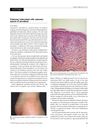
September 2001 in “Swiss Medical Forum ‒ Schweizerisches Medizin-Forum” July 2023 in “Clinical Cosmetic and Investigational Dermatology” In this case report, a 64-year-old Thai woman with a history of misdiagnosed eczema or folliculitis was ultimately found to have granular parakeratosis of the eccrine ostium, leading to significant symptom improvement once accurately diagnosed and advised to avoid excessive heat and moisture.
 9 citations
,
July 2002 in “Journal of the European Academy of Dermatology and Venereology”
9 citations
,
July 2002 in “Journal of the European Academy of Dermatology and Venereology” This article discusses multiple minute digitate hyperkeratosis in a dermatological context and reports no new clinical findings; the authors focus on a descriptive review.
 September 2025 in “Scientific periodicals of Ukraine”
 This study reports on a 46-year-old patient with pseudopelades of Brocq, highlighting the effectiveness of early diagnosis and treatment in preventing atrophy and controlling hair loss, as positive clinical outcomes were noted after prescribed therapy.
 March 2026 in “Indian journal of veterinary and animal sciences research.”
 In this study, a five-year-old Labrador with pemphigus, characterized by erythematous lesions and confirmed through cytology, was successfully treated with a six-week regimen of oral immunosuppressive azathioprine and supportive medications, resulting in total recovery.
1 citations
,
March 2006 in “Journal of Cosmetic Dermatology” This case report describes a 79-year-old woman whose skin lesions were attributed to a cosmetic product, with complete resolution following mechanical removal of material and metronidazole treatment.
 22 citations
,
January 2009 in “Medical mycology”
22 citations
,
January 2009 in “Medical mycology” In this case report, researchers identified Arthroderma vanbreuseghemii as the cause of a familial fungal infection, which was successfully treated with itraconazole and topical terbinafine cream.
January 2022 in “Optometric clinical practice” This case report describes a 59-year-old woman with a rare trichoepithelioma on her eyelid, emphasizing the importance for optometrists to differentiate it from basal cell carcinoma.
 April 2012 in “Informa Healthcare eBooks”
 Lichen planopilaris is a rare, chronic condition causing hair loss, mainly in middle-aged women, and early treatment is important to prevent permanent baldness.
This chapter provides dermatology trainees with insights on managing lichen planopilaris, emphasizing treating active disease to prevent further hair loss and recommending a tapered course of oral steroids for disease stabilization.
75 citations
,
September 1985 in “Archives of dermatology” This report of ichthyosis follicularis in two boys discusses the challenges of distinguishing it from similar disorders, noting its rarity and unclear inheritance pattern without providing new clinical results.
 October 2025 in “Indian Dermatology Online Journal”
 In this case report, an elderly woman was diagnosed with tinea capitis and eyebrow involvement, which was initially misdiagnosed as alopecia areata, illustrating the importance of trichoscopy in correctly identifying this infection even in uncommon sites like the eyebrow.
June 2017 in “Journal of the American Academy of Dermatology” Plucked hair can help diagnose pemphigus vulgaris early.
18 citations
,
April 2002 in “Journal of cutaneous pathology” This study concludes that tiny infundibular cysts, rather than comedones, are the primary lesions in chloracne.
 13 citations
,
August 2017 in “International Journal of Dermatology”
13 citations
,
August 2017 in “International Journal of Dermatology” This study reported that trichoscopy revealed distinctive patterns across different autoimmune bullous diseases, suggesting it can be a useful preliminary diagnostic tool for differentiating these conditions.
 May 2024 in “Indian Dermatology Online Journal”
 This study reports a case of trichobacteriosis pubis, a rare bacterial infection causing malodour in the pubic region, which improved with hair trimming and topical clindamycin, subsequently enhancing the patient's sexual relationship.
1 citations
,
December 2019 This study found that bimatoprost eye drops significantly increased eyelash length, thickness, pigmentation, and the number of eyelashes per follicle in rabbits within one month.
12 citations
,
March 2004 in “Journal of Investigative Dermatology” 69 citations
,
April 2010 in “Clinical ophthalmology” This article reviews the use of bimatoprost for eyelash hypotrichosis and reports its effectiveness in promoting eyelash growth but highlights uncertain efficacy in cases of eyelash alopecia areata.
 9 citations
,
January 2013 in “Acta dermato-venereologica”
9 citations
,
January 2013 in “Acta dermato-venereologica” The conclusion is that "trichoknesis" should be recognized as a separate condition from trichodynia, characterized by itching instead of pain.
14 citations
,
January 2018 in “Skin Appendage Disorders” This case report suggests that identifying hyperpigmentation on the upper eyelid with specific dermoscopy patterns could help diagnose facial lichen planus pigmentosus without needing a facial biopsy.
4 citations
,
July 2014 in “The Journal of Dermatology” This letter to the editor discusses plaque-type herpetic folliculitis involving the eccrine gland and does not report new research findings.
 1 citations
,
December 2022 in “Life”
1 citations
,
December 2022 in “Life” This review systematically analyzed evidence on treatment options for erosive pustular dermatosis, finding that while potent topical steroids like clobetasol propionate can be effective, recurrence is common, and more robust studies are necessary for stronger recommendations.
4 citations
,
December 2015 in “Redalyc (Universidad Autónoma del Estado de México)” This case report documents the diagnosis and successful treatment of sebaceous adenitis in a cat with ciclosporin and emollients, noting substantial clinical improvement in the animal.
1 citations
,
December 2019 in “Clinical ophthalmology” This study found that bimatoprost eye drops increased eyelash length, thickness, pigmentation, and the number of eyelashes per follicle in rabbits, without causing inflammation.