44 citations
,
November 2007 in “Journal of toxicology and environmental health. Part B, Critical reviews” This review explores how copper and zinc concentrations in hair may serve as bioindicators and discusses their potential associations with health disorders, but it reports no new clinical findings.
 1 citations
,
November 2023 in “Frontiers in veterinary science”
1 citations
,
November 2023 in “Frontiers in veterinary science” Goat hair shows changes in metal levels and stress when goats move from indoors to mountain pastures.
 7 citations
,
January 2012
7 citations
,
January 2012 This study reported that in the California Ground Squirrel, certain elements bioaccumulate in hair, providing baseline data for environmental health assessments.
 156 citations
,
October 1996 in “Science of The Total Environment”
156 citations
,
October 1996 in “Science of The Total Environment” This study observed that tributyltin pollution induces imposex, reduces reproductive success, and leads to population decline in Ocinebrina aciculata, highlighting its sensitivity compared to other prosobranch species.
January 2014 in “Journal of Jilin University” This study found that Th22 cells and their cytokine IL-22 may play an important role in the pathogenesis of systemic lupus erythematosus and could serve as bioindicators for monitoring disease severity.
 July 2026 in “Frontiers in Cellular and Infection Microbiology”
 This study found that patients with androgenetic alopecia had increased scalp microbial diversity and reduced Staphylococcus abundance, particularly in the frontal and vertex regions, suggesting this dysbiosis as a sensitive indicator of AGA.
 4 citations
,
March 2012 in “InTech eBooks”
4 citations
,
March 2012 in “InTech eBooks” This article discusses the major role of motor vehicles in contributing to urban air pollution and its significant health impacts, especially in developing countries, but reports no new findings.
 April 2023 in “Acta Poloniae Pharmaceutica”
 This study found that using Urtica cannabina extract shampoo led to increased levels of copper, zinc, and iodine in the scalp hair of Mongolian women, along with improvements in hair growth, diameter, and density compared to a regular shampoo.
 84 citations
,
February 2013 in “Clinica chimica acta”
84 citations
,
February 2013 in “Clinica chimica acta” This review presents evidence that correlations exist between hair mineral imbalances and various diseases, though inconsistencies in results highlight the need for standardized preparation methods.
 56 citations
,
January 2013 in “International journal of trichology”
56 citations
,
January 2013 in “International journal of trichology” This case report suggests that zinc supplements may be necessary to improve hair loss in hypothyroidism patients being treated with thyroxine.
 18 citations
,
January 2015 in “Data series”
18 citations
,
January 2015 in “Data series” This report describes a study of estuarine bed-sediment quality in New Jersey and New York post-Hurricane Sandy, focusing on contamination extent and potential long-term impacts, with no new findings included.
 11 citations
,
January 2008 in “International journal of environment and health”
11 citations
,
January 2008 in “International journal of environment and health” This review discusses the environmental contamination and health risks of Platinum Group Elements, highlighting their potential bioaccumulation and associated health issues, especially in vulnerable populations like children, and reports no new experimental findings.
 9 citations
,
April 2018 in “Journal of trace elements in medicine and biology”
9 citations
,
April 2018 in “Journal of trace elements in medicine and biology” This review presents the practice of using hair bioelement analysis to assess nutritional status or environmental exposure, proposing complex interactions and hypotheses regarding depression and autism but reports no new clinical results.
 2 citations
,
January 2013
2 citations
,
January 2013 This review discusses various forensic applications of hair analysis, such as species identification and drug addiction testing, and reports no new study results.
 1 citations
,
August 2024 in “Polish Journal of Environmental Studies”
1 citations
,
August 2024 in “Polish Journal of Environmental Studies” This study reviewed 54 articles to examine how continuous exposure to air pollution causes hair damage, hair loss, and scalp conditions due to oxidative stress and inflammation, and highlighted anti-inflammatory substances that could mitigate these effects.

This study utilized polarized light microscopy to examine hair shafts in ten children with rare genetic disorders, such as Netherton syndrome and ectodermal dysplasia, providing valuable diagnostic insights into hair thickness, composition, and structural irregularities associated with these conditions.
 January 2023 in “Book of Abstracts”
 COVID-19 can cause different types of hair loss, with telogen effluvium being the most common.
 January 2022 in “Bio web of conferences/BIO web of conferences”
 This study concluded that the elemental composition of tail brush hair in newborn calves can indicate trace element supply to the fetus during the last months of pregnancy.
 May 2017 in “Journal of microscopy and ultrastructure”
 This notice states that the article has been withdrawn due to the journal's transfer to a new publisher and reports no research findings.

This review discusses the association between hair element levels and autism spectrum disorder, reporting links between neurotoxic elements like mercury and lead and pathogenesis, alongside potentially protective roles for zinc and copper balance.
January 2024 in “Bioanalysis” 13 citations
,
January 2025 in “Lab on a Chip” This review discusses recent developments in capillary microfluidic wearables for non-invasive, continuous biofluid monitoring, highlighting advances in device design, electrochemical and optical biosensing, and the challenges of clinical validation and scalable manufacturing.
November 2025 in “Molecules” This review examines recent advancements in green and emerging microextraction techniques, such as SPME and DLLME, for more sustainable hormone detection in biological samples, emphasizing environmentally friendly solvents and bioanalytical applications.
66 citations
,
August 2007 in “Applied and environmental microbiology” This study engineered a bioluminescent yeast strain responsive to androgenic chemicals, demonstrating rapid and sensitive detection suitable for high-throughput screening and environmental monitoring.
 January 2024 in “LA Referencia (Red Federada de Repositorios Institucionales de Publicaciones Científicas)”
 This study found that Carbon Quantum Dots effectively detected and quantified Co²⁺ ions and methylcobalamin in tap water with high sensitivity and recovery rates between 95% and 105%.
 11 citations
,
June 2013 in “Journal of Chemical Education”
11 citations
,
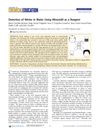
June 2013 in “Journal of Chemical Education” This study reports an easy colorimetric method for detecting nitrite in water using minoxidil, which may be suitable for various analytical applications due to its effective detection range.
 5 citations
,
December 2022 in “Research in Biotechnology and Environmental Science”
5 citations
,
December 2022 in “Research in Biotechnology and Environmental Science” This bibliometric review analyzes trends in published research on ocean pollution biodegradation and bioremediation over time, reporting a notable growth in related publications from 2010 to 2022.
 January 2024 in “Biotechnology advances”
 This review highlights the importance of selecting high-quality bioassays in discovering bioactive compounds from marine sources, emphasizing their role in evaluating safety and efficacy during pharmaceutical, food supplement, and cosmetic development.
2 citations
,
May 2024 in “Nanomaterials” This study reports the synthesis of a hectorite/phenanthroline nanomaterial which acts as a potential fluorescent sensor for detecting Zn ions in water, offering a solution to the low solubility issue of traditional metal ion-detecting molecules.
13 citations
,
July 2019 in “Chemical papers/Chemické zvesti” This study developed and optimized a molecularly imprinted polymer-based electrochemical sensor, demonstrating its ability to detect minoxidil with high sensitivity and selectivity at concentrations as low as 0.3 nM, and successfully applied it for minoxidil measurement in various real sample matrices.