 November 2022 in “Journal of the Endocrine Society”
 This case report describes a rare instance of virilizing androgen production due to an ovarian serous cystadenoma in a 59-year-old woman, with testosterone levels normalizing after its removal.
 November 2022 in “Journal of the Endocrine Society”
 This case report highlights the diagnostic challenge of identifying androgen-secreting ovarian Leydig cell tumors in postmenopausal women when imaging fails to reveal masses, emphasizing the usefulness of ovarian vein sampling for localization.
January 2022 in “Journal of Morphological Sciences” This case report presents a 60-year-old woman with virilization and elevated adrenal androgens, where a bilateral salpingo-oophorectomy confirmed ovarian steroid cell tumor NOS, and her symptoms resolved post-operatively.
 May 2021 in “Journal of the Endocrine Society”
 This case report describes a 47-year-old woman diagnosed with a rare Sertoliform endometrioid carcinoma of the ovary, emphasizing its early-stage presentation and generally favorable prognosis.
 January 2021 in “Case Reports”
 This case study reports a rare instance of mucinous cystadenoma causing severe virilization in a postmenopausal woman, highlighting a possible link with rapidly progressive hyperandrogenism.
 January 2021 in “touchREVIEWS in Endocrinology”
 Surgery successfully treated a hidden ovarian tumor causing hair loss and excess hair growth in a postmenopausal woman.
June 2020 in “ACTA MEDICA IRANICA” This case report describes a postmenopausal woman with virilization and an ovarian steroid cell tumor, highlighting the rarity and diagnostic importance of such tumors in this demographic.
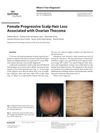 January 2019 in “Skin appendage disorders”
 This report presents a rare case where a bilateral ovarian thecoma in a postmenopausal woman led to an unusual pattern of female androgenetic alopecia mimicking male pattern hair loss.
 October 2014 in “Journal of Minimally Invasive Gynecology”
 Genetic testing for cancer risk can lead to early and life-saving treatments in people without symptoms.
April 2020 in “International journal of reproduction, contraception, obstetrics and gynecology” This case study discussed a postmenopausal female with androgenic alopecia and hirsutism due to a Leydig cell tumor, suggesting the importance of further workup in women with severe hirsutism or androgenic alopecia.
 22 citations
,
February 2014 in “Arquivos Brasileiros De Endocrinologia E Metabologia”
22 citations
,
February 2014 in “Arquivos Brasileiros De Endocrinologia E Metabologia” An 81-year-old woman's severe male hormone symptoms were caused by an ovarian tumor, which was treated with surgery.
 10 citations
,
May 2009 in “Cases Journal”
10 citations
,
May 2009 in “Cases Journal” This case study reports that a virilizing Leydig cell type ovarian tumor in a 40-year-old woman caused hyperandrogenism and virilization symptoms, which improved post-surgery.
 May 2023 in “The journal of sexual medicine”
 In this study, bilateral oophorectomy was reported as an effective treatment for normalizing androgen levels and resolving hypersexuality and related symptoms in a post-menopausal woman with ovarian hyperthecosis, suggesting its importance in addressing excess androgen production in such cases.
1 citations
,
August 2023 in “Case Reports in Women s Health” This case study in a 62-year-old postmenopausal woman highlights Leydig cell hyperplasia as a likely cause of hyperandrogenism of ovarian origin, where bilateral oophorectomy resolved the condition and confirmed the diagnosis through histopathological examination.
 January 2014 in “European Geriatric Medicine”
 A postmenopausal woman's virilization was caused by a rare ovarian tumor that was hard to detect but was successfully treated with surgery.
 1 citations
,
February 2016 in “European Journal of Obstetrics & Gynecology and Reproductive Biology”
1 citations
,
February 2016 in “European Journal of Obstetrics & Gynecology and Reproductive Biology” This case study reports that medical imaging of the ovaries may not always conclusively identify the cause of postmenopausal hyperandrogenism, as demonstrated by a patient with a rare condition.
 November 2018 in “Endocrine Abstracts”
 A woman's high testosterone levels were caused by a rare ovarian tumor, not the initially diagnosed condition.
 August 2019 in “Journal of Dermatology”
 This article is a letter to the editor discussing a rare case of Leydig cell tumor with type I diabetes mellitus causing female pattern hair loss, but it contains no abstract or new clinical findings.
 1 citations
,
February 2022 in “Case reports in endocrinology”
1 citations
,
February 2022 in “Case reports in endocrinology” This case report describes a 64-year-old postmenopausal woman with hirsutism due to a rare case of bilateral diffuse ovarian Leydig cell hyperplasia, leading to normalized testosterone levels and improved glycaemic control following surgery.
 May 2025 in “International Journal of Reproduction Contraception Obstetrics and Gynecology”
 In this case report, the researchers described a postmenopausal woman with androgenic symptoms who was found to have a benign Leydig cell tumor of the left ovary, indicated by elevated testosterone levels and MRI findings, which was successfully treated with surgery.
 January 2023 in “Seven Editora eBooks”
 This case report describes a 52-year-old postmenopausal woman diagnosed with a rare Steroid Tumor Without Other Specification, highlighting the diagnostic challenges and treatment approach involving bilateral salpingo-oophorectomy.
3 citations
,
January 2017 in “Gynecological endocrinology” This case report describes a 63-year-old woman with hyperandrogenism due to an ectopic adrenal gland adenoma on the ovaries, successfully treated with bilateral salpingo-oophorectomy.
 13 citations
,
August 2020 in “Mayo Clinic proceedings”
13 citations
,
August 2020 in “Mayo Clinic proceedings” In this study, women with lichen planopilaris were found to have high rates of thyroid disease, depression, and anxiety, and about half experienced slowed or stabilized disease progression with treatment.
3 citations
,
January 2021 in “touchREVIEWS in Endocrinology” This case report describes how a 68-year-old woman's hyperandrogenic symptoms improved and testosterone levels normalized after the surgical removal of an occult Leydig cell tumour.
 2 citations
,
May 2018 in “Diagnosis”
2 citations
,
May 2018 in “Diagnosis” This case report presents a rare instance of an ovarian steroid cell tumor in a 68-year-old female with virilism, which normalized androgen levels following surgical removal.
 1 citations
,
December 1998 in “PubMed”
1 citations
,
December 1998 in “PubMed” In this case report, a 68-year-old woman with a Leydig cell tumor of the ovary experienced virilization, and surgical removal led to normalization of testosterone levels and regression of symptoms.
July 2025 in “AACE Endocrinology and Diabetes” Ovarian hyperthecosis caused high testosterone and virilization symptoms in a 60-year-old woman, which improved after surgery.
 September 2024 in “Electronic Journal of General Medicine”
 In this case series study, two Peruvian women with virilizing ovarian tumors called Sertoli-Leydig cell tumors showed clinical improvement and normalization of androgens after surgical treatment, highlighting the diagnostic challenge of these rare presentations at different ages.
 December 2021 in “Aegean journal of obstetrics and gynecology”
 This case report highlights a rare instance of postmenopausal virilization in a 71-year-old woman due to coexisting ovarian hilus cell hyperplasia and a Sertoli-Leydig cell tumor.
 April 2019 in “Journal of the Endocrine Society”
 This study reported that testosterone levels over 150 ng/dL combined with lack of testosterone suppression during a low-dose dexamethasone suppression test may indicate androgen-producing tumors, though this wasn't consistent across all cases.