7 citations
,
August 2010 in “Medicinal Chemistry Research” This study found that some synthesized 17-oximino-5-androsten-3β-yl esters demonstrated stronger cytotoxicity and antiandrogenic activity against prostate cancer cells than finasteride.
2 citations
,
July 2021 in “UNC Libraries” This study suggests that residues Val-889 and Arg-752 in the androgen receptor's steroid binding domain are crucial for NH2-/carboxyl-terminal interaction, affecting receptor stability and function.
 1 citations
,
January 1989 in “Handbook of experimental pharmacology”
1 citations
,
January 1989 in “Handbook of experimental pharmacology” This article reviews the use of anti-androgens for dermatological conditions linked to androgen involvement and reports encouraging clinical experiences in females, with use in males limited to specific conditions due to toxicity concerns.
 97 citations
,
November 1986 in “Journal of Steroid Biochemistry”
97 citations
,
November 1986 in “Journal of Steroid Biochemistry” This review discusses the pharmacological properties and clinical applications of cyproterone acetate and similar antiandrogens, noting previous failures in local applications due to concentration limitations; it reports no new empirical results.
 45 citations
,
August 2005 in “Bioorganic & medicinal chemistry”
45 citations
,
August 2005 in “Bioorganic & medicinal chemistry” This study found that novel androgen antagonists incorporating a carborane moiety showed anti-androgenic activity comparable to flutamide in a laboratory setting.
22 citations
,
January 2017 in “Journal of steroid biochemistry and molecular biology/The Journal of steroid biochemistry and molecular biology” This study developed and validated a mass spectrometric method to measure hydroxy-androgens in serum, which aids in understanding androgen synthesis in castration resistant prostate cancer.
 1 citations
,
January 2013 in “MedChemComm”
1 citations
,
January 2013 in “MedChemComm” This study characterized the SARM PF-05314882, finding it demonstrates anabolic activity in rats with minimal effects on the prostate, seminal vesicles, and luteinizing hormone levels.
 42 citations
,
May 2003 in “Mini-reviews in Medicinal Chemistry”
42 citations
,
May 2003 in “Mini-reviews in Medicinal Chemistry” This study found that newly synthesized steroidal trienones demonstrated stronger 5α-reductase inhibitory activity compared to dienones in various biological models, suggesting potential for developing enhanced antiandrogenic drugs.
1 citations
,
January 2015 in “Elsevier eBooks” This review discusses the potential antiandrogenic effects of environmental chemicals on reproductive development, highlighting concerns about their impacts on humans but reports no new clinical findings.
![Activity of 17β-(N-Alkyl/Arylformamido) and 17β-[(N-Alkyl/Aryl) Alkyl/Arylamido]-4-Methyl-4-Aza-5α-Androstan-3-Ones as 5α-Reductase Inhibitors in the Hamster Flank Organ and Ear](/images/assets/861159f1-7bd4-420c-a16b-4829458efe68/small/15592.jpg) 10 citations
,
August 1998 in “Journal of Investigative Dermatology”
10 citations
,
August 1998 in “Journal of Investigative Dermatology” This study observed that the compound EM-402 reduced 5α-reductase activity and sebaceous gland size in the flank organs and ears of hamsters, indicating potent localized anti-androgenic effects without systemic action.
 1 citations
,
November 2008 in “Acta crystallographica”
1 citations
,
November 2008 in “Acta crystallographica” This study reports the crystallization of the human androgen receptor's ligand-binding domain with nonsteroidal ligands, which may aid in understanding the differences in binding compared to steroidal ligands.
November 2011 in “InTech eBooks” This study found no association between circulating androgens and prostate cancer risk, underscoring the complex role of androgen metabolism in the prostate.
 17 citations
,
August 2007 in “Bioorganic & Medicinal Chemistry Letters”
17 citations
,
August 2007 in “Bioorganic & Medicinal Chemistry Letters” This study found that a specific amino-pyridine compound showed potent androgen receptor antagonist activity, stimulating hair growth in mice and reducing sebum production in a hamster model.
 January 2022 in “Current Enzyme Inhibition”
 This study found that two novel nonsteroidal derivatives inhibited specific enzymes in vitro and in vivo, leading to dihydrotestosterone accumulation in androgen-dependent glands, suggesting potential therapeutic use for mood improvement in the elderly.
10 citations
,
July 2011 in “Archives of Pharmacal Research” 31 citations
,
October 1971 in “Steroids” This study found that human beard hair follicles metabolize dehydroepiandrosterone into various compounds at significantly higher rates than those reported for human skin, suggesting unique metabolic processes in hair follicles.
 15 citations
,
April 2008 in “Steroids”
15 citations
,
April 2008 in “Steroids” This study found that pregnane derivatives with higher lipophilicity, like compound 9d, had stronger androgen receptor binding and greater antiandrogenic effects in rats, correlating relative binding affinity with log P values.
 54 citations
,
February 1993 in “Endocrine reviews”
54 citations
,
February 1993 in “Endocrine reviews” This review examines the physiological role of androgen conjugates in cutaneous androgen metabolism and questions their association with hirsutism, without presenting new clinical findings.
March 2008 in “The Knowledge Bank (The Ohio State University)” This study found that AR-007 degrades faster and has a stronger association with hsp70 than AR-014, suggesting it is less stable when bound to the androgen receptor.
 18 citations
,
April 2001 in “Bioorganic & Medicinal Chemistry Letters”
18 citations
,
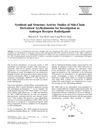
April 2001 in “Bioorganic & Medicinal Chemistry Letters” This study identified the N-(iodopropenyl) derivative 13 as a promising candidate for development as a radioiodinated androgen receptor ligand due to its binding affinity.
 6 citations
,
November 2004 in “Bioorganic & Medicinal Chemistry Letters”
6 citations
,
November 2004 in “Bioorganic & Medicinal Chemistry Letters” This study found that arylhydantoin and arylthiohydantoin derivatives with hydroxybutyl or methyl side-chains showed superior androgen receptor binding affinity and may serve as promising radioiodinated AR ligands.
June 2014 in “Zagazig Journal of Pharmaceutical Sciences/Zagazig Journal of Pharmaceutical Science” This study reports that using ascorbic acid or orlistat can significantly inhibit the metabolism of testosterone esters into malodorous metabolites by axillary bacteria, suggesting potential new deodorant applications.
 41 citations
,
November 2003 in “Annals of the New York Academy of Sciences”
41 citations
,
November 2003 in “Annals of the New York Academy of Sciences” This article discusses the complexities of androgen and antiandrogen therapies in women, detailing diagnostic measures, the effects on libido, and the potential benefits of new progestins with antiandrogenic properties, but presents no new empirical findings.
 13 citations
,
October 2002 in “Journal of Biochemical and Biophysical Methods”
13 citations
,
October 2002 in “Journal of Biochemical and Biophysical Methods” This study found that men with androgenic alopecia had significantly higher levels of certain urinary steroid metabolites, suggesting increased 5 alpha-reductase activity and possible mild hyperadrenal activity.
 12 citations
,
December 2012 in “Current Drug Targets”
12 citations
,
December 2012 in “Current Drug Targets” The Androgen Receptor could be a target for treating diseases like cancer, but more research is needed to confirm the effectiveness of potential treatments.
 3 citations
,
October 2022 in “Hormone and Metabolic Research”
3 citations
,
October 2022 in “Hormone and Metabolic Research” This review discusses the significant role androgens may play in COVID-19 severity and mortality, but it reports no new results; further research in diverse populations is needed.
5 citations
,
November 2015 in “Journal of Enzyme Inhibition and Medicinal Chemistry” This study found that aliphatic ester moieties in 16-formyl-17-methoxy dehydroepiandrosterone derivatives increased their potency as 5α-reductase type 2 inhibitors in vitro compared to finasteride.
11 citations
,
June 2016 in “European Journal of Medicinal Chemistry” This study found that two synthesized androst-4-ene-3-one derivatives, 6f and 6g, exhibited stronger anti-proliferative effects than common drugs on prostate cancer cell lines, with low toxicity to rat cells.
 7 citations
,
January 2021 in “The Journal of Sexual Medicine”
7 citations
,
January 2021 in “The Journal of Sexual Medicine” This study demonstrated that testosterone treatment increases muscle strength and alters body composition in transmen, and the addition of dutasteride does not impair these anabolic effects.
 1 citations
,
January 2022 in “Journal of Biosciences and Medicines”
1 citations
,
January 2022 in “Journal of Biosciences and Medicines” This review discusses the roles of androgens and androgen receptor in skin diseases like acne and hirsutism, and highlights the promise of antiandrogen drugs, reporting no new clinical findings.