1 citations
,
January 2020 in “IRIS UNIMORE (University of Modena and Reggio Emilia)” This study found that Aminexil clinical 5 significantly reduced hair loss in men and women with mild alopecia and was well tolerated with high subject satisfaction.
 55 citations
,
May 2017 in “Current stem cell research & therapy”
55 citations
,
May 2017 in “Current stem cell research & therapy” In this study, Japanese patients treated with adipose-derived stem cell-conditioned medium for hair regeneration showed positive outcomes, suggesting it may be an effective new therapy for alopecia.
20 citations
,
August 2003 in “Clinical and Experimental Dermatology” In this study, a novel E583V missense mutation in the hairless gene was identified in an Italian family with atrichia with papular lesions, reinforcing the significance of zinc-finger and LXXLL domains in this condition.
June 2026 in “Value in Health”  May 2025 in “Journal of Clinical Images and Medical Case Reports”
 The study observed that patterned fibrosing alopecia, a type of scarring hair loss, appears in some patients after hair transplants, facelifts, and other surgical interventions, sharing features with lichen planopilaris and androgenetic alopecia.
October 2006 in “Urology” The study found that different criteria led to different patient groups in the CombAT study compared to the MTOPS study.
SMP creates illusion of full hair, addressing various issues and bringing happiness to those with thinning hair.
3 citations
,
September 2025 in “Plant Signaling & Behavior” This study observed that extracellular ATP (eATP) levels outside Arabidopsis root cells vary inversely with the expression of AtAPY1 and AtAPY2 apyrases, suggesting these enzymes regulate eATP concentrations crucial for root growth.
October 2012 in “Institutional Repositories DataBase (IRDB)” The researchers reported that treatment with adipose-derived stem cell conditioned medium significantly increased hair count in the study participants, suggesting it is an effective therapy for hair regeneration.
In this case-control study, researchers found that serum apelin-12 levels were significantly higher in acne patients and correlated with acne severity, BMI, insulin resistance, and inflammation, suggesting that managing insulin resistance could be important for acne treatment.
 August 2025 in “Journal of IMAB - Annual Proceeding (Scientific Papers)”
 This study describes a successful reconstructive A-T flap surgery on a 74-year-old male with a 35mm basal cell carcinoma on the scalp, resulting in a 50mm defect, with no complications and optimal functional and cosmetic outcomes reported.
 8 citations
,
January 2018 in “Journal of the American Academy of Dermatology”
8 citations
,
January 2018 in “Journal of the American Academy of Dermatology” This study found that maintenance treatment with diphenylcyclopropenone was associated with a lower relapse rate in alopecia areata patients, highlighting the importance of adjusting treatment intervals post-improvement.
 November 2025 in “Scientific Reports”
 This study demonstrates that an AI-based grading framework using a novel area ratio metric improves the accuracy and consistency of male pattern hair loss classification, especially in advanced grades, compared to traditional methods.
June 2026 in “British Journal of Dermatology” This study reported that dermatological adverse events are common in patients treated with amivantamab for non-small cell lung cancer, often impacting quality of life and requiring treatment modifications.
 February 2024 in “Archiv EuroMedica”
 This review suggests that annurca apple extract, rich in polyphenols, may be a promising alternative for treating baldness, though further research is needed to clearly assess its effectiveness compared to existing treatments.
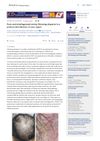 March 2023 in “Journal of Cosmetic Dermatology”
 This case report illustrates that fibrosing alopecia in a pattern distribution may be misdiagnosed as androgenetic alopecia due to similar hair loss patterns, but distinctive trichoscopic and histopathologic features help differentiate it.
July 2021 in “Belarusian State Pedagogical University repository (Belarusian State Pedagogical University)” In this study, PMC was identified as a promising plant for nourishing hair, with effective hair growth promotion and 5α-reductase inhibition observed in both laboratory and animal studies for androgenetic alopecia treatment.
 18 citations
,
October 2018 in “Nutrients”
18 citations
,
October 2018 in “Nutrients” This study found that Annurca apple polyphenolic extracts reprogram hair follicle metabolism in mice, enhancing mitochondrial activity and keratin production while inhibiting some metabolic pathways.
 19 citations
,
November 2018 in “Nutrients”
19 citations
,
November 2018 in “Nutrients” This study reports that polyphenols from Annurca apples may safely promote hair growth and protect against chemotherapy-induced alopecia without interfering with chemotherapy regimens.
 November 2021 in “Revista Ibero-Americana de Humanidades, Ciências e Educação”
 This paper evaluates the therapeutic response of androgenetic alopecia to topical application of specific compounds using digital drug delivery but reports no new clinical results.
 July 2018 in “Plastic and Aesthetic Nursing”
 This research abstract provides information about the publisher, Wolters Kluwer Health, and the journal's subscription services, but it doesn’t describe a specific study or research findings. Results are not reported.
7 citations
,
August 2024 in “Clinical and Experimental Dermatology” In this retrospective study conducted at a trichology clinic, the off-label use of upadacitinib for at least 24 weeks was found to have a promising efficacy and safety profile for treating severe alopecia areata in adolescents.
 December 2022 in “Jurnal Kesehatan Jompa”
 This article reviews the causes and current treatment options for androgenetic alopecia, reporting no new clinical findings and highlighting the need for more therapeutic choices.
April 2024 in “American Journal Of Pathology”  10 citations
,
January 2018 in “Postępy Dermatologii i Alergologii”
10 citations
,
January 2018 in “Postępy Dermatologii i Alergologii” This study found that 21 out of 39 patients with alopecia areata experienced more than 50% hair regrowth after six months of DPCP treatment, with better outcomes observed in those treated at 3-week intervals compared to weekly intervals.

In this study, adding plum blossom needle tapping to finasteride treatment significantly improved the clinical efficacy and symptom scores for male patients with androgenic alopecia compared to finasteride alone.

This review outlines platelet-rich plasma practices for androgenetic alopecia at a large academic center and highlights the importance of standardizing PRP protocols to improve treatment outcomes, but it reports no new clinical results.
This study found that a short-term treatment with all-trans retinoic acid may effectively stabilize platelet counts in idiopathic thrombocytopenic purpura patients experiencing fluctuations during thrombopoietin receptor agonist therapy.
7 citations
,
April 2020 in “JIMD Reports” In this follow-up of three siblings with ATP6AP1 deficiency, the researchers observed progression to total hearing loss, hair loss, and proteinuria.