 May 2026 in “Theranostics”
 This study found that the DKK3-CKAP4 signaling axis is involved in fibroimmune remodeling in androgenetic alopecia and that targeting this pathway may restore a regenerative hair follicle environment, offering a potential therapeutic strategy to counteract hair follicle miniaturization.
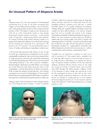 January 2014 in “International Journal of Trichology”
 A man had an unusual type of hair loss that didn't match known patterns and didn't improve with treatment.
August 2024 in “British Journal of Dermatology” The trial is ongoing, but researchers are evaluating the efficacy and safety of REZPEG, a potential new therapy for severe alopecia areata, which selectively expands regulatory T cells.
 January 1999 in “Journal of the European Academy of Dermatology and Venereology”
 RAPK is a rare skin disorder with pigmented spots, mainly on hands and feet, starting in youth.
 4 citations
,
December 2020 in “Mammalian genome”
4 citations
,
December 2020 in “Mammalian genome” This study found that pelage abnormalities in Harlequin mutant mice are linked to severe AIF deficiency and associated with altered expression of genes related to hair structure.
January 2026 in “International Journal of Dermatology” This review examines the androgen-dependent subtype of acquired progressive kinking of the hair and suggests it may be an early indicator of androgenetic alopecia, emphasizing the importance of distinguishing between subtypes for clinical decisions.
4 citations
,
February 2024 in “Anais Brasileiros de Dermatologia” July 2026 in “Journal of the American Academy of Dermatology” February 2020 in “Oncology Times” This article reviews antibody drug conjugates for cancer treatment, describing their mechanism, recent approvals, and ongoing research efforts, but reports no new clinical results.
 33 citations
,
August 1985 in “Archives of Dermatology”
33 citations
,
August 1985 in “Archives of Dermatology” This study suggests that acquired progressive kinking of hair, which typically appears at or after puberty, may be androgen dependent and could progress to male pattern baldness.
July 2026 in “SKIN The Journal of Cutaneous Medicine” This case report details a 17-year-old male with Alopecic and Aseptic Nodules of the Scalp successfully treated with doxycycline and intralesional corticosteroids, highlighting the importance of thorough evaluation for accurate diagnosis.
 23 citations
,
September 2019 in “Dermatology practical & conceptual”
23 citations
,
September 2019 in “Dermatology practical & conceptual” This study analyzed the features of alopecia areata incognita and diffuse alopecia areata, finding distinct patterns in hair loss regions and trichoscopic signs, and noted a benign course responsive to topical steroid therapy.
In this observational study, men with early onset androgenic alopecia exhibited a statistically significant correlation with more severe forms of coronary artery disease compared to those without the condition.
14 citations
,
March 1994 in “Archives of Dermatology” This article presents two cases of alopecia areata occurring simultaneously in a married couple, suggesting a potential psychosocial factor like stress rather than genetic causation.
April 2025 in “Science Journal of University of Zakho” This study found that higher Dietary Inflammatory Index scores were significantly associated with an increase in both the occurrence and severity of alopecia areata.
 40 citations
,
August 2022 in “Frontiers in immunology”
40 citations
,
August 2022 in “Frontiers in immunology” This review discusses the potential of JAK inhibitors as a promising treatment strategy for alopecia areata, highlighting their mechanism and recent FDA approval based on clinical trial efficacy.
 September 2023 in “Drugs in context”
 This article discusses baricitinib, a JAK1 and JAK2 inhibitor, as an approved and promising treatment for alopecia areata but reports no new clinical results.
11 citations
,
January 2020 in “Journal of Drugs in Dermatology” This study found that intralesional triamcinolone acetonide injections effectively increased hair density in African American women with traction alopecia, showing promise as a safe treatment option.
147 citations
,
August 2005 in “The Plant Cell” This study identified a key Arabidopsis thaliana gene, TIP1, whose product is involved in S-acylation crucial for normal plant cell growth, particularly affecting root hair development.
 May 2023 in “Sučasna pedìatrìâ. Ukraïna”
 In a clinical observation study, researchers documented a case of total alopecia in an 11-year-old child, highlighting a potential link to genetic conditions such as autoimmune polyendocrinopathy candidiasis-ectodermal dystrophy (APECED syndrome) requiring further genetic and serological testing to verify the diagnosis.
June 2026 in “Serbian Journal of Dermatology and Venerology” This report highlights that oral Janus kinase inhibitors, including baricitinib, ritlecitinib, deuruxolitinib, and brepocitinib, show promise for treating alopecia areata by promoting substantial hair regrowth with mild-to-moderate side effects, positioning them as a favorable alternative to corticosteroids.
 6 citations
,
May 2023 in “Drugs”
6 citations
,
May 2023 in “Drugs” This study reports that baricitinib was more effective than placebo in promoting hair growth in adults with severe alopecia areata after 36 weeks of treatment in clinical trials.
 December 2013 in “International Journal of Dermatology”
 The clinical signs of Adams-Oliver syndrome can vary greatly, even among family members.
November 2025 in “Skin Health and Disease” This study found that patients with alopecia areata had a higher prevalence of depression, anxiety, and alexithymia compared to normative data, with alexithymia more common in those with earlier onset AA, lower education levels, and younger age.
September 2025 in “Asian journal of pediatric dermatology.” This case study reports the successful use of abrocitinib for treating severe alopecia areata in a 14-year-old patient, demonstrating significant hair regrowth and suggesting the need for sustained JAK1 inhibition to prevent relapse.
505 citations
,
October 2011 in “Journal of clinical oncology” This phase I study found that MK-2206 was well tolerated and demonstrated evidence of AKT signaling blockade in patients with advanced solid tumors, with the maximum-tolerated dose established at 60 mg.
 12 citations
,
June 2023 in “JAMA network open”
12 citations
,
June 2023 in “JAMA network open” In this study of seven randomized clinical trials, JAK inhibitors were associated with improved hair regrowth outcomes in alopecia areata patients compared to placebo, with oral administration being more effective than external application, though longer trials are needed to confirm safety and effectiveness.
69 citations
,
December 2006 in “Archives of dermatology” This entry contains no research abstract, so no scientific findings or conclusions are reported.
19 citations
,
August 2019 in “Dermatologic therapy” This review discusses the use of Janus kinase inhibitors for alopecia areata and reports promising short-term efficacy but low-quality evidence, highlighting the need for further research to confirm long-term safety and effectiveness.
 February 2016 in “The journal of investigative dermatology/Journal of investigative dermatology”
 This quiz presents educational questions about alopecia areata, including its diagnosis and underlying mechanisms, but reports no new clinical outcomes.