 March 2026 in “Cosmoderma”
 This clinical study found that using a cream or lotion as an additional treatment alongside standard care for atopic dermatitis significantly reduced symptoms and improved skin moisturization and barrier function within 28 days compared to standard care alone in participants with mild-to-moderate eczema.
 January 2026 in “Frontiers in Immunology”
 This case study details a 44-year-old woman with rheumatoid arthritis and systemic lupus erythematosus who developed hypereosinophilic asthma and was initially treated as ANCA-negative eosinophilic granulomatosis with polyangiitis. Her condition, eventually classified as HASM, underscores the need for evaluating EGPA-spectrum disorders in similar scenarios.
January 2024 in “Skin Appendage Disorders” This article discusses ciliary madarosis as a transient condition secondary to IAC, emphasizing the value of physical and trichoscopic evaluations for diagnosis and prognosis; it does not report new clinical results.
 3 citations
,
April 2002 in “The Lancet”
3 citations
,
April 2002 in “The Lancet” In this case report, the authors identified giant cell arteritis as the underlying cause of bitemporal hair loss and scalp tenderness in a 70-year-old woman, initially misdiagnosed as age-related symptoms.
27 citations
,
May 2016 in “Integrative Cancer Therapies” In this study, in vitro and in vivo models showed that chrysin enhanced the efficacy of docetaxel and reduced its adverse effects in non–small cell lung cancer treatment.
 5 citations
,
December 2019 in “JAAD Case Reports”
5 citations
,
December 2019 in “JAAD Case Reports” This paper discusses anagen effluvium, a reversible non-scarring hair loss often triggered by certain chemotherapy drugs, but presents no new clinical results.
 48 citations
,
November 1992 in “International Journal of Dermatology”
48 citations
,
November 1992 in “International Journal of Dermatology” This article discusses the history and terminology of toxic epidermal necrolysis but reports no new clinical results.
27 citations
,
October 2003 in “Journal of the American Academy of Dermatology” This case report describes white piedra infection of the scalp hair with a synergistic bacterial infection in two US native sisters, highlighting its relevance in diagnosing scalp hair concretions despite its rarity in North America.
 May 2023 in “The journal of investigative dermatology/Journal of investigative dermatology”
 In this study, researchers found that the expression of SLC1A6, a gene linked to calcium gradient and keratinocyte differentiation in the skin, significantly decreases with age, which may contribute to reduced skin barrier function in elderly individuals.
 May 2009 in “South African Family Practice”
 The author believes that giving medical conditions official names can sometimes overwhelm or scare patients.
January 2015 in “프로그램북(구 초록집)” This study highlights that the combination of adapalene and benzoyl peroxide (Epiduo®) is an effective first-line treatment for acne, significantly inhibiting antibiotic-susceptible and antibiotic-resistant P. acnes strains.
January 2004 in “Indian Journal of Nephrology” 
This case report highlights that Tjalma Syndrome may present as a main symptom of systemic lupus erythematosus and should be considered in patients with ascites, pleural effusions, and elevated CA-125 levels.
 September 2011 in “American Journal of Clinical Dermatology”
 The birth control pill containing ethinylestradiol and chlormadinone may help treat acne and other skin and hair conditions related to hormones.
May 2015 in “Cancer research” This study found that persistent significant alopecia was a common side effect following FEC-docetaxel chemotherapy, with a 33.4% global incidence, highlighting the need for awareness and potential preventative measures like cooling caps during treatment.
 April 2014 in “Medical Clinics of North America”
 Accurate diagnosis and tailored treatment are crucial for managing common primary care symptoms.
 September 2024 in “Meditsinskiy sovet = Medical Council”
 This article reports a rare case of toxic keratitis in a patient due to excessive intake of vitamin A, highlighting hypervitaminosis A risks such as severe eye conditions and systemic health issues, especially with cumulative doses exceeding therapeutic levels.
November 2007 in “Hospital pharmacy” This article discusses the importance of increasing awareness about specific adverse drug reactions, prevention methods, and the promotion of reporting ADRs to the FDA's MEDWATCH program; it reports no new results.
 January 2005 in “Nihon Yasei Doubutsu Igakkaishi/Japanese journal of zoo and wildlife medicine”
 This study observed that Aloe vera gel applied topically to mange-affected camels led to the rapid disappearance of skin lesions and mites.
This case study reports that prolonged high-dose vitamin A intake led to multiple adverse health effects in a young man, which mostly resolved after stopping the supplement, although liver changes persisted.
9 citations
,
July 1993 in “Archives of dermatology” This report describes ten cases of pityriasis amiantacea to raise awareness of this uncommon scalp condition, highlighting its negative test findings and its uncertain association with other skin diseases.
 July 2025 in “Jurnal Farmasi Sains dan Praktis”
 This study found that breast cancer patients treated with the docetaxel-doxorubicin regimen experienced various adverse drug reactions, with nausea being the most common and mainly mild in severity.
 October 2011 in “Journal of dermatology”
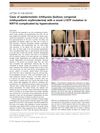
 A man with a rare skin condition and a new gene mutation developed high calcium levels due to his treatment.
13 citations
,
October 2001 in “British Journal of Ophthalmology” This report discusses the use of intralesional cidofovir and suggests it might be a viable option for treating SCC due to its successful outcome without observed systemic toxicity in this case.
14 citations
,
August 2013 in “Journal of Parasitology” This study reported that 39.7% of Amargosa voles had mite-associated lesions, which may severely impact their health and fitness.
 April 2016 in “Journal of The American Academy of Dermatology”
 Both atopy and eosinophilia are linked to more severe hair loss in people with alopecia areata.
6 citations
,
October 2001 in “British Journal of Ophthalmology” This article discusses the potential of intralesional cidofovir for treating SCC without systemic toxicity, noting that surgical excision remains the best treatment option; it reports no new clinical results.
 November 2025 in “SKIN The Journal of Cutaneous Medicine”
 In this phase 3 trial, baricitinib showed effectiveness and safety in both adolescents and adults with severe alopecia areata, with adolescents achieving higher response rates despite more severe baseline conditions, suggesting the advantages of early treatment.
 April 2020 in “Journal of evolution of medical and dental sciences”
 This report reviews the clinical presentation and genetic aspects of a case of acrodermatitis enteropathica in a one-year-old child but provides no new clinical findings.
3 citations
,
October 2021 in “Turkish Journal Of Neurology” This study identifies novel genetic variants in the NOTCH3 and HTRA1 genes associated with CADASIL and CARASIL, highlighting their potential in supporting clinical diagnosis and informing treatment strategies.