4 citations
,
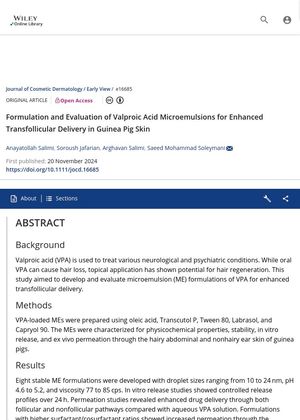
July 2023 in “Journal of Cosmetic Dermatology” This study found that adapalene-loaded microemulsions significantly enhanced the drug's penetration through guinea pig skin compared to an aqueous suspension, with factors like surfactant ratios and the water-oil phase balance affecting the transfollicular drug delivery efficiency.
January 2022 in “Advanced Pharmaceutical Bulletin” This study found that clove oil and LPGSE pretreatment increased finasteride skin permeability, while extending urea pretreatment reduced its penetration.
18 citations
,
October 2019 in “Advanced Pharmaceutical Bulletin” This study found that finasteride microemulsions significantly increased skin permeability in vitro, highlighting the potential for enhanced delivery of this drug through the skin.
August 2018 in “Jundishapur journal of natural pharmaceutical products” Transfollicular drug delivery can improve medication absorption through hair follicles.
 2 citations
,
April 2017 in “Asian Journal of Psychiatry”
2 citations
,
April 2017 in “Asian Journal of Psychiatry” This review discusses the role of histone deacetylases in hearing loss, proposing potential pharmacological interventions, but reports no new clinical results.
9 citations
,
January 2015 in “Indian Journal of Pharmacology/The Indian journal of pharmacology” This study reports that alopecia may develop in patients with chronic exposure to high plasma concentrations of valproate, but resolved after dose reduction or treatment discontinuation.
 37 citations
,
February 2014 in “Journal of Dermatology”
37 citations
,
February 2014 in “Journal of Dermatology” This study found that topical valproic acid significantly increased hair count in male patients with moderate androgenetic alopecia compared to placebo over 24 weeks.
 16 citations
,
October 2004 in “Acta dermato-venereologica”
16 citations
,
October 2004 in “Acta dermato-venereologica” This article provides information about the University of Bologna's departments involved and includes contact details for the lead author, but it presents no research findings.