TLDR Injectable gelatin microspheres with platelet-rich plasma speed up wound healing.
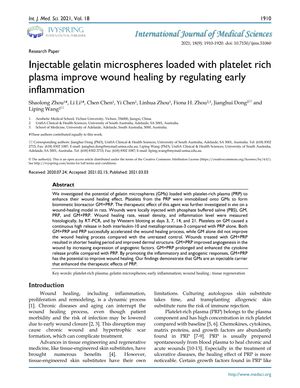
The study investigated the use of gelatin microspheres (GMs) loaded with platelet-rich plasma (PRP) to enhance wound healing in a rat model. The combination of GMs and PRP (GM+PRP) was found to significantly accelerate the wound healing process compared to PRP or GMs alone. GM+PRP improved the healing rate, dermal structure, and angiogenesis by increasing the expression of angiogenic factors and prolonging cytokine release. The study concluded that GMs serve as an effective injectable carrier that enhances the therapeutic effects of PRP by promoting inflammatory and angiogenic responses, leading to improved wound healing outcomes.
44 citations
,
February 2020 in “Expert Opinion on Biological Therapy” PRP, especially AA-PRP, can help improve hair growth in androgenetic alopecia.
69 citations
,
April 2019 in “Biomedicines” PRP and HF-MSCs treatment improves hair growth, thickness, and density in androgenetic alopecia.
24 citations
,
January 2018 in “Journal of Visualized Experiments” PRP injections effectively promote hair growth in androgenetic alopecia patients.
January 2018 in “Journal of Visualized Experiments” PRP injections significantly increased hair count and density with less pain.
183 citations
,
January 2014 in “BioMed Research International” AA-PRP injections effectively increase hair count and thickness for male pattern hair loss.
12 citations
,
June 2023 in “International Journal of Molecular Sciences” Innovative biomaterials show promise in healing chronic diabetic foot ulcers.
6 citations
,
February 2023 in “Biomaterials Research” Special gels help heal diabetic foot sores and reduce the risk of amputation or death.
16 citations
,
March 2024 in “International Journal of Molecular Sciences” Natural compounds and biomimetic engineering can improve wound healing by enhancing fibroblast activity.
133 citations
,
July 2020 in “Cells” Creating fully functional artificial skin for chronic wounds is still very challenging.
14 citations
,
November 2020 in “International Journal of Molecular Sciences” Advanced therapies like gene, cell, and tissue engineering show promise for hair regrowth in alopecia, but their safety and effectiveness need more verification.