 December 2025 in “Pakistan Journal of Health Sciences”
 This systematic review found that estrogen deficiency in postmenopausal women leads to structural and symptomatic changes in genital and cutaneous tissues, with local estrogen therapy providing short-term benefits, while evidence for device-based treatments remains limited and requires larger trials.
 January 2018 in “Elsevier eBooks”
 Different nail disorders are treated by targeting their specific causes and using appropriate medications or protective measures.
 104 citations
,
August 2008 in “Clinics in Dermatology”
104 citations
,
August 2008 in “Clinics in Dermatology” This review discusses current treatment challenges and strategies for managing psoriasis in the scalp, nails, and intertriginous areas, emphasizing the need for effective and well-tolerated long-term options, but reports no new clinical results.
 55 citations
,
November 2004 in “Expert opinion on drug safety”
55 citations
,
November 2004 in “Expert opinion on drug safety” This review describes the variety of mucocutaneous side effects caused by antineoplastic chemotherapy, with emphasis on skin, nails, and mucous membranes, while highlighting potential severity and the possibility of needing to adjust or interrupt treatment in rare cases; it presents no new clinical results.
1 citations
,
December 2024 in “Indian Dermatology Online Journal” This research notes that biologics and small molecules are effective for treating nail psoriasis and alopecia areata, albeit with precautions for adverse events, but no clinical trials have been published for their use in treating nail lichen planus and atopic dermatitis.
 1 citations
,
December 2013 in “Journal of Evolution of Medical and Dental Sciences”
1 citations
,
December 2013 in “Journal of Evolution of Medical and Dental Sciences” This historical review examines the diagnostic and etiological understanding of alopecia areata, emphasizing the evolution of theories and the impact of immunological data, while providing no new clinical results.
 356 citations
,
December 1986 in “The journal of cell biology/The Journal of cell biology”
356 citations
,
December 1986 in “The journal of cell biology/The Journal of cell biology” This study found that specific human hair keratins are differentially expressed in the hair follicle, suggesting a shared pathway of epithelial differentiation between hair cortex and nail plate cells.
 132 citations
,
July 2000 in “Lupus”
132 citations
,
July 2000 in “Lupus” This study found that chronic cutaneous lupus erythematosus with discoid lesions was the most common skin manifestation among patients with lupus erythematosus, while nonspecific skin lesions were linked to systemic lupus erythematosus, particularly during active disease phases.
 32 citations
,
January 2012 in “International Journal of Dermatology”
32 citations
,
January 2012 in “International Journal of Dermatology” This study reported that the most common skin side effect of epidermal growth factor receptor inhibitors was a papulopustular rash, treatable with symptom-targeted therapies, while drug suspension was rarely needed.
12 citations
,
March 2021 in “JAAD Case Reports” This study reported that immunotherapy in cancer patients can lead to skin-related immune adverse events, such as rashes, pruritus, and vitiligo, affecting a substantial proportion of patients.
 February 2026 in “Journal of Clinical Medicine”
 In this narrative review, researchers found preliminary evidence suggesting that minoxidil, both topical and oral, may enhance nail growth and improve nail strength and appearance, though more extensive studies are needed to confirm its efficacy and safety for this off-label use.
March 2025 in “Dermatology” Systemic therapies improve nail psoriasis but have high side effects; more research is needed.
July 2023 in “UNESP Institutional Repository (São Paulo State University)” This study found that oral minoxidil increased the growth rates of nails and hair in healthy adult men, with 2.5mg proving more effective for nails than 1mg, and both doses boosting hair growth, without significant adverse effects.
September 2018 in “CRC Press eBooks” This review explores the trichoscopic features of dark scalp, particularly the brown honeycomb pigment network, and its variations in different types of alopecia, but it presents no new clinical findings.
32 citations
,
May 2016 in “European journal of dermatology/EJD. European journal of dermatology” In this study, researchers found that targeted therapies for metastatic melanoma often cause hair and nail side effects, with hair changes more common in patients treated with BRAF inhibitors like vemurafenib.
24 citations
,
August 2009 in “Expert opinion on pharmacotherapy” This article highlights the benefits of combining calcipotriene and betamethasone for treating localized plaque-type, scalp, and nail psoriasis, enhancing effectiveness while reducing side effects compared to single-agent therapies.
 2 citations
,
January 2020 in “Skin appendage disorders”
2 citations
,
January 2020 in “Skin appendage disorders” This study in Mexican patients with alopecia areata found that body hair involvement was linked to disease progression, while treatment adherence was associated with both remission and progression.
This study found that activating BMP signaling in rodent and primate models significantly promotes nail and digit regeneration after amputation by enhancing the role of specific nail stem cells, though extreme proximal amputation only permitted partial regeneration without bone reconstruction.
October 2023 in “Journal of Pakistan Association of Dermatologists” This study found that yellow dots and broken hairs were the most common dermatoscopic features of alopecia areata in children, while short vellus hairs were most frequent in adults, with nail changes related to disease severity for both groups.
 October 2023 in “TURKDERM”
 This study observed a 30.4% decrease in dermatology outpatient visits during the COVID-19 pandemic, with a shift in patient demographics and an increased frequency of psoriasis, bullous diseases, and melanoma diagnoses, while conditions like acne and xerosis cutis were less frequent.
 65 citations
,
January 2013 in “Cochrane library”
65 citations
,
January 2013 in “Cochrane library” This review found that infliximab, golimumab, and some forms of radiotherapy significantly improved nail psoriasis compared to controls, although they could have serious adverse effects and are not commonly used specifically for nail issues.
 18 citations
,
March 2004 in “Clinics in Dermatology”
18 citations
,
March 2004 in “Clinics in Dermatology” This review discusses recent advances in understanding the cellular, molecular, and genetic factors contributing to lupus erythematosus and reports no new experimental findings.
 11 citations
,
September 2007 in “Advances in therapy”
11 citations
,
September 2007 in “Advances in therapy” This study found that the oral supplement INVERSION® Femme significantly reduced weight and hair loss and improved skin and nails in overweight women.
 2 citations
,
May 2009 in “Medicine”
2 citations
,
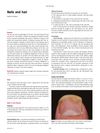
May 2009 in “Medicine” This review discusses skin appendages like hair and nails as indicators of local and systemic pathologies, emphasizing conditions such as inflammatory diseases and infections, but reports no new clinical findings.
 1 citations
,
November 2025 in “Journal of Korean Medical Association”
1 citations
,
November 2025 in “Journal of Korean Medical Association” This review describes nail changes linked to various non-infectious skin diseases, highlighting how these alterations can help diagnose and manage conditions like psoriasis and lupus by noting specific and overlapping nail characteristics.

This review discusses various skin-related conditions affecting hair and nails, highlighting associations with systemic pathologies but reports no new clinical findings.

This study found that polycystic ovary syndrome was the most common cause of hirsutism among premenopausal Algerian women.
74 citations
,
October 2012 in “The American Journal of Human Genetics” This study found that loss-of-function mutations in the HOXC13 gene cause autosomal-recessive pure hair and nail ectodermal dysplasia, emphasizing its role in hair and nail development.
 42 citations
,
October 2009 in “The journal of investigative dermatology/Journal of investigative dermatology”
42 citations
,
October 2009 in “The journal of investigative dermatology/Journal of investigative dermatology” In this study, researchers identified two distinct homozygous mutations in the KRT85 gene among consanguineous Pakistani families with pure hair and nail ectodermal dysplasia, highlighting variations in severity and potential impacts on the K85 protein function.
4 citations
,
January 2025 in “Diagnostics” This article reviews the use of high-frequency ultrasonography to visualize nail units and scalps in dermatology, highlighting its potential benefits for disease assessment and treatment monitoring, but reports no new clinical results.