16 citations
,
January 1998 in “Dermatology” This study observed that vellus hairs and empty spaces are present in prepubertal children's scalps, but they likely do not indicate androgenetic alopecia, suggesting a natural 'true resting' phase of scalp hair.
 2 citations
,
May 2022 in “Clinical, Cosmetic and Investigational Dermatology”
2 citations
,
May 2022 in “Clinical, Cosmetic and Investigational Dermatology” This study reports that quantitative trichoscopy, while noninvasive and convenient, provides less accurate hair density data compared to invasive histopathologic examination, which was demonstrated in a sample of adult Chinese individuals without alopecia.
 December 2025 in “TURKDERM”
 This article discusses Trikostazis spinuloza (TS), a dermatological condition often misdiagnosed, and reviews its demographic, clinical, and dermoscopic features, but reports no new clinical results.
December 2025 in “Al-Azhar International Medical Journal /Al-Azhar International Medical Journal” This study compared the diagnostic effectiveness of Folliscope and Trichoscope in 100 men with androgenetic alopecia, concluding that using both methods enhances diagnostic accuracy by providing complementary insights—Trichoscope highlights patterns while Folliscope offers objective measurements.

This case study reports that a 14-year-old female with loose anagen hair syndrome and trichotillomania initially improved with topical minoxidil and counseling, but relapsed after a year, highlighting treatment challenges.

Trichodysplasia spinulosa can occur after a heart transplant due to immunosuppressive drugs.
 51 citations
,
August 2013 in “Journal of Investigative Dermatology”
51 citations
,
August 2013 in “Journal of Investigative Dermatology” This study demonstrated that cultured human dermal papilla cells can induce full hair follicle formation when combined with neonatal foreskin keratinocytes in a grafted dermal-epidermal construct on mice.
175 citations
,
December 1980 in “Archives of Dermatology” In this study, researchers examined two new cases of trichothiodystrophy and observed that the condition is linked to decreased synthesis of high-sulfur matrix proteins in hair.
1 citations
,
October 1978 in “The Journal of Pediatrics” 2 citations
,
September 1998 in “Der Hautarzt” A gene mutation causes a rare hereditary hair loss, offering potential for new treatments.
5 citations
,
June 2014 in “Pediatric dermatology” This case report details how a 9-month-old girl's generalized hypertrichosis developed following exposure to 5% topical minoxidil via her grandfather's use, which resolved after removing the exposure.
 3 citations
,
April 2016 in “International Journal of Dermatology”
3 citations
,
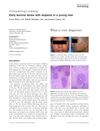
April 2016 in “International Journal of Dermatology” This article presents a clinicopathologic challenge involving early leonine facies with alopecia in a young man and reports no new clinical results.
1 citations
,
June 2022 in “bioRxiv (Cold Spring Harbor Laboratory)” This study found that modulating epithelial and mesenchymal cell interactions in vitro enabled nearly 100% efficient induction of hair follicles, suggesting potential applications for understanding and testing hair growth and graying.
 January 2026 in “International Journal of Research and Innovation in Applied Science”
 This case report details a rare instance of malignant proliferating trichilemmal tumour in a 60-year-old male, emphasizing the significance of histochemical and immunohistochemical markers for accurate diagnosis and differentiation from squamous cell carcinoma.
13 citations
,
January 2018 in “Skin Appendage Disorders” This study found that dermoscopy improves clinical diagnosis accuracy for trichostasis spinulosa and proposes a new dermoscopic classification with implications for treatment outcomes.
1 citations
,
March 2023 in “Journal of the Turkish Academy of Dermatology” This report suggests a possible association between temporal triangular alopecia and sebaceous nevus, and identifies a pinkish background as a new trichoscopic finding for TTA.
 June 2003 in “Journal of Investigative Dermatology Symposium Proceedings”
 This special issue reviews recent progress in hair research discussed at the 2001 International Hair Workshop, reporting developments in androgen action, stem cell biology, and potential therapies for hair growth disorders without presenting new experimental results.
12 citations
,
January 2019 in “International Journal of Trichology” This study found that trichoscopy revealed significant differences in certain variables, such as the brown peripilar sign and white peripilar sign, which may aid in diagnosing early and late stages of androgenetic alopecia.
April 2023 in “The Medical Journal of Australia” In this case report, a five-year-old girl with a bald patch was diagnosed with congenital triangular alopecia, a localized non-scarring condition that typically remains unchanged and lacks effective treatment.

In this study, trichoscopy was found to be a valuable non-invasive tool for diagnosing scalp lesions, enhancing diagnostic accuracy and reducing the need for scalp biopsies by identifying specific trichoscopic features associated with conditions like psoriasis, seborrheic dermatitis, and alopecia areata.
1 citations
,
November 2021 in “International Journal of Dermatology and Venereology” This paper highlights a case where a 2-year-old boy with temporal triangular alopecia was initially misdiagnosed with alopecia areata, emphasizing the importance of dermoscopy for accurate early diagnosis to avoid unnecessary treatments.
 January 2019 in “The Egyptian Journal of Hospital Medicine”
 In this study, researchers evaluated trichoscopic features in 500 Egyptian patients with patchy hair loss and found specific patterns, such as perifollicular scale with 90% sensitivity and 99.5% specificity, which effectively aid in diagnosing primary cicatricial alopecias.
June 2022 in “Our Dermatology Online” In this study, researchers found that trichoscopy helps detect early signs of female-pattern hair loss before it is visible, highlighting its importance for monitoring and managing the condition.
 4 citations
,
May 2015 in “Indian Journal of Dermatology, Venereology and Leprology”
4 citations
,
May 2015 in “Indian Journal of Dermatology, Venereology and Leprology” Congenital triangular alopecia can occur outside the typical fronto-temporal region.
59 citations
,
August 1981 in “PubMed” This study describes trichilemmal keratinization as a distinct process of hair follicle keratinization that occurs in specific areas of the outer root sheath, illustrated using electron microscopy on dog hair.
July 2024 in “Journal of Investigative Dermatology” Topical thyroid hormones may boost hair growth.
1 citations
,
January 2008 6 citations
,
October 2006 in “International Journal of Dermatology” This article discusses central trichoptilosis with onycholysis but provides no new clinical results.
7 citations
,
January 2017 in “Sub-cellular biochemistry/Subcellular biochemistry” 5 citations
,
March 2015 in “Indian Journal of Dermatology” This report describes a rare case of multiple trichofolliculomas on the face, which clinically resembled multiple trichoepitheliomas.