1 citations
,
January 2022 in “Anais brasileiros de dermatologia/Anais Brasileiros de Dermatologia” In this study, authors reported that reflectance confocal microscopy may aid in diagnosing trichofolliculoma by identifying specific features correlated with histopathology that can be difficult to discern with other methods.
 June 2021 in “Scholars journal of applied medical sciences”
 This article reviews the literature on trichofolliculoma, a rare benign hair follicle tumor, and provides an observational report, noting the lack of consensus on treatment.
 October 2024 in “Dermatology Practical & Conceptual”
 In this study, the authors evaluated 200 Egyptian children with focal non-cicatricial alopecia, finding that alopecia areata (42%) and tinea capitis (40.5%) were the most prevalent causes. Trichoscopy identified unique features for each condition, enhancing diagnosis and management.
 September 2021 in “Mağallaẗ al-Muẖtar li-l-ʿulūm”
 This report describes a case of two sisters with kinky, tangled hair diagnosed using trichoscopic and microscopic methods; they were treated with topical minoxidil.
15 citations
,
June 2020 in “Journal of the American Academy of Dermatology” Shiny white structures in trichoscopy can indicate long-standing discoid lupus erythematosus alopecia.
 April 2016 in “Journal of The American Academy of Dermatology”
 The study found that Temporal Triangular Alopecia often starts in early childhood, while Folliculitis Decalvans is characterized by tufted hairs and redness around hair follicles.
 26 citations
,
September 2016 in “International Journal of Dermatology”
26 citations
,
September 2016 in “International Journal of Dermatology” This study aimed to identify trichoscopic features that help differentiate between tinea capitis and alopecia areata in children, enhancing diagnosis and treatment decisions visually and non-invasively.
33 citations
,
September 1987 in “American Journal of Medical Genetics” This study documents dominant transmission and complete penetrance of uncombable hair syndrome in a family, despite the father lacking visible abnormalities.
February 2013 in “Journal of the American Academy of Dermatology” Uncombable hair syndrome causes dry, frizzy hair that can't be combed flat, seen in a young child.
January 2026 in “Surgical & Cosmetic Dermatology”  66 citations
,
May 2012 in “Scientific Reports”
66 citations
,
May 2012 in “Scientific Reports” This study demonstrated that bioengineered hair follicles reconstituted from embryonic skin cells and transplanted into hosts can restore physiological hair functions, suggesting potential applications for treating alopecia.
 36 citations
,
March 2011 in “Nature Communications”
36 citations
,
March 2011 in “Nature Communications” This study found that TSC2-null fibroblast cells from TSC skin hamartomas can induce hair follicle formation and hamartomatous changes in keratinocytes, with active mTOR signaling observable in a mouse xenograft model.
 28 citations
,
October 2013 in “Cornea”
28 citations
,
October 2013 in “Cornea” This review discusses the strategies and progress in developing bioengineered organ replacement therapies but reports no new clinical results, highlighting the potential for future regenerative solutions.
 16 citations
,
July 2021 in “Histopathology”
16 citations
,
July 2021 in “Histopathology” This review discusses recent findings on molecular changes in cutaneous adnexal tumours and reports novel markers and pathways involved, highlighting the diverse oncogenic drivers and tumour suppressor alterations.

research Acne
2 citations
,
May 2011 in “Harper's Textbook of Pediatric Dermatology” Acne is a common skin condition linked to diet, hormones, and genetics, and early treatment can prevent scarring.

This genetic study identified a potential interval for the Marie Unna hypotrichosis gene but found no mutations in the nearby hr gene, suggesting its involvement remains unconfirmed.
 March 2017 in “InTech eBooks”
 This source provides a comprehensive review of acne vulgaris, highlighting its pathophysiology, epidemiology, molecular mechanisms, and treatment options, emphasizing the significance of addressing acne's psychosocial burden for adolescents and beyond.
 5 citations
,
January 2014 in “Journal of Cutaneous and Aesthetic Surgery”
5 citations
,
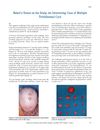
January 2014 in “Journal of Cutaneous and Aesthetic Surgery” A woman had 13 non-cancerous cysts on her scalp successfully removed in one surgery.
December 2021 in “Pathologica” This case report describes a rare instance of trichogerminoma with unusually numerous mitotic figures and a higher Ki67 proliferative rate, distinguishing it from previously documented cases.
 96 citations
,
January 2013 in “International Journal of Trichology”
96 citations
,
January 2013 in “International Journal of Trichology” This article reviews the use of trichoscopy for diagnosing various types of alopecia and reports no new clinical results; it is suggested as a non-invasive method for diagnosis and monitoring treatment responses.
5 citations
,
March 2023 in “Journal of the European Academy of Dermatology and Venereology” This review discusses the use of trichoscopy for diagnosing systemic diseases and concludes that certain trichoscopic features may help dermatologists suspect these conditions.
8 citations
,
June 2010 in “Plastic & Reconstructive Surgery” This study found that complete surgical resection and multidisciplinary management were crucial for treating proliferating trichilemmal tumors, though malignant cases showed recurrence and mortality risks.
Trichorrhexis nodosa causes hair to break easily, often affecting young to middle-aged black women.
April 2023 in “International Journal of Medical Science and Clinical Research Studies” This article reports a case study of recurrent trichilemmal carcinoma of the scalp, highlighting its clinico-radiological and pathological features, along with its unique characteristics compared to other skin cancers.
July 2026 in “Cosmoderma” In this case report, a 5-year-old boy presented with an itchy patch of hair loss in the frontotemporal region, with trichoscopy revealing specific hair shaft features, such as black dots and corkscrew hairs.
2 citations
,
September 2021 in “JAAD case reports” This report describes a case of trichodysplasia spinulosa in a renal transplant patient, characterized by unique dermatoscopic features and highlighting the need for timely diagnosis.

Trichodysplasia spinulosa can occur after a heart transplant due to immunosuppressive drugs.
26 citations
,
January 1993 in “Dermatology” This report describes a new case of isolated trichothiodystrophy with characteristic brittle hair and suggests a simplified classification scheme for understanding sulfur-deficient hair disorders.
In this study, trichoscopy was diagnostically useful in 97.5% of alopecia cases at a rural Indian hospital, confirming initial diagnoses in most cases and reducing the need for invasive scalp biopsies.
 24 citations
,
September 2014 in “Journal of the European Academy of Dermatology and Venereology”
24 citations
,
September 2014 in “Journal of the European Academy of Dermatology and Venereology” This study suggests that trichoscopy with a handheld dermatoscope may help differentiate temporal triangular alopecia from other localized alopecia by identifying specific hair features.