35 citations
,
September 2003 in “Archives of dermatology” This study proposed that the tiger tail phenomenon in trichothiodystrophy hair is caused by regular undulations of hair fibers, altering the optical properties seen under polarized light.
 1 citations
,
October 2022 in “Dermatology practical & conceptual”
1 citations
,
October 2022 in “Dermatology practical & conceptual” Isolated patchy heterochromia with pili annulati can occur without other health issues.
53 citations
,
September 1999 in “Journal of Synchrotron Radiation” This study shows that microdiffraction experiments reveal structural layers in keratinous tissues, each with different keratin types, potentially explaining their dual role as mechanical support and chemical barriers.
13 citations
,
January 2001 in “Pediatric dermatology” This study reports pseudopili annulati in a dark-haired Chinese girl, identifying the unique appearance and structural characteristics of her hair without finding abnormalities in the cuticle and cortex.
71 citations
,
May 2006 in “The journal of investigative dermatology/Journal of investigative dermatology” In this study, researchers found that trichothiodystrophy hair brittleness is linked to abnormalities in sulfur content and structural organization, making it prone to breakage.
3 citations
,
July 2025 in “Acta Biomaterialia” In this study, AFM-based indentation was used to assess mechanical properties of murine skin wounds at two healing stages, revealing that early wounds exhibit stiffer hyperproliferative epithelium compared to granulation tissue, and highlighting significant influences of surface roughness on tissue stiffness measurements.
 5 citations
,
March 2009 in “Pediatric Dermatology”
5 citations
,
March 2009 in “Pediatric Dermatology” The study found that pili bifurcati causes hair to intermittently split into two branches, each with its own outer layer.
36 citations
,
December 2004 in “British Journal of Dermatology” This case study reports a peculiar variant of an epidermal cyst in a patient, featuring unique characteristics like brownish, lumpy contents resembling bone marrow.
 May 2022 in “Experimental dermatology”
 In this study, hair shafts from trichothiodystrophy patients with ERCC2 mutations revealed abnormal cuticle structures and protein imbalances compared to normal hair shafts.
1 citations
,
June 1998 in “Journal of Forestry Research” Mammalian hair scales change from smooth to wavy due to friction.
49 citations
,
September 2004 in “Journal of the European Academy of Dermatology and Venereology” This study found that careful light microscopy using fluid-mounted hair improves detection of the pili annulati phenotype, which varies widely in expression and affects hair fragility.
 33 citations
,
March 2006 in “Seminars in cutaneous medicine and surgery”
33 citations
,
March 2006 in “Seminars in cutaneous medicine and surgery” This article illustrates various hair shaft defects and suggests that dermatologists can diagnose most of them using light microscopy and polarization without needing advanced imaging techniques.
8 citations
,
November 2020 in “Skin Research and Technology” This study found that enlarged facial pores in women show distinct microstructural alterations, including regular keratinocyte arrangement and irregular dermo-epidermal junctions, highlighting changes in skin tension linked to pore enlargement.
 January 2019 in “Global Dermatology”
 This review discusses the genetic disorder, monilethrix, characterized by fragile, brittle hair and its inheritance patterns, and reports no new clinical results.
 12 citations
,
July 2016 in “Forensic science international”
12 citations
,
July 2016 in “Forensic science international” This study found that postmortem root banding in hair is likely due to the degradation of the intermacrofibrillar matrix in the cortex, with no damage to the cuticle observed.
4 citations
,
July 2010 in “International Journal of Cosmetic Science” This study observed that hair fibers in older women become more curved with age, decreasing hair luster due to their disordered alignment and structural differences between the convex and concave sides.
24 citations
,
January 1969 in “Archives of Dermatological Research” Hair malformations may occur due to timing issues in hair development.
19 citations
,
August 1996 in “British Journal of Dermatology” This study found that dermal papillae in alopecia areata, including clinically normal follicles, exhibited ultrastructural abnormalities that suggest an early pathological role in the disease's development.
7 citations
,
May 1988 in “International Journal of Dermatology” This case report describes an 18-year-old man with pili annulati, characterized by a "shagreened" appearance of the hair shaft with alternate bright and dark bands and wide holes throughout the cortex.
This chapter reviews the clinical and morphological diagnostic features of various hair dysplasias, including atypical pili torti, pseudomonilethrix, and trichothiodystrophy, and reports no new results.
2 citations
,
June 2001 in “Medical Electron Microscopy” This study observed that the keratinization pattern of trichilemmal cysts in two Japanese women may originate from the proliferation of the outer root sheath in the follicular isthmus of anagen hairs.
 December 2022 in “Skin Pharmacology and Physiology”
 This study found that most hair shaft abnormalities can be accurately diagnosed using a handheld dermoscope in a clinical setting.
 36 citations
,
August 2018 in “Dermatologic Clinics”
36 citations
,
August 2018 in “Dermatologic Clinics” This article reviews various hair abnormalities observable through trichoscopy in conditions like monilethrix, trichorrhexis nodosa, and ectodermal dysplasias, with no new clinical findings reported.
22 citations
,
March 2007 in “European journal of pediatrics” This study found that scanning electron microscopy revealed considerable abnormalities in hair morphology in MPS I, II, IIIA, and IIIB patients, potentially related to heparan sulfate accumulation.
42 citations
,
September 1985 in “British Journal of Dermatology” This study found that trichothiodystrophic hair shows reduced and disoriented protein deposition in follicles, with both the cuticle and cortex affected, providing localized structural insights into keratin abnormalities.
 1 citations
,
January 2018 in “Acta dermato-venereologica”
1 citations
,
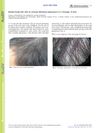
January 2018 in “Acta dermato-venereologica” A teenager's hair with alternating white and dark bands, known as Pili annulati, is a genetic condition that is usually harmless and often considered attractive.
 13 citations
,
January 2012 in “International journal of trichology”
13 citations
,
January 2012 in “International journal of trichology” This case study describes a 14-year-old girl with pili annulati who had fragile hair, which may be due to cavities within the hair shafts as seen in electron microscopic examinations.
February 2024 in “Medicina” In this study, researchers used atomic force microscopy to capture and analyze morphological changes in the surface of healthy hair, identifying features such as pitting and rod-shaped macro-fibrillar elements, which could inform future research on hair conditions and care.
3 citations
,
July 2019 in “Fibers And Polymers/Fibers and polymers”  February 2022 in “International journal of research in dermatology”
 This case series describes seven distinct hair shaft disorders, highlighting the importance of accurate diagnosis since these conditions are often treated incorrectly as alopecias without improvement.