 September 2017 in “Pediatric Dermatology”
 The document concludes that an experimental drug may help wound healing in Epidermolysis Bullosa, links Hydroa vacciniforme to EBV, discusses diagnosing hair loss disorders, finds many children with eczema have allergies, reviews the safety of a skin medication in children, notes side effects of a Duchenne's treatment, and identifies a marker for pediatric mastocytosis.

This paper discusses advancements in forensic hair analysis, emphasizing a novel DART–HRMS method that improves the accuracy and efficiency of detecting drug use timelines.
 January 2016 in “Research Explorer (The University of Manchester)”
 Activating the Eda/Edar pathway improves wound healing by enhancing hair follicle growth.
 May 2014 in “Transfusion and Apheresis Science”
 PRP is a safe natural treatment that improves skin by reducing wrinkles and enhancing texture for up to 4 months.

This study reported that high cholesterol levels were linked to increased prostate cancer risk, while selenium supplementation affected gene expression, suggesting nutritional and clinical factors might influence prostate cancer risk and biology.
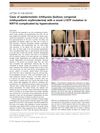 October 2011 in “Journal of dermatology”
 A man with a rare skin condition and a new gene mutation developed high calcium levels due to his treatment.
 September 2009 in “Pediatric Dermatology”
 This meeting abstract volume for the Society for Pediatric Dermatology reports no new clinical results.
 October 2004 in “European Neuropsychopharmacology”
 This article reviews studies on younger men using finasteride for hair loss, finding persistent sexual and nonsexual side effects like erectile dysfunction and depression, and reports lower neurosteroid levels in affected individuals.
 January 1993 in “Side effects of drugs annual”
 This chapter covers various dermatological drugs, cosmetics, and topical agents, focusing on the properties and uses of propolis, but does not present new clinical findings.
 November 2023 in “Dermatology Research and Reports”
 This study reported that a 1% ivermectin topical cream for rosacea was stable over six months, showing no significant changes in key physical properties or microbial contamination, suggesting it may reduce chronic antibiotic use in rosacea treatment.
 May 2021 in “GSC Advanced Research and Reviews”
 This review discusses recent advances in the understanding of follicular melanogenesis and its pathological changes, particularly how these changes are associated with specific disease phenotypes, but it reports no new results.

This dissertation reported that the loss of Ovol2 impairs hair follicle regeneration and wound repair in mice, highlighting its role in regulating directional migration of epithelial cells.
 25 citations
,
January 2000 in “Hormone Research in Paediatrics”
25 citations
,
January 2000 in “Hormone Research in Paediatrics” This article reviews androgen insensitivity syndrome and highlights the factors contributing to phenotypic diversity in 46,XY patients with AR gene mutations, reporting no new clinical results.
 173 citations
,
May 2001 in “Human reproduction update”
173 citations
,
May 2001 in “Human reproduction update” This review discusses the role of oestrogens in stimulating growth hormone secretion and influencing linear bone growth in children, and reports no new clinical results; the authors suggest that oestrogens play a key role in pubertal growth spurts for both genders.
 138 citations
,
November 2015 in “Journal of Pharmacology and Experimental Therapeutics”
138 citations
,
November 2015 in “Journal of Pharmacology and Experimental Therapeutics” This review discusses the mechanisms associated with protoporphyrin IX in living cells and reports no clinical results; the authors emphasize its potential in cancer diagnosis and the risks of toxicity.
 115 citations
,
October 2009 in “The Journal of clinical endocrinology and metabolism/Journal of clinical endocrinology & metabolism”
115 citations
,
October 2009 in “The Journal of clinical endocrinology and metabolism/Journal of clinical endocrinology & metabolism” In this study, researchers identified novel LMNA mutations in patients with atypical progeroid syndrome, revealing clinical features distinct from other similar disorders, but unrelated to mutant prelamin A accumulation.
 107 citations
,
September 2002 in “Journal of Investigative Dermatology”
107 citations
,
September 2002 in “Journal of Investigative Dermatology” This study identified a distinct "exogen" phase in the hair cycle during which hair shedding occurs, primarily coupled with the anagen phase, rather than as part of the telogen phase.
 92 citations
,
December 2012 in “Current opinion in genetics & development”
92 citations
,
December 2012 in “Current opinion in genetics & development” This review covers the recent advances in understanding how Turing models may explain various morphogenetic processes, but it reports no new experimental findings.
 74 citations
,
August 2006 in “Journal of clinical gastroenterology”
74 citations
,
August 2006 in “Journal of clinical gastroenterology” This report describes a case of acute liver injury in a woman following the use of Shen-Min, a herbal hair growth supplement, highlighting a potential link to acute hepatitis.
 71 citations
,
October 2008 in “The journal of investigative dermatology/Journal of investigative dermatology”
71 citations
,
October 2008 in “The journal of investigative dermatology/Journal of investigative dermatology” This study presents a novel in vitro assay using human folliculoid microspheres to research hair growth, which may facilitate preclinical testing of hair growth-modulatory agents.
 62 citations
,
June 2015 in “The Journal of Dermatology”
62 citations
,
June 2015 in “The Journal of Dermatology” This study found that patients with alopecia areata had higher levels of Th17 cells and lower levels of regulatory T cells compared to healthy controls, suggesting an immune imbalance in these patients.
 49 citations
,
December 2009 in “Journal of Investigative Dermatology”
49 citations
,
December 2009 in “Journal of Investigative Dermatology” This review explores the complex relationship between thyroid hormones and skin, discussing potential mechanisms and known interactions but reports no new clinical results, emphasizing the need for further research.
 41 citations
,
September 1991 in “Medical hypotheses”
41 citations
,
September 1991 in “Medical hypotheses” This article reviews the potential role of prolactin as a neuroendocrine modulator in skin biology and pathology, discussing its relevance for conditions such as psoriasis and hair growth, but reports no new clinical findings.
 36 citations
,
June 2009 in “Archives of Dermatology”
36 citations
,
June 2009 in “Archives of Dermatology” This text is an informational content piece about JAMA Dermatology's website and does not contain any research findings or conclusions.
 30 citations
,
July 2010 in “Experimental Dermatology”
30 citations
,
July 2010 in “Experimental Dermatology” This article reviews the role of polyamines in hair follicle growth and discusses potential therapeutic applications but provides no new clinical results.
 26 citations
,
October 2007 in “Experimental Dermatology”
26 citations
,
October 2007 in “Experimental Dermatology” This study found that l-carnitine stimulated hair growth in vitro by promoting proliferation and reducing apoptosis in human scalp hair follicles, suggesting potential as a treatment for hair loss.
![Comparative Oncology: Evaluation of 2-Deoxy-2-[18F]Fluoro-D-Glucose (FDG) Positron Emission Tomography/Computed Tomography (PET/CT) for the Staging of Dogs with Malignant Tumors](/images/assets/d55cf8d9-d8ee-4735-9b38-42a266b4059d/small/24322.jpg) 17 citations
,
June 2015 in “PLOS ONE”
17 citations
,
June 2015 in “PLOS ONE” This study reported that FDG PET/CT imaging provided additional information that significantly impacted the treatment and prognosis in seven out of ten canine cancer patients, suggesting its potential in veterinary oncology.
 10 citations
,
October 2010 in “Hepatology”
10 citations
,
October 2010 in “Hepatology” This case study suggests that treatment with Pil-Food, intended for hair loss prevention, may have triggered postinfantile giant cell hepatitis with autoimmune characteristics, which showed a rapid and effective response to corticosteroid therapy.
 8 citations
,
February 2014 in “Stem cells translational medicine”
8 citations
,
February 2014 in “Stem cells translational medicine” This study found that human mesenchymal stem cells overexpressing JAM-A improved hair follicle structure and hair formation in mice by reducing abnormalities such as curved and zigzagged follicles.
 7 citations
,
March 2024 in “Scientific Reports”
7 citations
,
March 2024 in “Scientific Reports” This study reports that the new neighborhood face index (NFI) demonstrates a remarkably high correlation with the physiochemical properties of benzenoid hydrocarbons, highlighting its potential as a predictive tool.