 59 citations
,
May 2017 in “Scientific reports”
59 citations
,
May 2017 in “Scientific reports” This study found that ZDHHC13 deficiency in mice is associated with abnormal liver function, lipid metabolism issues, and impaired mitochondrial function, highlighting ZDHHC13's regulatory role in liver metabolism.
 76 citations
,
September 1992 in “Endocrinology”
76 citations
,
September 1992 in “Endocrinology” This study details the isolation and characterization of the human type II 5 alpha-reductase gene, which may play a role in male pseudohermaphroditism, prostate cancer, and benign prostatic hyperplasia.
 30 citations
,
December 2011 in “Journal of biological chemistry/The Journal of biological chemistry”
30 citations
,
December 2011 in “Journal of biological chemistry/The Journal of biological chemistry” This study found that serine 44 in the N-terminal head domain of keratin 17 is phosphorylated in response to various stimuli affecting skin keratinocyte growth, linking K17 up-regulation with growth and stress responses in skin epithelium.
 3 citations
,
February 2020 in “The journal of gene medicine”
3 citations
,
February 2020 in “The journal of gene medicine” This study found a recurrent nonsense mutation in the HR gene linked to atrichia with papular lesions in two Kashmiri families, suggesting whole exome sequencing as an efficient method for diagnosis and genetic counseling.
 April 2019 in “Journal of Investigative Dermatology”
 This study found that BRG1 is crucial for keratinocyte migration during skin wound healing, as its suppression impairs wound closure by inhibiting migration without affecting cell proliferation or apoptosis.
 7 citations
,
July 2005 in “Journal of Dermatological Science”
7 citations
,
July 2005 in “Journal of Dermatological Science” This study identified a gene transcript overexpressed in dermal papilla cells, showing strong similarity to a mouse gene associated with adipose tissue in bombesin receptor subtype-3-deficient mice.
 5 citations
,
August 2019 in “iScience”
5 citations
,
August 2019 in “iScience” In this study, Trf1 genetic deletion in mice, including those with cancer-prone mutations, was shown to not affect overall viability and cause only mild effects, while being necessary for tumor formation, suggesting a potential therapeutic window for Trf1 as an anti-cancer target.
 10 citations
,
January 2010 in “Veterinary pathology”
10 citations
,
January 2010 in “Veterinary pathology” This study found that a newly identified mutation in the hairless gene in mice led to decreased Hr mRNA levels and changes in gene expression related to hair follicle development.
 9 citations
,
March 2018 in “European journal of dermatology/EJD. European journal of dermatology”
9 citations
,
March 2018 in “European journal of dermatology/EJD. European journal of dermatology” This study in a Pakistani family identified a novel ST14 gene variant as the likely genetic cause of autosomal recessive ichthyosis with hypotrichosis syndrome.
 64 citations
,
August 2014 in “The journal of allergy and clinical immunology/Journal of allergy and clinical immunology/The journal of allergy and clinical immunology”
64 citations
,
August 2014 in “The journal of allergy and clinical immunology/Journal of allergy and clinical immunology/The journal of allergy and clinical immunology” This study found that biallelic mutations in the TTC7A gene affect lymphocyte and gut epithelial cell function, thereby contributing to the development of inflammatory bowel disease in patients.
 January 2018 in “bioRxiv (Cold Spring Harbor Laboratory)”
 This study identified a new cis-regulatory element in the mouse Hr gene that influences its expression in skin and brain cells, highlighting a complex molecular network involved in hair follicle formation.
22 citations
,
April 2010 in “Journal of Cellular Biochemistry” This study concluded that the hairless protein interacts with the vitamin D receptor to repress transcription crucial for hair cycling, employing multiple protein interfaces and modulating chromatin structure.
20 citations
,
August 2003 in “Clinical and Experimental Dermatology” In this study, a novel E583V missense mutation in the hairless gene was identified in an Italian family with atrichia with papular lesions, reinforcing the significance of zinc-finger and LXXLL domains in this condition.
 6 citations
,
October 2012 in “Journal of Heredity”
6 citations
,
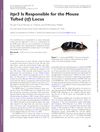
October 2012 in “Journal of Heredity” This study identified the Itpr3 gene as responsible for the tufted hair loss phenotype in the BTBR mouse strain.
 July 2016 in “Experimental Dermatology”
 This article provides clinical snippets from Experimental Dermatology and reports no new research findings.
84 citations
,
September 2008 in “Developmental biology” This study found that cellular retinoic acid-binding proteins and fatty acid-binding proteins are dynamically expressed in skin development and respond differently to retinoic acid, β-catenin, and Notch signaling.
2 citations
,
January 2014 in “Photochemical & photobiological sciences” This study suggests that the Grasp protein may play a role in regulating skin homeostasis following UVB exposure by influencing p53-mediated apoptotic responses in mice.
 June 2021 in “bioRxiv (Cold Spring Harbor Laboratory)”
 This research found that the microtubule catastrophe factor KIF18B plays a crucial role in promoting spindle orientation in keratinocytes, linking this process to cell fate decisions during hair follicle morphogenesis.
 2 citations
,
June 2023 in “Journal of cell science”
2 citations
,
June 2023 in “Journal of cell science” In this study, researchers found that specific mutations in iRhom2 in mice lead to skin and hair abnormalities which depend on the presence of the protein ADAM17, suggesting a complex role for iRhom2 in tissue development and potential implications for treating tylosis with oesophageal cancer.
26 citations
,
March 1995 in “Differentiation” This study isolated and sequenced the complete gene rKAP4L1, which encodes a cysteine-rich hair keratin-associated protein in rabbit hair follicles.
 February 2023 in “Research Square (Research Square)”
 This study reports that a new mouse model with a CARD14 mutation successfully mimics key human PRP symptoms, and anti-IL-17A antibody significantly reduces these symptoms.
11 citations
,
May 2012 in “Genesis” This study in mutant mice found that Bmpr2 and Acvr2a are individually redundant, but together essential for normal hair follicle development, with their reduction causing rapid hair cycling and graying.
5 citations
,
September 2011 in “Biochimica et Biophysica Acta (BBA) - Molecular Basis of Disease” Hairless protein helps control hair growth by regulating vitamin D receptor activity.
9 citations
,
February 2001 in “Journal of Dermatological Science” This study found that the expressions of CDK inhibitors p21waf1/cip1 and p27kip1 were higher during the anagen phase compared to telogen, suggesting a role in follicular epithelial cell differentiation.
 9 citations
,
February 2018 in “The Journal of Dermatology”
9 citations
,
February 2018 in “The Journal of Dermatology” This study identified a novel splice site mutation in the LIPH gene associated with autosomal recessive woolly hair, contributing to understanding the genetic basis of this condition.
 October 2025 in “Proceedings of the National Academy of Sciences”
 This study identifies the PI4P-RHD4 module as a key regulator of GET pathway receptor dynamics in Arabidopsis, affecting TA protein insertion and root hair growth.
15 citations
,
September 2018 in “Frontiers in Plant Science” This study identified that downregulation of the gene BcFLA1 decreases root hair length in Brassica carinata under phosphate-deficient conditions, highlighting its role in root hair elongation.
24 citations
,
December 2016 in “Stem Cell Research & Therapy” This study found that P311 triggers transdifferentiation of epidermal stem cells into myofibroblast-like cells via TGFβ1/Smad signaling during wound healing.
66 citations
,
December 1999 in “Journal of Investigative Dermatology” New mutations in the hairless gene may cause hair loss and affect bone development.
109 citations
,
February 2018 in “CB/Current biology” This study concluded that the receptor-like kinase ERULUS, regulated by auxin, is crucial for modulating cell wall composition and pectin dynamics during root hair growth in Arabidopsis.