
This article reviews the cutaneous side effects of immune checkpoint inhibitors and targeted therapies for skin cancers, noting that while generally mild, these effects can influence treatment decisions and quality of life, underscoring the need for physicians to be aware of these adverse reactions.
May 2022 in “Голова и шея.” This report describes a case of a patient with metastatic renal cell carcinoma who developed a psoriasiform skin lesion while undergoing immune checkpoint inhibitor therapy.
 1 citations
,
April 2012 in “Informa Healthcare eBooks”
1 citations
,
April 2012 in “Informa Healthcare eBooks” Some medications for inflammation can cause a condition with scalp rashes and hair loss, often linked to Crohn's disease, and may require treatment changes to prevent permanent hair loss.
November 2022 in “International Journal of Trichology” This case study reports a 25-year-old male developing an extensive psoriasiform eruption within a week after starting finasteride 1 mg for androgenetic alopecia.
December 2025 in “Skin Health and Disease” This case report details the development of a psoriasiform rash and inflammatory alopecia in a 29-year-old man with severe atopic dermatitis following dupilumab treatment. The authors observed hair regrowth and eczema control after discontinuing dupilumab and beginning treatment with abrocitinib.
July 2012 in “American Journal of Clinical Pathology” This case report describes a 15-month-old girl with a history of dermatitis, eosinophilic esophagitis, and failure to thrive, leading to a suspected diagnosis of Netherton syndrome.
 August 2018 in “Journal of Investigative Dermatology”
 This study found that combining optical clearing methods with light-sheet fluorescence microscopy allows detailed 3D visualization of normal and pathological human skin biopsies, revealing differences in epidermal thickness and volume.
 15 citations
,
November 1994 in “International Journal of Dermatology”
15 citations
,
November 1994 in “International Journal of Dermatology” This study found that while the combination of oral propranolol and intradermal injections in guinea pigs led to psoriasiform changes, it did not fully mimic psoriasis.
 10 citations
,
January 2008 in “Acta dermato-venereologica”
10 citations
,
January 2008 in “Acta dermato-venereologica” This report describes a case of diffuse hair loss and palmoplantar psoriasiform eruptions in a 52-year-old woman, potentially linked to her use of carbamazepine, with improvement after reducing the drug's dosage.
 1 citations
,
October 2015 in “The American journal of gastroenterology”
1 citations
,
October 2015 in “The American journal of gastroenterology” This study reported two cases where infliximab-associated psoriasiform alopecia resolved with significant hair regrowth after stopping infliximab and using potent topical steroid treatment.
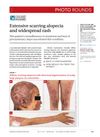 March 2022 in “The Journal of Family Practice”
 Following treatment plans is crucial to prevent worsening skin and hair conditions.
 4 citations
,
January 2012 in “Elsevier eBooks”
4 citations
,
January 2012 in “Elsevier eBooks” The document concludes that various skin conditions have specific treatments, ranging from antihistamines for urticaria to surgery and medication for tumors and chronic skin diseases.
 132 citations
,
July 2000 in “Lupus”
132 citations
,
July 2000 in “Lupus” This study found that chronic cutaneous lupus erythematosus with discoid lesions was the most common skin manifestation among patients with lupus erythematosus, while nonspecific skin lesions were linked to systemic lupus erythematosus, particularly during active disease phases.
 3 citations
,
March 2017 in “Case Reports in Dermatology”
3 citations
,
March 2017 in “Case Reports in Dermatology” This case report describes a 26-year-old with systemic lupus erythematosus presenting with psoriatic alopecia, revealing a novel scalp dermoscopic pattern of “patchy dotted vessels.
November 2014 in “The Pediatric Infectious Disease Journal” This case study of a 3-and-a-half-year-old girl with skin lesions revealed a diagnosis of extensive suppurative folliculitis with mixed granulomatous reaction upon further examination of hair follicles.
 72 citations
,
February 2011 in “The American Journal of Dermatopathology”
72 citations
,
February 2011 in “The American Journal of Dermatopathology” This study found that anti-TNF therapy-induced alopecia exhibits distinct clinical and histopathological features and can mimic psoriatic alopecia and alopecia areata, with some patients improving with topical treatment.
 14 citations
,
February 2023 in “Frontiers in immunology”
14 citations
,
February 2023 in “Frontiers in immunology” This review discusses the range of cutaneous immune-related adverse events induced by immune checkpoint inhibitors and the proposed mechanisms underlying these skin reactions, but reports no new clinical results.
 1 citations
,
January 2017 in “Journal of Pakistan Association of Dermatology”
1 citations
,
January 2017 in “Journal of Pakistan Association of Dermatology” This study found that cutaneous manifestations in children with systemic lupus erythematosus differ from adults, with no female preponderance and less frequent photosensitivity and vascular lesions.
 149 citations
,
July 2002 in “Dermatologic clinics”
149 citations
,
July 2002 in “Dermatologic clinics” This review discusses the pathogenesis, clinical presentation, diagnosis, and treatment of cutaneous lupus erythematosus, reporting no new clinical findings.
 60 citations
,
September 2013 in “Alimentary Pharmacology & Therapeutics”
60 citations
,
September 2013 in “Alimentary Pharmacology & Therapeutics” This review discusses the dermatological adverse events from immunosuppressive and anti-TNF therapy in IBD, finding increased risks of non-melanoma skin cancer and other skin conditions, and recommends regular cancer screening.
 46 citations
,
January 2015 in “Pediatric Rheumatology”
46 citations
,
January 2015 in “Pediatric Rheumatology” This review highlights the importance of recognizing mucocutaneous lesions in diagnosing juvenile-onset systemic lupus erythematosus, noting that these lesions often improve with controlled lupus and can indicate disease activity.
 42 citations
,
April 2012 in “Seminars in Oncology”
42 citations
,
April 2012 in “Seminars in Oncology” This review discusses the skin side effects associated with targeted cancer therapies and reports no new clinical results; it emphasizes the need for empirical management based on expert opinion.
 16 citations
,
December 2016 in “Skin appendage disorders”
16 citations
,
December 2016 in “Skin appendage disorders” This study analyzed patch test results to identify allergens causing scalp contact dermatitis, finding nickel, cobalt, and balsam of Peru among the most common in the patient population.
 7 citations
,
June 2015 in “Cutaneous and Ocular Toxicology”
7 citations
,
June 2015 in “Cutaneous and Ocular Toxicology” This study attempts to classify histomorphologic reactions to drugs to aid in diagnosing drug eruptions, which are common in hospitalized patients but lack specific diagnostic features.
 5 citations
,
January 2017 in “Skin appendage disorders”
5 citations
,
January 2017 in “Skin appendage disorders” In this case report, the authors linked acute psoriasiform contact dermatitis of the forehead and scalp to a low-laser light cap, identifying DMDE in the fabric as a likely cause.
 4 citations
,
January 2012 in “Chemical Immunology”
4 citations
,
January 2012 in “Chemical Immunology” This paper discusses the challenges of diagnosing drug eruptions, emphasizing the nonspecific patterns and unclear pathomechanisms, and calls for further research using new biologic drugs to understand these reactions better.
 November 2025 in “Pacific Journal of Medical Research”
 This study found that acute cutaneous lupus erythematosus, particularly malar rash, was the most common skin manifestation among SLE patients in Bangladesh, with significant occurrences of nonspecific lesions like alopecia and mucosal ulcers.

This study reports an increase in the frequency and variety of skin conditions associated with COVID-19, noting that milder cases often present with pernio-like lesions, while severe cases may involve livedo racemosa, retiform purpura, and acral ischemia.
 April 2018 in “International Journal of Research in Dermatology”
 In this study, 82% of systemic lupus erythematosus patients at a tertiary care center in India exhibited skin manifestations, including photosensitivity, malar rash, discoid rash, and oral ulcers.
 January 2018 in “Springer eBooks”
 This chapter reviews the skin side effects associated with targeted cancer therapies and emphasizes the importance of collaboration between oncologists and dermatologists without reporting new results.