13 citations
,
January 2018 in “Yonsei Medical Journal” This study reports the first case of Olmsted syndrome in a Korean patient, identifying a novel TRPV3 gene mutation, p.Gly568Val, associated with the condition.
6 citations
,
January 1997 in “Pediatric dermatology” This case report highlights a 21-year-old man with severe nodulocystic acne resistant to conventional treatments, who showed moderate improvement with isotretinoin, and discusses its potential link to congenital digital abnormalities and Apert syndrome.
2 citations
,
June 2019 in “The Journal of Dermatology” This report describes two cases of aplasia cutis congenita with hair collar signs and hemangioma, which may suggest neural tube defects, although imaging showed no bone or neural tissue abnormalities.
 28 citations
,
February 2012 in “PLoS ONE”
28 citations
,
February 2012 in “PLoS ONE” In this study, researchers identified a novel congenital skin disorder in Chesapeake Bay retrievers, linked to a plakophilin-1 deficiency due to a genetic mutation, marking the first known occurrence in an animal species.
 1 citations
,
January 2018 in “Acta dermato-venereologica”
1 citations
,
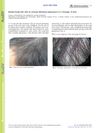
January 2018 in “Acta dermato-venereologica” A teenager's hair with alternating white and dark bands, known as Pili annulati, is a genetic condition that is usually harmless and often considered attractive.
12 citations
,
January 2013 in “Indian dermatology online journal” This case report details a 21-year-old woman with dermatopathia pigmentosa reticularis, presenting with generalized reticulate hyperpigmentation, diffuse noncicatricial alopecia, onychodystrophy, palmoplantar keratoderma, and poorly developed dermatoglyphics.
33 citations
,
October 2005 in “Journal of Investigative Dermatology” A specific gene mutation causes sparse, brittle hair in a family.
5 citations
,
January 2002 in “European journal of pediatrics” "D-CHRAMPS syndrome" is a newly identified condition with multiple severe symptoms.
 36 citations
,
March 2019 in “European Journal of Human Genetics”
36 citations
,
March 2019 in “European Journal of Human Genetics” This study found genetic variations, including de novo variants and copy number variations, that may be associated with phenotypic discordance in monozygotic twins with various clinical conditions.
September 1973 in “Primates”  30 citations
,
June 2016 in “Journal of Human Genetics”
30 citations
,
June 2016 in “Journal of Human Genetics” This study found pathogenic mutations in genes EDA, EDA1R, and EDARADD in 101 out of 124 hypohidrotic ectodermal dysplasia patients, revealing 23 novel mutations and indicating genetic variability.
This study identified novel mutations associated with ectodermal dysplasias in Pakistani families, including a missense mutation in the KRTHB5 gene linked to pure hair-nail ectodermal dysplasias and mutations in the EDAR gene related to hypohidrotic ectodermal dysplasia.
Recognizing bamboo hair helps diagnose Netherton’s syndrome.
 April 2023 in “The journal of investigative dermatology/Journal of investigative dermatology”
 This research suggests that hair keratins evolved from claw keratins in a hairless ancestor, with Hoxc13 controlling their expression in tetrapods, evidenced by the knockout of Hoxc13 hindering claw formation in Xenopus tropicalis frogs.
88 citations
,
March 2004 in “Journal of Investigative Dermatology” September 2021 in “Pediatrics in review” This case study describes a 7-month-old boy diagnosed with keratitis-ichthyosis-deafness syndrome due to a de novo GJB2 gene mutation, highlighting the challenges in treatment and eventual fatal outcome due to severe complications.
 42 citations
,
August 2017 in “Human Reproduction”
42 citations
,
August 2017 in “Human Reproduction” This study observed that a longer anterior clitoral anogenital distance (AGDAC) is associated with polycystic ovary syndrome in adult Mediterranean women.
 December 2024 in “Kırıkkale Üniversitesi Tıp Fakültesi Dergisi”
 This study found that chromosomal microarray analysis identified copy number variations in 12% of patients with dysmorphic features and congenital anomalies, demonstrating its potential as a diagnostic tool, especially for rare CNVs and immune deficiency linked to the deletion of CTLA4.
January 2025 in “Case Reports in Genetics” The researchers identified a pathogenic variant in the SRD5A2 gene among siblings with 46,XY disorder of sexual development, highlighting the importance of comprehensive genetic testing in diagnosis and management.
5 citations
,
December 2014 in “Molecular cytogenetics” This study identified a 290 Kb microduplication in chromosome 1q22 in a family with members exhibiting neurodevelopmental disorders, suggesting a link between this genetic alteration and the observed neurological symptoms.
1 citations
,
January 2018 in “Indian dermatology online journal” This case report describes a girl diagnosed with ADULT syndrome, highlighting its rarity, varied presentation, and the importance of early diagnosis to prevent unnecessary stress and medical expenses.
April 2016 in “Journal of the American Academy of Dermatology” A 4-year-old girl had a rare hair disorder affecting only part of her scalp.
 January 2012 in “International Journal of Trichology”
 Two siblings have a rare genetic condition causing curly, coarse hair.
84 citations
,
June 1970 in “Journal of Investigative Dermatology” 264 citations
,
October 1958 in “Archives of Dermatology” This report describes a 1949 case of a young girl with a rare congenital ectodermal defect causing unique hair fragility, which had not been previously documented in the literature.
 32 citations
,
February 2017 in “Human Reproduction”
32 citations
,
February 2017 in “Human Reproduction” This study found that women with PCOS were more likely to have longer anogenital distances, indicating possible intrauterine origins linked to prenatal androgen exposure.
12 citations
,
June 2016 in “Clinical and experimental dermatology” This study reported a previously undescribed G573V point mutation in the TRPV3 gene as a cause of familial Olmsted syndrome in a Mongolian family.
 15 citations
,
October 2018 in “Reproductive Biomedicine Online”
15 citations
,
October 2018 in “Reproductive Biomedicine Online” This study suggests that the anogenital distance measure AGDAC may moderately discriminate the presence of polycystic ovarian syndrome and could be a useful clinical tool.
26 citations
,
October 1998 in “Experimental Dermatology” This study describes a co-dominant E410D mutation in keratin hHb6 associated with severe hair loss and extensive papules in homozygous individuals, with variable expression in heterozygous family members.

This study in a nine-year-old boy from Lebanon identified a gene mutation (c.1066dup p.(Arg356Profs*16)) associated with a rare inborn error of immunity, characterized by craniosynostosis, jaundice, and several other symptoms, expanding the known genotypic and phenotypic spectrum of this condition.