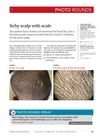
 December 2020 in “The Journal of Family Practice”
 This report describes an 11-year-old boy in Panama who visited a village health center due to scalp itching and subtle hair loss, previously treated for head lice, with no hair pulling reported.
 February 2023 in “Journal of dermatology”
 This letter reports the first known Japanese case of autosomal recessive woolly hair/hypotrichosis with compound heterozygous mutations in the LIPH gene.
January 2015 in “Chinese Veterinary Science” This study observed distinct changes in the ultrastructure of Hexi cashmere goat hair follicles throughout the year, highlighting stages with specific cellular and structural characteristics.
 October 2025 in “Nepal Journal of Dermatology Venereology & Leprology”
 In this case study, a 55-year-old male farmer from Nepal with a kerion barbae in the beard region showed complete resolution after initiating oral itraconazole, highlighting the potential for misdiagnosis when bacterial superinfection complicates dermatophyte infections.
3 citations
,
June 2001 in “Journal of Zoo and Wildlife Medicine” This case study reported that after removal of an interstitial cell tumor from a ruffed lemur, the animal experienced improved coat quality and a return to normal behavior without signs of cancer spread.
32 citations
,
January 2012 in “Chinese Medicine” In this study, a hydro-alcoholic extract of Urtica dioica demonstrated in vitro antioxidant activity, potentially linked to its ferulic acid content.
 November 2021 in “Folia Microbiologica”
 This study documented the first confirmed infections of Trichophyton bullosum in donkeys in Africa, indicating equines as primary hosts and highlighting the potential underestimation of this pathogen's prevalence.
February 2016 in “Journal of Allergy and Clinical Immunology” This report highlights a case of disseminated and recurrent infundibulofolliculitis in a 45-year-old African American male and underscores the importance of performing a skin biopsy for diagnosis.
 8 citations
,
January 2007 in “Mycoses”
8 citations
,
January 2007 in “Mycoses” This case report describes a 36-year-old Senegalese man with tinea capitis caused by Trichophyton soudanense, a dermatophyte more frequently encountered in Europe due to immigration.
January 2016 in “Methods in molecular biology” This study identified a population of GFP-expressing nestin-positive cells in transgenic mice hair follicles that varied in location during different hair cycle phases, suggesting a shared relationship with neural stem cells.
 49 citations
,
January 2003 in “Clinical and Experimental Dermatology”
49 citations
,
January 2003 in “Clinical and Experimental Dermatology” This report from the UK reviews the literature on post-menopausal frontal fibrosing alopecia and highlights its under-recognition and distinctive characteristics compared to lichen planopilaris, but does not provide new results.
 July 2022 in “JEADV Clinical Practice”
 This review discusses the classification of lichen planopilaris and its subtypes under the proposed term "lichenoid alopecias," suggesting they exist along a clinical and histological spectrum.
 1 citations
,
June 2017 in “Skin”
1 citations
,
June 2017 in “Skin” This study is the first to report that apremilast may be effective in treating refractory lichen planopilaris and frontal fibrosing alopecia, though some patients experienced adverse effects leading to discontinuation.
 May 2024 in “Journal of cosmetic dermatology”
 This study investigated the effects of heat-treated Limosilactobacillus fermentum LM1020 on hair growth and reported increased hair density, improved cellular activity, and beneficial scalp microbiota changes in patients with androgenetic alopecia over 24 weeks.
 1 citations
,
January 2023 in “Mycopathologia”
1 citations
,
January 2023 in “Mycopathologia” In this case report, a 34-year-old woman with black dot tinea capitis did not respond to oral Itraconazole but was successfully treated with Terbinafine.
4 citations
,
April 1989 in “The Journal of Dermatology” This study observed in mouse skin that trichohyalin granules in hair follicles transform into filamentous structures as inner root sheath cells differentiate and cornify.
8 citations
,
April 2014 in “Experimental Dermatology” This review discusses the use of hairs and feathers as defensive tools through toxin incorporation in certain mammals and birds and reports no new experimental findings.
11 citations
,
January 2015 in “JOURNAL OF HEALTH SCIENCE” This case report details a 12-year-old boy with Lichen Spinulosus and plantar keratoderma, who responded well to topical treatments including lactic acid, urea, and betamethasone valerate.
59 citations
,
November 2011 in “Development” This study found that the transcription factor Trps1 acts as a novel regulator of the Wnt signaling pathway and early hair follicle progenitors in developing vibrissa follicles in mice.
57 citations
,
August 2002 in “American Journal Of Pathology” Cathepsin L deficiency causes hair and skin issues in mice.
 1 citations
,
October 2018 in “International research journal of pharmacy”
1 citations
,
October 2018 in “International research journal of pharmacy” This study found that ethanol extract and n-hexane fraction of rampai leaves may stimulate hair growth in rabbits, showing potential as an anti-alopecia treatment.
 3 citations
,
November 2021 in “Frontiers in Genetics”
3 citations
,
November 2021 in “Frontiers in Genetics” This study suggests that the CXCL8 gene may regulate cashmere fineness in Liaoning cashmere goats, providing new insights into the cellular mechanisms of cashmere growth and quality.
16 citations
,
June 1992 in “Journal of Investigative Dermatology” This case report details a patient with lichen planopilaris who maintained successful hair transplant results for seven years, suggesting chemotherapy may have played a role in preventing re-activation of the disease.
 8 citations
,
April 2019 in “International journal of scientific research in biological science”
8 citations
,
April 2019 in “International journal of scientific research in biological science” This review discusses the natural habitat, taxonomy, phytochemical components, pharmacological activities, and potential medical applications of Tridax procumbens but reports no new experimental findings.
 February 2024 in “Medical mycology case reports”
 This study reported the presence of dermatophyte macroconidia directly in clinical samples from a 3-year-old boy with tinea capitis, marking the first time this has been documented. The infection, caused by Microsporum ferrugineum, was successfully treated with systemic itraconazole and topical ketoconazole shampoo.
 1 citations
,
October 2022 in “Scientific reports”
1 citations
,
October 2022 in “Scientific reports” This study found that nestin-expressing progenitor cells, capable of becoming ORS keratinocytes, are present in both developing and adult mouse hair follicles.
This study found that finasteride and luteolin may prevent hair loss and promote hair growth in vitro and in vivo by modulating specific gene expressions related to cell differentiation and apoptosis.

In this study of foxes and jackals in Ilam province, Iran, 19.35% of foxes and 17.85% of jackals were found to be infested with ectoparasites, mainly Ctenocephalides canis.
 September 2023 in “Bulletin of the Medical Institute of Continuing Education”
 This study discusses clinical cases of Lichen Planopilaris in men that were initially misdiagnosed and inadequately treated, resulting in significant irreversible hair loss.