 7 citations
,
December 2011 in “Elsevier eBooks”
7 citations
,
December 2011 in “Elsevier eBooks” The document concludes that early diagnosis and treatment are crucial for managing skin diseases in ferrets.
6 citations
,
February 2024 in “JAAD International” ChatGPT is preferred for creating dermatology patient handouts, but all models can be useful with oversight.
 6 citations
,
September 2013 in “The Obstetrician & Gynaecologist”
6 citations
,
September 2013 in “The Obstetrician & Gynaecologist” This article reviews the physiological skin changes and unique dermatoses in pregnancy, discussing their causes and management, but reports no new clinical findings.
 5 citations
,
January 2022 in “Journal of the European Academy of Dermatology and Venereology”
5 citations
,
January 2022 in “Journal of the European Academy of Dermatology and Venereology” In this study, Covishield vaccination was associated with cutaneous adverse effects, notably telogen effluvium and urticaria, among recipients at a hospital in northern India.
5 citations
,
July 2013 in “InTech eBooks” This book reviews the role of skin biopsy in diagnosing and treating various dermatological diseases, discussing site selection and applications for conditions like alopecia and pemphigus, but reports no new clinical results.
 4 citations
,
June 2025 in “Frontiers in Immunology”
4 citations
,
June 2025 in “Frontiers in Immunology” This review discusses the role of the BAFF system in autoimmune diseases and highlights its therapeutic potential, emphasizing the need for disease-specific clinical trials to improve treatment strategies.
 3 citations
,
June 2020 in “Cutis”
3 citations
,
June 2020 in “Cutis” This review discusses the link between nutritional deficiencies and cutaneous diseases, outlining risk factors, disease presentations, diagnostic processes, and supplementation in undernourished patients, but reports no new results.
3 citations
,
April 2025 in “Journal of Feline Medicine and Surgery” In this review, the authors examined the clinical presentations, differential diagnoses, and management strategies for feline immune-mediated skin diseases, focusing on conditions like pemphigus complex and cutaneous lupus erythematosus, highlighting that despite their rarity, these diseases can lead to severe systemic issues in cats.
3 citations
,
October 2024 in “Cancers” In this study, 37.5% of patients with nodal or metastatic cutaneous melanoma treated with immune checkpoint inhibitors developed skin adverse events, primarily low-grade rashes, vitiligo, and other dermatological symptoms, occurring mainly after 10 weeks of treatment.
 2 citations
,
December 2017 in “Skin appendage disorders”
2 citations
,
December 2017 in “Skin appendage disorders” An elderly man's non-healing scalp lesion was successfully treated with a strong topical steroid.
2 citations
,
January 2015 in “Elsevier eBooks” This review discusses current research on epigenetic changes in autoimmune skin diseases like vitiligo and alopecia areata, noting that the field is still developing and lacks extensive analysis.
 2 citations
,
January 2005 in “Elsevier eBooks”
2 citations
,
January 2005 in “Elsevier eBooks” The document describes skin diseases affecting the outer ear in dogs and cats, their spread to other body parts, and treatment options.
2 citations
,
September 2004 in “Experimental Dermatology” This review discusses how dysfunction in keratinocyte adhesion affects skin integrity and conditions like alopecia and keratoderma, highlighting the roles of intercellular junctions, and reports no new clinical results.
2 citations
,
September 2004 in “Experimental Dermatology” This study found that desmosomal adhesion plays a crucial role in epithelial morphogenesis and cell positioning, equivalent in importance to that of adherens junctions.
 1 citations
,
April 2019 in “Journal of Investigative Dermatology”
1 citations
,
April 2019 in “Journal of Investigative Dermatology” This study highlights that patients with pemphigus experiencing cutaneous involvement endure pruritus levels approaching those of bullous pemphigoid, impacting their quality of life alongside other autoimmune blistering diseases.
 1 citations
,
September 2010 in “The journal of investigative dermatology/Journal of investigative dermatology”
1 citations
,
September 2010 in “The journal of investigative dermatology/Journal of investigative dermatology” This article reviews a variety of research presentations from the Society for Investigative Dermatology's annual meeting, highlighting advances in dermatological research without reporting new clinical results.
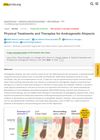
This review discusses various physical therapies for androgenetic alopecia, reporting that low-level laser therapy has the most evidence but highlighting other promising treatments, such as non-ablative lasers and multimodal approaches, that warrant further investigation.
 1 citations
,
January 2013 in “The Journal of Dermatology”
1 citations
,
January 2013 in “The Journal of Dermatology” A skin condition called pyodermatitis vegetans was found in a patient with multiple myeloma for the first time.
1 citations
,
June 2003 in “CRC Press eBooks” This review analyzes the relationship between stress and skin disease, finding clearer evidence for stress exacerbating psoriasis and atopic dermatitis, while its role in other conditions remains uncertain.
August 2026 in “Frontiers in Medicine” This review discusses the potential applications of JAK inhibitors in various dermatological conditions beyond atopic dermatitis, emphasizing gaps in evidence and therapeutic opportunities in the context of Chinese clinical practice, but reports no new clinical results.

This review examines the potential of Parquetina nigrescens for managing Polyendocrine Metabolic Ovarian Syndrome, emphasizing its pharmacological activities and highlighting its promise as an affordable complementary therapy.
February 2026 in “Advanced Science” This study found that the combination of TTNPB and CHIR99021 enhanced the derivation of highly advanced neural stem cells from human pluripotent stem cells, with improved chromatin accessibility and neuroectodermal gene expression, and these cells successfully engrafted in rat hippocampi to ameliorate depression-like symptoms.
 January 2026 in “Immunity & Inflammation”
 This review discusses a "stochastic multi-hit model" to explain the onset, progression, and recurrence of vitiligo and other autoimmune skin diseases, emphasizing genetic and environmental influences, immune cell interactions, and unexplored mechanistic gaps.
January 2026 in “Clinical Journal for Nurse Practitioners in Women s Health” In this article, it is explored how pregnancy-related physiologic changes can predispose women to dermatologic conditions affecting well-being, and it highlights the critical role of women’s health nurse practitioners in managing these conditions with attention to safety and efficacy in pregnant patients.
July 2025 in “Carolina Digital Repository (University of North Carolina at Chapel Hill)” This review evaluated various physical treatments for androgenetic alopecia and highlighted that low-level laser therapy is well-supported by evidence. However, nonablative laser and multimodal approaches like PEMF-LLLT appear promising and warrant further investigation.
May 2025 in “Journal of the European Academy of Dermatology and Venereology” This study observed that early treatment with ritlecitinib in patients with alopecia areata, especially when severity is low, led to more favorable responses, and continued improvement was seen up to 24 months, offering guidance on treatment timing and duration.
 February 2025 in “Quality in Sport”
 This review reports that pregnancy-specific dermatoses, including AEP, PEP, ICP, and PG, present overlapping clinical features and can significantly impact fetal outcomes, particularly ICP and PG, which are linked to preterm birth and stillbirth.
August 2024 in “Journal of Clinical Medicine” This review concludes that low-level laser therapy is the most supported physical treatment for androgenetic alopecia, but other therapies like nonablative laser treatments and combinations including PEMF may also be promising.

This study reports that COVID-19 can trigger various dermatological autoimmune and autoinflammatory diseases, highlighting the need for clinicians to consider these potential connections during the pandemic.
 March 2024 in “International journal of molecular sciences”
 This study suggests that abnormal levels of zinc, copper, and iron in serum or hair may serve as auxiliary and prognostic tests for various skin diseases, though further research is necessary due to conflicting data.