This chapter reviews alopecia areata treatments, highlighting factors like age and disease extent in choosing management strategies, but reports no new clinical findings.
 April 2016 in “Journal of The American Academy of Dermatology”
 Both atopy and eosinophilia are linked to more severe hair loss in people with alopecia areata.
8 citations
,
June 1981 in “Clinica Chimica Acta”  5 citations
,
September 2015 in “Nepalese journal of ophthalmology”
5 citations
,
September 2015 in “Nepalese journal of ophthalmology” This case report highlights an 11-year-old girl with dermatopathia pigmentosa reticularis, identifying associated Salzmann's nodular degeneration of the cornea and emphasizing the need for a multidisciplinary management approach.
January 2022 in “Optometric clinical practice” This case report describes a 59-year-old woman with a rare trichoepithelioma on her eyelid, emphasizing the importance for optometrists to differentiate it from basal cell carcinoma.
 December 2020 in “Skin appendage disorders”
 This discussion highlights the evolving clinical spectrum of lichen planopilaris, noting atypical features and presentations in younger males that suggest potential different pathomechanisms from previously recognized variants.
 1 citations
,
December 2017 in “Acta biomedica scientifica”
1 citations
,
December 2017 in “Acta biomedica scientifica” This study observed that 30% of women with polycystic ovary syndrome had androgenic alopecia, suggesting it is a prevalent but unreliable marker of hyperandrogenism.
 5 citations
,
September 1986 in “Pediatric Dermatology”
5 citations
,
September 1986 in “Pediatric Dermatology” This study reported a previously undescribed form of hereditary hypotrichosis in a family, characterized by childhood-onset hair loss, morphea, and probable autosomal dominant inheritance.
May 2025 in “Apollo Medicine” This study found that trichoscopy can be a helpful, noninvasive tool for identifying specific patterns that correlate with the clinical activity and severity of alopecia areata, enhancing its diagnosis and monitoring.
 July 2024 in “JAAD Case Reports”
 This study reports two cases of central serous chorioretinopathy developing after intralesional corticosteroid injections to the scalp for alopecia areata, suggesting a potential association that warrants cautious use and monitoring for ocular complications.
29 citations
,
January 2020 in “Frontiers in endocrinology” This paper considers fibrodysplasia ossificans progressiva as a segmental progeroid syndrome, which may help uncover mechanisms of normal aging and suggest targets for new treatments.
1 citations
,
January 2018 in “Indian dermatology online journal” This case report describes a girl diagnosed with ADULT syndrome, highlighting its rarity, varied presentation, and the importance of early diagnosis to prevent unnecessary stress and medical expenses.
 January 2021 in “International journal of dermatology, venereology and leprosy sciences”
 This study found that, among 100 patients with alopecia areata, the most prevalent subtype was patchy alopecia areata, with characteristic trichoscopic features including black dots, yellow dots, and empty hair follicles.
 3 citations
,
April 2010 in “Journal of Receptors and Signal Transduction”
3 citations
,
April 2010 in “Journal of Receptors and Signal Transduction” This review discusses the higher prevalence of retinal changes in alopecia areata patients and suggests a potential connection to Minoxidil, but emphasizes the lack of a proposed mechanism or extensive literature on this association.
August 2002 in “British journal of ophthalmology” This article reports that while surgical excision is often the best treatment for SCC, intralesional cidofovir also showed success without systemic toxicity in the case discussed.

This chapter reviews the clinical features, diagnosis, treatment, and prognosis of various non-hormonal, non-infectious alopecias without providing new clinical findings.
 1 citations
,
April 2020 in “Baylor University Medical Center Proceedings”
1 citations
,
April 2020 in “Baylor University Medical Center Proceedings” This case report describes a 58-year-old man with ophiasis-pattern alopecia areata who showed significant hair regrowth after treatment with clobetasol and microneedling with triamcinolone.
 64 citations
,
July 1997 in “Journal of The American Academy of Dermatology”
64 citations
,
July 1997 in “Journal of The American Academy of Dermatology” This study found that eosinophils are a useful diagnostic feature for alopecia areata, especially when the typical "swarm of bees" lymphoid infiltrate is absent, helping differentiate it from trichotillomania.
 1 citations
,
December 2013 in “Journal of Evolution of Medical and Dental Sciences”
1 citations
,
December 2013 in “Journal of Evolution of Medical and Dental Sciences” This historical review examines the diagnostic and etiological understanding of alopecia areata, emphasizing the evolution of theories and the impact of immunological data, while providing no new clinical results.
2 citations
,
January 2017 in “International Journal of Trichology” This case report describes the trichoscopic and histological features observed in a 7-year-old boy with morphea en coup de sabre and details the positive response to systemic immunosuppressive therapy.
 December 2024 in “Cermin Dunia Kedokteran”
 This source highlights that intraocular foreign bodies are urgent ophthalmologic emergencies requiring prompt diagnosis and treatment to prevent blindness and eye loss, with most cases involving the posterior segment of the eye.
 6 citations
,
July 2008 in “Clinical and experimental optometry”
6 citations
,
July 2008 in “Clinical and experimental optometry” This case report describes a rare complication of prostaglandin analogue eye drops for glaucoma, where a patient experienced extensive unwanted malar hair growth, leading to potential therapy discontinuation.
11 citations
,
January 2017 in “Skin Appendage Disorders” This study associated ivory-colored areas observed through trichoscopy with steroid deposits in the dermis among patients with steroid-induced atrophy on the scalp.
3 citations
,
August 2024 in “Skin Research and Technology” In this study, LC-OCT imaging was found to noninvasively identify specific features of cicatricial alopecia due to lupus erythematosus, such as hyperreflective collagen fibers, which may aid in distinguishing it from other types of scarring alopecia.
 August 2023 in “Journal of The American Academy of Dermatology”
 Recent studies highlighted in this research suggest that alopecia types in men, traditionally thought to affect only certain scalp areas, can also impact the occipital region, which was previously presumed unaffected.
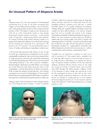 January 2014 in “International Journal of Trichology”
 A man had an unusual type of hair loss that didn't match known patterns and didn't improve with treatment.
 October 2024 in “Journal of the Endocrine Society”
 This case report highlights a patient with Ayme-Gripp syndrome, revealing an association between the syndrome and hypothyroidism, and underscores the importance of considering rare genetic conditions in differential diagnoses of endocrinopathies.
November 2021 in “International Journal of Trichology” This study found that androgenetic alopecia patients had significantly lower serum levels of paraoxonase 1, which correlated with disease severity and suggests a role of oxidative stress in its pathogenesis.
 November 2017 in “Journal of Surgical Academia”
 This case report describes a woman with systemic lupus erythematosus who developed non-progressive visual field defects after hypertensive retinopathy, with cotton wool spots indicating retinal nerve fiber microinfarctions.
 June 2026 in “EXPERIMENTAL & CLINICAL MEDICINE GEORGIA”
 In this study, researchers found a positive correlation between trichoscopic features and histomorphological findings, supporting trichoscopy as a valuable tool for assessing androgenetic alopecia severity and monitoring treatment outcomes.