 18 citations
,
January 2020 in “Ecology and evolution”
18 citations
,
January 2020 in “Ecology and evolution” This study analyzed gene expression changes during the autumn coat color change in mountain hares and found conserved gene regulation with snowshoe hares, highlighting its role in seasonal camouflage adaptation.
July 2021 in “Anais brasileiros de dermatologia/Anais Brasileiros de Dermatologia” This article reports on a family with six members diagnosed with monilethrix, highlighting varying degrees of alopecia linked to this rare hair shaft defect.
39 citations
,
September 2018 in “American Journal of Medical Genetics Part A” This case report describes a 32-month-old girl with a newly identified pediatric disorder linked to a de novo mutation in the ODC1 gene, mirroring symptoms seen in a transgenic mouse model.
45 citations
,
October 2015 in “BMC Genomics” This study identified morphotype-specific gene expression patterns in feathers, enhancing understanding of the molecular and cellular processes involved in feather development and diversification.
21 citations
,
March 2003 in “Clinical and Experimental Dermatology” This study found two recurrent missense mutations in the hHb6 gene associated with monilethrix in families from Russia and Colombia, supporting their role in this hair disorder worldwide.
 113 citations
,
March 2018 in “Biological reviews/Biological reviews of the Cambridge Philosophical Society”
113 citations
,
March 2018 in “Biological reviews/Biological reviews of the Cambridge Philosophical Society” This review examines the adaptive value and mechanisms of seasonal coat colour moulting in birds and mammals, highlighting the challenge of camouflage mismatch and the necessity for evolutionary adaptation under climate change.
September 1973 in “Primates” 1 citations
,
January 2017 in “International Journal of Trichology” This case report describes a 6-year-old girl diagnosed with monilethrix, experiencing hair fragility and loss after a fever, and showing improvement in hair density following treatment, despite persistent symptoms.
4 citations
,
May 2020 in “The journal of pediatrics/The Journal of pediatrics” This case report details the diagnosis of monilethrix in a 4-year-old boy, characterized by brittle hair and specific dermoscopic findings, and highlights the condition's hereditary nature and management through avoiding mechanical hair damage.
 4 citations
,
July 2021 in “bioRxiv (Cold Spring Harbor Laboratory)”
4 citations
,
July 2021 in “bioRxiv (Cold Spring Harbor Laboratory)” This study suggests that BLMP-1 is important for timely molting and oscillatory gene expression in C. elegans, indicating a potentially conserved mechanism for rhythmic skin regeneration.
61 citations
,
February 1982 in “Cell and Tissue Research”  November 2023 in “bioRxiv (Cold Spring Harbor Laboratory)”
 This study used a novel fluorescent tagging method in mice to observe collagen IV dynamics during hair follicle development, revealing that alterations in basement membrane turnover can influence epithelial progenitor cell behavior and organ morphology by affecting cell proliferation and movement.
 6 citations
,
August 2012 in “The Journal of Pediatrics”
6 citations
,
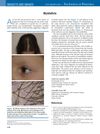
August 2012 in “The Journal of Pediatrics” This case report describes a 12-year-old girl diagnosed with monilethrix, characterized by fragile, beaded hair shafts, with no effective treatment currently available.
September 2017 in “PubMed” In this case report, a Danish family with monilethrix showed varying symptoms, diagnosed via dermatoscopy, microscopy, and gene sequencing. The study highlights that while no cure exists, oral minoxidil shows promise in a single case, and reducing hair trauma remains key for management.
 September 2016 in “Journal of Dermatological Science”
 This study investigated the mechanism responsible for pili torti formation in Björnstad syndrome using a transmission electron microscope, but did not establish a definitive explanation.
14 citations
,
December 1991 in “Annals of the New York Academy of Sciences” This study reports that lower levels of N-myc mRNA are observed when hair growth ceases in certain phases in mice, and attempts to create transgenic mice for further investigation resulted in high embryonic mortality.
 36 citations
,
July 2016 in “Scientific reports”
36 citations
,
July 2016 in “Scientific reports” This study found that decision-making effects related to time of day and chronotype were only significant when using RNA-based chronotype measurements, indicating molecular clock differences may influence these behaviors.
 June 2026 in “Institutional Repositories DataBase (IRDB)”
 Crickets have genetically controlled hair plates that help them sense and move their antennae.
13 citations
,
June 2012 in “European journal of medical genetics” In this study, researchers observed monochorionic diamniotic twins with discordant clinical phenotypes, where one had high-grade trisomy 12p mosaicism in certain tissues, while the other showed confined mosaicism likely due to twin-to-twin transfusion.
49 citations
,
August 1999 in “Journal of Investigative Dermatology” In this study, transgenic mice expressing Msx-2 developed flaky skin with hyperproliferation and misalignment in epidermal cells, suggesting Msx-2 plays a role in skin and appendage growth control.
2 citations
,
August 2021 in “Animal Cells and Systems” This study suggests that egfl6 expression in the pharyngeal pouches is not essential for craniofacial development in zebrafish.
11 citations
,
December 2015 in “Indian journal of dermatology, venereology, and leprology” Dermoscopy quickly and accurately diagnosed a rare hair disorder in a 12-year-old girl.
 2 citations
,
August 2023 in “Development”
2 citations
,
August 2023 in “Development” In this study, researchers explored how hair follicle orientation is affected in the rosette fancy mouse and found that a mutation in the PCP gene Fzd6 caused reversed hair orientations in the posterior region, leading to the formation of unique whorls.
14 citations
,
August 2013 in “Journal of Parasitology” This study reported that 39.7% of Amargosa voles had mite-associated lesions, which may severely impact their health and fitness.
 1 citations
,
April 2024 in “Science Advances”
1 citations
,
April 2024 in “Science Advances” In this study, researchers found that the female plumage color variations in the common cuckoo are linked to the female-restricted genome and suggest this pattern is maintained by balancing selection, sharing ancestry with the oriental cuckoo.
 50 citations
,
April 2014 in “Nature Communications”
50 citations
,
April 2014 in “Nature Communications” This study analyzed skin from 538 knockout mouse mutants and identified 50 with epidermal phenotypes, providing valuable insights into genetic conditions and systemic effects related to skin abnormalities.
26 citations
,
April 2011 in “British Journal of Dermatology” This study identified novel mutations in the DSG4 gene in a Japanese patient with monilethrix, affecting protein interactions that may disrupt hair shaft structure.
69 citations
,
May 1997 in “Veterinary Pathology” This study found that the angora mouse mutation prolongs the anagen phase, resulting in excessively long hair and follicular abnormalities, without involving circulating hair cycle factors.
April 2023 in “The journal of investigative dermatology/Journal of investigative dermatology” This study identified that disrupting Mef2c in dermal papilla cells delays the early stages of hair cycle catagen in mice, revealing potential interactions with Sox18 in regulating hair growth.
This abstract provides definitions and descriptions of terms related to insects, arachnids, and other invertebrates, but includes no new research findings.