 September 2004 in “Experimental dermatology”
 This study found that normal murine hair follicles are direct targets for melatonin bioregulation, expressing receptors that are regulated in a hair cycle-dependent manner, influencing keratinocyte apoptosis.
 December 2017 in “Springer eBooks”
 Treat pediatric skin issues with accurate diagnosis, multidisciplinary team, and various treatment options.
 98 citations
,
July 2014 in “Trends in Molecular Medicine”
98 citations
,
July 2014 in “Trends in Molecular Medicine” This article discusses the role of human hair follicles in neuroendocrinology and suggests potential new therapeutic targets by examining how neuromediators influence hair growth, pigmentation, and stem cell biology in organ cultures.
 36 citations
,
September 2009 in “Journal of Cellular and Molecular Medicine”
36 citations
,
September 2009 in “Journal of Cellular and Molecular Medicine” This review addresses the role of skin-resident adult stem/progenitor cells in skin homeostasis, disease, and cancer development, and reports no new research results.
 25 citations
,
November 2014 in “Ageing Research Reviews”
25 citations
,
November 2014 in “Ageing Research Reviews” This review discusses the mechanisms of skin aging, highlighting the roles of stem/progenitor cells, genetic and environmental factors, and suggests potential for cell-based therapies, but reports no new experimental findings.
 19 citations
,
November 1993 in “Mammalian Genome”
19 citations
,
November 1993 in “Mammalian Genome” This study reports that transgene insertion in homozygous transgenic mice causes irreversible hair loss and impaired immune function, linked to interruption of the hairless locus on Chromosome 14.
 14 citations
,
November 2013 in “PloS one”
14 citations
,
November 2013 in “PloS one” This study found that transgenic mice overexpressing HGF/SF are more susceptible to UVA-induced melanoma, with melanin in the papillary dermis interacting with UVA to induce melanoma.
 11 citations
,
May 2011 in “World Journal of Pediatrics”
11 citations
,
May 2011 in “World Journal of Pediatrics” The document emphasizes the importance of correctly identifying and classifying genetic hair disorders to help diagnose related health conditions.
 June 2026 in “Quality in Sport”
 This narrative review analyzed the literature on premature hair graying, identifying potential contributors such as nutrient deficiencies, oxidative and emotional stress, smoking, genetic factors, autoimmune diseases, and medication side effects, but reported no effective treatment to reverse it, underscoring the necessity for further research.
 July 2024 in “Dermatology and Therapy”
 This study found that individuals with black hair have a significantly higher risk of alopecia areata compared to those with dark brown hair, while lighter hair colors like red or blonde are associated with a lower risk.
 January 2023 in “Åbo Akademi University Research Portal”
 This study found that vimentin is essential for proper wound healing and cell growth by influencing EMT signaling and mTOR activity in mice.
 10 citations
,
February 2015 in “Clinics in Dermatology”
10 citations
,
February 2015 in “Clinics in Dermatology” This article discusses various periocular conditions like madarosis, milphosis, trichomegaly, and dermatochalasis, and highlights their potential link to underlying local and systemic diseases, but reports no new clinical findings.
This case report describes a novel mutation in the CDH3 gene in an 11-year-old Iranian boy with sparse scalp hair and macular dystrophy, leading to altered P-cadherin synthesis.
 May 2009 in “The American Journal of Dermatopathology”
 This abstract contains only journal subscription and informational content and does not present any research findings.
 January 1987 in “Side effects of drugs annual”
 This chapter reviews dermatological drugs and cosmetics, identifying common allergens and preservatives linked to contact dermatitis without reporting new clinical results.
May 2013 in “Optometry and vision science” This abstract provides summaries of multiple clinical reports on topics like macular holes with posterior uveal melanoma, hemolacria, trichotillomania management with bimatoprost, Demodex identification methods, and psychological factors in contact lens discomfort, but reports no new research findings.
23 citations
,
January 2017 in “BMC Medical Genetics” This study presents the first reported Spanish case of Hypotrichosis with Juvenile Macular Dystrophy, identifying a new CDH3 mutation and highlighting the importance of clinical and genetic evaluation for accurate diagnosis.
 October 2023 in “Indian Journal of Ophthalmology - Case Reports”
 This report details the clinical presentation of an 18-year-old female with Kallmann syndrome, noting her ocular issues and differences in sexual development. The researchers treated her eye conditions cosmetically with superficial keratectomy and amniotic membrane graft, followed by corneal tattooing and strabismus correction.
9 citations
,
August 2002 in “British journal of ophthalmology” This case report describes a young man diagnosed with encephalocraniocutaneous lipomatosis who had unique bilateral optic disc colobomas, a previously unreported association with this syndrome.
12 citations
,
October 2001 in “British Journal of Ophthalmology” This paper suggests intralesional cidofovir as a potentially effective treatment for SCC with no systemic toxicity observed, but surgical excision remains the standard for its curative outcomes and thorough evaluation.
 June 2022 in “Indian journal of clinical and experimental opthalmology”
 This case report details the ocular complications of Hutchinson-Gilford Progeria syndrome in a 20-year-old Bangladeshi patient, highlighting symptoms like dry eyes, Meibomian gland dysfunction, and cataracts.
1 citations
,
August 2024 in “Pediatric Dermatology” In this report, researchers describe an unusual case of congenital pili multigemini, a hair follicle disorder, presenting on the eyebrow of a female infant, highlighting its rarity and atypical location.
 52 citations
,
November 2003 in “Journal of Investigative Dermatology”
52 citations
,
November 2003 in “Journal of Investigative Dermatology” In this study, mutations in the CDH3 gene were identified as the cause of hypotrichosis with juvenile macular dystrophy, and the researchers observed substantial phenotypic variability among affected individuals.
 3 citations
,
November 2020 in “Cleveland Clinic Journal of Medicine”
3 citations
,
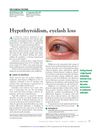
November 2020 in “Cleveland Clinic Journal of Medicine” Eyelash loss can be a sign of thyroid problems.
 September 2024 in “Egyptian Journal of Medical Human Genetics”
 This case report adds to the understanding of neurofibromatosis type 1 by documenting an Egyptian child with the condition alongside multiple unusual congenital anomalies, highlighting the importance of considering NF1 when these features are present.
3 citations
,
December 1991 in “PubMed” This report describes an infant who was diagnosed with Rothmund-Thomson syndrome, a rare genetic disorder characterized by diverse skin changes, short stature, and other developmental anomalies.
 37 citations
,
January 2023 in “Ophthalmology and Therapy”
37 citations
,
January 2023 in “Ophthalmology and Therapy” In this study, more than 25% of children experienced axial length shortening greater than 0.05 mm/year following repeated low-level red-light therapy.
2 citations
,
June 2019 in “The Journal of Dermatology” This report describes two cases of aplasia cutis congenita with hair collar signs and hemangioma, which may suggest neural tube defects, although imaging showed no bone or neural tissue abnormalities.
 October 2023 in “Indian Dermatology Online Journal”
 This case report describes a 1.5-month-old baby with Schimmelpenning-Feuerstein-Mims syndrome, manifested by skin and ocular abnormalities along with developmental delays and hearing loss observed later, highlighting the syndrome's progression and need for multidisciplinary management.
June 2022 in “Indian Journal of Ophthalmology/Indian journal of ophthalmology” This case report of an infant with AEC syndrome highlights the importance of early and aggressive management of ocular complications to preserve vision and reduce the risk of amblyopia.