 206 citations
,
September 2010 in “PLoS ONE”
206 citations
,
September 2010 in “PLoS ONE” This study found that using a Picosecond IR Laser (PIRL) on mouse skin led to less tissue damage and scarring compared to conventional surgical lasers and tools.

This study introduced a new laser-only method called EKA for acne treatment, which is reported to be safe, painless, and heat-free, showing promising results for both acne and scar repair in initial sessions without combining with LED light.
13 citations
,
July 2024 in “Medicina” This review investigates laser-induced Koebner-related reactions and highlights how different laser types, targets, and session frequencies affect the development of these skin responses, particularly in individuals with darker skin phototypes.
September 2021 in “Zenodo (CERN European Organization for Nuclear Research)” This study evaluated a new high-power, 810 nm diode laser for hair removal, finding it to be effective and safe, with a mean hair reduction of 74.4% in one session, and noted it worked efficiently on both large and small areas with minimal side effects.
20 citations
,
November 2014 in “JAMA dermatology” This study found that three treatments with the 810-nm diode laser improved skin texture and roughness/bumpiness in keratosis pilaris patients, although it did not reduce redness.
December 2025 in “Lasers in Surgery and Medicine”  10 citations
,
July 1997 in “Dermatologic Clinics”
10 citations
,
July 1997 in “Dermatologic Clinics” This article discusses the use of laser technology in hair transplantation and highlights its potential benefits and drawbacks, emphasizing its role in achieving natural results in cosmetic hair restoration.
5 citations
,
January 2000 in “Journal of Cutaneous Laser Therapy” Choose IPL for versatility and speed, ruby lasers for precision.
 9 citations
,
July 2022 in “Dermatology and Therapy”
9 citations
,
July 2022 in “Dermatology and Therapy” In this study, long-pulsed 755-nm alexandrite laser treatment for keratosis pilaris significantly improved skin roughness and redness, as well as follicular plug reduction, with good safety and patient satisfaction compared to a moisturizing lotion alone.
 14 citations
,
March 2012 in “Lasers in Surgery and Medicine”
14 citations
,
March 2012 in “Lasers in Surgery and Medicine” This study concluded that low-level fluence 810 nm diode laser therapy was generally well tolerated, safe, and effective for long-term hair reduction in a small sample of patients with various skin types.
2 citations
,
December 2016 in “International Journal of Surgery” 2 citations
,
December 2024 in “Microscopy Research and Technique” This study introduced a novel microscopy system using an Er3 + −doped femtosecond fiber laser, achieving detailed imaging of biological structures in plant and skin samples with improved spatial resolution for various applications, including in vivo imaging.
69 citations
,
August 1995 in “Annals of Plastic Surgery” This study showed that ultrapulse carbon dioxide laser ablation can precisely remove rabbit skin without scarring, facilitating normal skin and hair restoration within one month.
 April 2019 in “Archives of aesthetic plastic surgery”
 This study evaluated an 808-nm diode laser at different fluences for permanent axillary hair removal in Korean women and found that high-fluence treatment (14 J/cm2) effectively reduced hair density and thickness, with no significant difference in comfort compared to lower fluences.
 January 2000 in “Optics Letters”
 This study found that the maximum infrared temperature of laser-irradiated hair depends on melanin type, with eumelanin-rich hair reaching higher temperatures than pheomelanin-containing hair.
March 2026 in “Health Science Reports” Among individuals with skin types II and III, this study found the 755 nm laser more effective for axillary hair removal than the dual-wavelength laser, with a better safety profile and enduring results up to 12 months.
 January 2018 in “Springer eBooks”
 This review discusses the factors affecting laser hair removal results and adverse events, emphasizing the need for more research to determine optimal treatment parameters; it reports no new clinical findings.
15 citations
,
January 2008 in “PubMed” This article reviews considerations and requirements for performing laser hair removal and reports no new clinical results.
 3 citations
,
August 1995 in “Journal of Clinical Laser Medicine & Surgery”
3 citations
,
August 1995 in “Journal of Clinical Laser Medicine & Surgery” Using a CO₂ laser for hair transplants improves the surgery and may become important in future hair restoration.
December 2005 in “Springer eBooks” Laser hair removal is generally effective, with results varying by laser type and patient.
 May 2013 in “Proceedings of SPIE”
 In this study, the researchers demonstrated an automatic alignment method for beams in an electron pumped excimer laser system that achieved high precision and accuracy, with a reported alignment accuracy of 0.63μrad.
February 2020 in “Journal of Physics Conference Series” This study found that laser hair removal is optimal for light to moderate skin tones using 10-15 J/cm² at 755 nm and for dark skin with 4.5-10 J/cm² at 755-1064 nm.
3 citations
,
May 2023 in “PLoS ONE” This study found that while both professional and home-use lasers effectively reduced axillary hair, the professional Diode laser was significantly more effective, achieving 85-88% reduction compared to 46-52% with the home-use laser, which still offers some safety for users.
 11 citations
,
June 2005 in “Journal of Cosmetic Dermatology”
11 citations
,
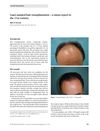
June 2005 in “Journal of Cosmetic Dermatology” Lasers in hair transplantation show promise but are not yet standard, with current methods causing some side effects and needles still being preferred for creating recipient sites.
6 citations
,
September 2025 in “Cosmetics” This study introduced laser-assisted exosome delivery and observed early signs of clinical improvement in two patients, though causality cannot be inferred from these preliminary, uncontrolled cases.
 January 1998 in “Lasers in Surgery and Medicine”
 This study found that both 5-ALA and Photofrin can effectively destroy human microvascular endothelial cells in vitro and cause tissue necrosis in vivo, with Photofrin showing greater efficacy at lower concentrations or power densities.
9 citations
,
June 2019 in “JAAD case reports” This report discusses laser hair removal for acne keloidalis nuchae, noting generally favorable outcomes but variability in lesion responsiveness and a need for standardized assessment criteria; it reports no new results.
85 citations
,
January 2002 in “Dermatologic Clinics” This article reviews the use of light-based technologies for hair removal, detailing different laser systems and treatment protocols, but reports no new clinical results.
 1 citations
,
March 2019 in “Lasers in Surgery and Medicine”
1 citations
,
March 2019 in “Lasers in Surgery and Medicine” This article contains the late-breaking abstracts from the 39th Annual Conference of the American Society for Laser Medicine and Surgery and does not present new research results.
26 citations
,
June 1993 in “Archives of Otolaryngology - Head and Neck Surgery” This study found that the endolaser technique using a small incision is as effective as standard forehead lifts for reducing glabellar frown lines and forehead creases with a shorter recovery time.