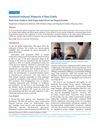
 November 2022 in “The Indian journal of chest diseases & allied sciences”
 This case report documents a rare instance of hair loss associated with isoniazid initiation in a 32-year-old male undergoing antitubercular treatment.
 January 2013 in “Dermatology”
 The ILDS Newsletter reported on efforts to support albinism patients in Tanzania and dermatological conferences.
4 citations
,
February 2024 in “Anais Brasileiros de Dermatologia”  April 2016 in “Journal of The American Academy of Dermatology”
 Ixekizumab is effective and safe for patients who did not improve with etanercept treatment for psoriasis.
 January 2020 in “Elsevier eBooks”
 This review discusses the potential health benefits of Indian gooseberries, including blood glucose management and cardiovascular health, and highlights the need for additional research; no new clinical results are reported.
August 2020 in “European Journal of Dermatology” This study identified three EDAR gene variants potentially linked to hypohidrotic ectodermal dysplasia in three Pakistani families, which could aid in genetic counseling for similar cases.
2 citations
,
January 2004 in “Linchuang pifuke zazhi” In a reported case, the use of ZD1839 (Iressa), an EGFR tyrosine kinase inhibitor, resulted in hair changes and acneiform eruptions as cutaneous side effects.
 September 2014 in “Hair transplant forum international”
 This article discusses the XV Congress of the Italian Society of Hair Restoration held in Ortigia and reports no clinical findings.
July 2017 in “Journal of Ayurveda and Integrated Medical Sciences” This study reported that Ayurvedic treatment involving the internal administration of Vidangarishta, Krimikutararasa, and Shatavari Guda, alongside external papaya exudate application, led to significant, rapid, and lasting improvements in alopecia areata in a week-long trial.
This study found that in an ex vivo model simulating alopecia areata, the DHODH inhibitor farudodstat reduced T-cell proliferation and MHC protein expression in hair follicles, suggesting it may protect against immune privilege collapse without cytotoxic effects.
This study demonstrated that the IVL-DrugFluidic® platform is effective for mass-producing finasteride-loaded polymeric microspheres for long-acting injectables, maintaining stable drug release without an initial burst for a month.
 October 2009 in “Reactions Weekly”
 A woman developed lupus after taking hydroxyurea for two years.
8 citations
,
July 2022 in “Journal of Ayurveda and Integrative Medicine” This case report suggests that shodhana and shamana treatments may facilitate hair regrowth in a patient with índralupta, with improvements observed within 15 days.
1 citations
,
February 2023 in “Pediatric Dermatology” This case report of an infant with IPEX syndrome highlights the importance of early recognition and treatment, as the patient experienced severe symptoms and succumbed before stem cell transplantation.
January 2026 in “Journal of Investigative Dermatology” This study found that 3D imaging may serve as a promising tool for objectively evaluating facial vitiligo repigmentation after treatment with upadacitinib.
2 citations
,
December 2024 in “eLife” This study observed that individuals with Down syndrome exhibit early immune dysregulation, including multi-organ autoimmunity and hypercytokinemia, and found that the JAK inhibitor tofacitinib showed a good safety profile and reduced skin pathology in a Phase II trial.
 November 2018 in “Springer eBooks”
 Children need early diagnosis and treatment for iron-deficiency anemia to prevent learning problems and promote health.
2 citations
,
September 2024 in “Internal Medicine Journal” In this case study, upadacitinib treatment for a patient with coexisting ulcerative colitis and alopecia universalis resulted in significant hair regrowth and maintained UC remission, suggesting potential for treating similar dual-diagnosed cases.
3 citations
,
July 2025 in “International Immunopharmacology” 3 citations
,
May 2024 in “Indian Journal of Dermatology” In this case report, researchers identified a potential adverse skin reaction, called SDRIFE or Baboon syndrome, caused by the drug tofacitinib in a 19-year-old woman being treated for alopecia subtotalis, leading the authors to recommend discontinuation of the drug.
March 2022 in “Institutional Repositories DataBase (IRDB)” This system overview describes the UTokyo Repository's role in storing and providing online access to digital resources from the University of Tokyo, reporting no new empirical findings or research results.
July 2019 in “International Society of Hair Restoration Surgery” This course overview discusses educational sessions on hair restoration surgery and FUE techniques and reports no new research findings.
 February 2026 in “Indian Journal of Dermatology”
 This case report found that a 48-year-old woman with idiopathic twenty-nail dystrophy experienced significant improvement in nail appearance after six months of treatment with oral Upadacitinib.
July 2026 in “Frontiers in Immunology” In this case report, a 28-year-old male with severe atopic dermatitis, prurigo nodularis-like lesions, and alopecia areata showed rapid improvements in skin and hair following treatment with the JAK1 inhibitor, ivarmacitinib, suggesting its potential benefit for complex AD phenotypes with immune-mediated hair loss.
32 citations
,
January 2012 in “Chinese Medicine” In this study, a hydro-alcoholic extract of Urtica dioica demonstrated in vitro antioxidant activity, potentially linked to its ferulic acid content.
May 2008 in “10th European Congress of Endocrinology” This study discovered that TTR is expressed in the human placenta as early as 6 weeks gestation, with increased levels in the first trimester potentially facilitating thyroid hormone delivery to the fetus.
 October 2023 in “Journal of Family Medicine and Primary Care”
 This survey in Riyadh Province found that most participants identified malnutrition as the leading cause of iron deficiency anemia and reported symptoms like weakness and cold extremities.
3 citations
,
July 2025 in “British Journal of Dermatology” Cinainu is effective and safe for treating children's alopecia areata.
This study investigated the safety and efficacy of IV iron maltoside 1000 in treating iron-deficiency anemia among children with IBD and found a significant increase in hemoglobin levels by 6 weeks, maintained for up to a year, with minimal side effects reported.
Ivarmacitinib effectively regrows hair in severe alopecia areata.