 16 citations
,
January 2007 in “Actas dermo-sifiliográficas/Actas dermo-sifiliográficas”
16 citations
,
January 2007 in “Actas dermo-sifiliográficas/Actas dermo-sifiliográficas” This review discusses frontal fibrosing alopecia and reports no clinical results; the authors note that no therapeutic options tested, including corticosteroids, finasteride, and minoxidil, have shown clear benefits.
 41 citations
,
July 2017 in “Journal of The American Academy of Dermatology”
41 citations
,
July 2017 in “Journal of The American Academy of Dermatology” This study observed that frontal fibrosing alopecia also occurs in men, with clinical features and areas of involvement similar to those seen in women, but often affecting sideburns and facial hair.
January 2026 in “Elsevier eBooks” 40 citations
,
January 2022 in “Frontiers in Chemistry” This study found that a microneedle array patch using a blend of kangfuxin, chitosan, and fucoidan significantly accelerated wound healing in rats by enhancing epithelial thickness and collagen deposition.
92 citations
,
May 2004 in “Journal of Investigative Dermatology” August 2025 in “Biomolecules” This review explores the role of FGF signaling in hair follicle development and highlights its potential as a new therapeutic target for hair loss, which could surpass existing treatments in terms of efficacy and safety.
 April 2018 in “Journal of Investigative Dermatology”
 This study found that Fgf20 signaling facilitates fibroblast migration and influences dermal condensate cell development during hair follicle morphogenesis by supporting cellular activities such as cell cycle exit and specific cell shape adoption.
32 citations
,
July 2017 in “Oncotarget” This study found that intermittent treatment with FTI lonafarnib and sulforaphane may be a promising therapeutic approach for children with Hutchinson-Gilford progeria syndrome, as it improved the cellular phenotype.
 23 citations
,
November 2018 in “Journal of the European Academy of Dermatology and Venereology”
23 citations
,
November 2018 in “Journal of the European Academy of Dermatology and Venereology” This study observed that frontal fibrosing alopecia is increasingly diagnosed in Italian Caucasian females, often showing premenopausal onset and eyebrow alopecia as an early sign.
 6 citations
,
January 2019 in “Medical Hypotheses”
6 citations
,
January 2019 in “Medical Hypotheses” This hypothesis article explores frontal fibrosing alopecia as a potential autoimmune condition and calls for future research to investigate this possibility, but reports no new clinical results.
 3 citations
,
June 2021 in “PLOS ONE”
3 citations
,
June 2021 in “PLOS ONE” This study found that topical application of the BRAF inhibitor vemurafenib improved wound healing and promoted hair follicle regeneration in a diabetic murine model.
7 citations
,
August 2019 in “American Journal of Dermatopathology” This study found that limb hair loss in frontal fibrosing alopecia is inflammatory and permanent, but lacks the classic scarring features seen in scalp alopecia, prompting potential misdiagnosis as alopecia areata.
7 citations
,
October 2020 in “Science and Innovations in Medicine” This review discusses how fibroblast metabolic processes and life span are influenced by the malate dehydrogenase shuttle system and highlights factors affecting fibroblast proliferative activity, without presenting new experimental results.
In this study, FGF5-knockout Dorper sheep generated using CRISPR/Cas9 showed increased fine-wool and active hair-follicle density, suggesting potential therapeutic applications for androgen alopecia.
Folicrex may help with hair growth and health but lacks clinical evidence.
2 citations
,
September 2021 in “Anais Brasileiros de Dermatologia” Increased sunscreen use may be linked to frontal fibrosing alopecia in Hispanic females.
August 2021 in “Journal of the American Academy of Dermatology” This article reviews the use of hair filler fibers for improving the appearance of thinning hair and calls for more studies on patient satisfaction and side effects, without providing new clinical results.
January 2016 in “Indian dermatology online journal” This case study diagnosed a 60-year-old woman with frontal fibrosing alopecia after histopathological analysis showed characteristic scarring patterns in the hairline area.

This article discusses the features and increasing prevalence of frontal fibrosing alopecia, a type of scarring hair loss, and reports no new clinical results.

This study found that melatonin upregulates LncRNA16913.1, which sequesters chi-miR-195-5p to release FZD6 and enhance fibroblast proliferation in cashmere goat skin, suggesting a regulatory mechanism within the lncRNA-miRNA-mRNA cascade in vitro.
2 citations
,
February 2019 in “PubMed” In this study, Biofibre® artificial hair implantation showed high patient satisfaction and low fiber loss over three years among those with androgenetic alopecia, suggesting its safety and effectiveness for both genders with limited donor supply or needing quick results.
 20 citations
,
January 2016 in “Intractable & Rare Diseases Research”
20 citations
,
January 2016 in “Intractable & Rare Diseases Research” In this clinical experience, treating frontal fibrosing alopecia with oral finasteride, hydroxychloroquine, tacrolimus, and excimer laser was associated with optimal results in patients with active inflammation.
 16 citations
,
January 2017 in “Anais brasileiros de dermatologia/Anais Brasileiros de Dermatologia”
16 citations
,
January 2017 in “Anais brasileiros de dermatologia/Anais Brasileiros de Dermatologia” This case study discusses a postmenopausal woman's frontal fibrosing alopecia and lichen planus pigmentosus, controlled with corticosteroids and finasteride, highlighting diagnostic and therapeutic challenges in scarring alopecia.
 26 citations
,
June 2018 in “Australasian Journal of Dermatology”
26 citations
,
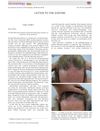
June 2018 in “Australasian Journal of Dermatology” Stopping sunscreen use on the forehead led to hair regrowth in a woman with frontal fibrosing alopecia.
 July 2026 in “bioRxiv (Cold Spring Harbor Laboratory)”
 This study identified a new FAK isoform, FAKΔe4, which is regulated by ECM stiffness and affects cell migration, invasion, and mechanosensing in human-derived data and engineered models.
55 citations
,
May 1995 in “The journal of investigative dermatology/Journal of investigative dermatology” 1 citations
,
October 2024 in “The American Journal of Gastroenterology” This case study suggests that the use of the dietary supplement Nutrafol may have led to drug-induced liver injury in a 26-year-old woman, as evidenced by increased liver enzymes and bilirubin levels which improved after stopping the supplement.
 5 citations
,
August 2018 in “PubMed”
5 citations
,
August 2018 in “PubMed” This case report documented successful full hair regrowth in an 8-year-old with alopecia universalis after oral tofacitinib treatment, but mild headaches led to discontinuation.
This study found that various reduced folates effectively penetrated an in vitro skin model, promoted cell proliferation and migration, and may enhance wound healing, suggesting potential for topical treatment in skin conditions.
 March 2024 in “Advanced science”
 This study observed that a novel extracellular matrix hydrogel made from human fibroblast-derived matrix improved wound healing in animal models, showing significant effects such as hair follicle formation, reduced inflammation, enhanced pro-healing growth factor levels, and interaction with macrophages, compared to traditional collagen hydrogels.