
In this retrospective cohort study of individuals diagnosed with late-onset systemic lupus erythematosus after age 80, most were women, joint and skin issues were prevalent, average survival was 4.5 years, and men had notably lower survival rates with higher mortality.
 May 2023 in “Siriraj Medical Journal”
 This study demonstrated that the Thai version of the FDLQI is a valid and reliable tool for assessing the quality of life of family members of patients with dermatological diseases.
Topical corticosteroids are effective for skin conditions but can have side effects.
 January 2023 in “Frontiers research topics”
 This article describes the Frontiers journal series, highlighting its open-access approach and tiered publishing system, but it presents no new empirical findings.
 December 2022 in “Research Square (Research Square)”
 This study discusses the development of deep learning models for diagnosing skin disorders and notes challenges such as lack of data for darker skin tones, without providing new clinical results.
 October 2022 in “Journal of Pharmaceutical Negative Results”
 This review examines the therapeutic effects of photobiomodulation on severe medical illnesses but reports no new clinical results; it emphasizes its potential in neurology, pulmonology, inflammation, dermatology, wound healing, and oncology.
 September 2022 in “Revista de la Asociación Colombiana de Dermatología y Cirugía Dermatológica”
 This review discusses mucocutaneous manifestations associated with Covid-19, classifies the lesions, and describes their characteristics and treatments but reports no new clinical findings.
 June 2022 in “Journal of the turkish academy of dermatology”
 This study from Turkey observed that the COVID-19 pandemic adversely affected dermatology patients, particularly by interrupting treatments and restricting outpatient visits.
March 2022 in “Journal of Pakistan Association of Dermatologists” This case report describes the association of alopecia areata with COVID-19 in a 7-year-old girl.
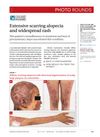 March 2022 in “The Journal of Family Practice”
 Following treatment plans is crucial to prevent worsening skin and hair conditions.
 January 2022 in “Turkiye Klinikleri Journal of Dermatology”
 This study found that COVID-19 patients with skin symptoms had a shorter hospital stay than those without, suggesting these signs may indicate a different disease course.
November 2021 in “Zenodo (CERN European Organization for Nuclear Research)” This article reviews the growing interest in integrating alternative therapies with conventional dermatology but does not provide new clinical results; it emphasizes the importance of complementary medicine in addressing treatment challenges.
 October 2021 in “Dermatology Reports”
 This study describes a case where a patient with alopecia totalis treated with the JAK inhibitor tofacitinib showed hair regrowth but experienced worsened facial acne.
 October 2021 in “Journal of Investigative Dermatology”
 This study found that COVID-19 pandemic restrictions may have led to delayed access to dermatological care for leprosy patients, resulting in increased bacillary load and disease severity.
 August 2021 in “Annals of Agricultural and Environmental Medicine”
 This review provides a detailed analysis of frontal fibrosing alopecia, focusing on its prevalence in postmenopausal Caucasian women, associated comorbidities, and potential autoimmune, genetic, hormonal, and environmental factors; it emphasizes the need for improved understanding to enhance diagnosis and treatment.
 August 2021 in “Journal of medical science and clinical research”
 This case report describes an 11-month-old infant with Biotinidase deficiency who exhibited multifocal seizures, neuroregression, alopecia, and skin issues, highlighting prompt diagnosis and the dramatic clinical response to biotin treatment.
 February 2021 in “PDEAS International Journal of Research in Ayurved and Allied Sciences”
 This review highlights the lack of formal clinical research on Ayurvedic approaches to hair and scalp disorders despite Ayurveda's long history and global interest in botanical dermatology.
 December 2020 in “Journal of medical science and clinical research”
 This study analyzed dermatology cases in children during the COVID-19 lockdown in India, finding that most conditions, including pruritic and non-emergency skin diseases, could have been managed through teleconsultation instead of in-person visits.
 July 2020 in “International Journal of Dermatology Venereology and Leprosy Sciences”
 In this study, dermatological changes were highly prevalent among postmenopausal women, with xerosis, pigmentary changes, and hair thinning being the most common findings, suggesting such changes are often overlooked in clinical practice.
 January 2020 in “Jornal Vascular Brasileiro”
 This review discusses the mechanisms behind alopecia during anticoagulation therapy and current treatments but reports no new clinical results.
July 2019 in “Dermatology practical & conceptual” This report presents personal observations of alopecia areata in twins with autoimmune thyroiditis and suggests a possible link, though it does not provide new clinical results.
February 2019 in “Veterinarski glasnik” Guinea pigs' skin issues in the lumbar area may be caused by dermatological problems and need proper care.
 April 2018 in “Nasza Dermatologia Online”
 This case report describes an 8-year-old child with Down's syndrome who presented with eruptive syringomas on the face and hand.
 January 2018 in “Haydarpaşa Numune Hastanesi tıp dergisi”
 This review discusses the diagnosis and treatment of diffuse alopecia but reports no new results; the authors emphasize the importance of detailed history and examination for accurate diagnosis.
January 2016 in “cIRcle (University of British Columbia)” This literature review discusses the need for a clinical practice guideline to help Canadian Nurse Practitioners in diagnosing and managing PCOS, noting its complexity and lack of existing guidelines.
January 2016 in “SHILAP Revista de lepidopterología” This paper presents a case where alopecia was associated with the use of escitalopram and improved after switching to duloxetine, alongside a literature review of antidepressant-related alopecia.
December 2015 in “DOAJ (DOAJ: Directory of Open Access Journals)” This review analyzes the psychoemotional impact of alopecia on women, highlighting how changes in appearance and treatment challenges can affect their emotional well-being and treatment efficacy.
 December 2015 in “Turkderm”
 This study found that 30.5% of patients at an outpatient clinic reported using complementary and alternative medicine, with many believing in its positive effects despite limited knowledge of potential side effects.
 March 2015 in “Surgery (oxford)”
 This article reviews the challenges patients face after critical illness and highlights the potential benefits of individualized rehabilitation programs, though it reports no new clinical results.
 January 2015 in “Turkiye Klinikleri Journal of Ophthalmology”
 This article examines the morphological and physiological characteristics of eyelash follicles and offers clinical management suggestions for conditions like eyelash loss and trichomegaly, but presents no new clinical results.