 1 citations
,
January 2018 in “Journal of Neurology Research”
1 citations
,
January 2018 in “Journal of Neurology Research” This case report describes a 23-year-old male who developed leukopenia, thrombocytopenia, and rash associated with lamotrigine treatment, emphasizing the importance for clinicians to monitor for serious side effects, especially early in treatment.
 5 citations
,
January 2014 in “Journal of Cutaneous and Aesthetic Surgery”
5 citations
,
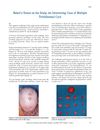
January 2014 in “Journal of Cutaneous and Aesthetic Surgery” A woman had 13 non-cancerous cysts on her scalp successfully removed in one surgery.
 June 2026 in “World Journal of Gastrointestinal Pathophysiology”
 This review consolidates current knowledge about Cronkhite-Canada syndrome, highlighting its symptoms, diagnostic challenges, and evolving treatment strategies, but reports no new clinical results.
 5 citations
,
March 2013 in “International journal of surgical pathology”
5 citations
,
March 2013 in “International journal of surgical pathology” This case report illustrates that a diagnosis of Cronkhite-Canada syndrome can be made without the presence of polyps, as demonstrated by resolving symptoms with steroid treatment.
3 citations
,
February 2020 in “The Egyptian Rheumatologist” This case report from Tishreen Hospital describes the rare presentation of lupus erythematosus tumidus and autoimmune thyroid dysfunction as initial manifestations of systemic lupus erythematosus, highlighting the importance of early diagnosis for better outcomes.
33 citations
,
December 2005 in “British Journal of Clinical Pharmacology” This study found that the Transdermal Delivery System efficiently delivers testosterone systemically and showed bioequivalent hormone concentrations to a known topical gel in healthy males.

In this study, researchers developed de novo designed hetero-bifunctional proteins as an alternative approach for targeted protein degradation, successfully targeting BCL-xL for degradation in cells and inducing apoptosis, which may expand the range of addressable E3 ligases and disease targets.
 16 citations
,
May 2013 in “Australasian Journal of Dermatology”
16 citations
,
May 2013 in “Australasian Journal of Dermatology” In this study, detailed examinations of alopecic lesions in two female Cronkhite-Canada syndrome patients suggested hair regrowth might occur without systemic corticosteroids if not required for gastrointestinal treatment, and hair loss may begin with anagen-telogen transition.
This study concluded that the combination of all-trans-retinoic acid and tocopherol-α is not recommended for treating del(5q) myelodysplastic syndromes due to low efficacy and high incidence of adverse effects.
 December 2025 in “TURKDERM”
 This article discusses Trikostazis spinuloza (TS), a dermatological condition often misdiagnosed, and reviews its demographic, clinical, and dermoscopic features, but reports no new clinical results.
147 citations
,
August 2005 in “The Plant Cell” This study identified a key Arabidopsis thaliana gene, TIP1, whose product is involved in S-acylation crucial for normal plant cell growth, particularly affecting root hair development.
 March 2025 in “American Journal of Medical Genetics Part A”
 In this study, researchers found that mosaic PLCD1 hotspot variants, even without the recognized germline "risk allele," may be a rare but significant genetic cause of nevus trichilemmocysticus, warranting DNA testing and sensitive sequencing technologies for accurate diagnosis.
 July 2018 in “Elsevier eBooks”
 This chapter reviews traction alopecia, discusses its clinical presentation and severity grading, and reports no new clinical results; the authors highlight controversies in its treatment and prevention strategies.
September 2017 in “The journal of investigative dermatology/Journal of investigative dermatology” The researchers reported that TGM2 appears to play a crucial role in sebocyte differentiation and may act as a negative regulator of lipid metabolism in sebaceous glands.
7 citations
,
April 1979 in “The Journal of Pediatrics” October 2010 in “eCommons (Cornell University)” This case report highlights that cutaneous epitheliotropic lymphoma in dogs can present with various skin lesions, such as depigmentation, making diagnosis challenging for veterinarians.
1 citations
,
September 2025 in “Viruses” This literature review observed that patients with thrombophilic conditions may experience distinct and more severe Long COVID symptoms, potentially linked to chronic hypercoagulation post-COVID-19 infection.
3 citations
,
February 2018 in “Aesthetic plastic surgery” This study found that the locked cheek lift technique effectively corrects cheek gravitational migration and reduces the lid cheek distance with minimal complications, maintaining results for over a year.
 1 citations
,
January 2017 in “Social Science Research Network”
1 citations
,
January 2017 in “Social Science Research Network” This paper suggests that to better protect traditional and indigenous knowledge, TKDL should expand its database or establish a separate confidential resource for indigenous, tribal, and nomadic communities.
February 2022 in “Actas Dermo-Sifiliográficas” This abstract presents a clinical case of a woman with traction alopecia and discusses trichoscopic findings without reporting any new research results.
 January 2017 in “Clinical approaches and procedures in cosmetic dermatology”
 This review explores clinical studies on low-level laser therapy (LLLT) for alopecia and suggests it may benefit patients unresponsive to conventional treatments, but larger studies are needed to confirm efficacy.
 2 citations
,
January 2006 in “International Journal of Cosmetic Science”
2 citations
,
January 2006 in “International Journal of Cosmetic Science” This study investigated the penetration of a low-molecular-weight cationic conditioning compound into the hair cortex and suggests it may improve hair's fatigue resistance.
21 citations
,
November 2014 in “Cytotechnology” 1 citations
,
January 2024 in “Clinical Cosmetic and Investigational Dermatology” This case report discusses a 58-year-old female diagnosed with oral lichen sclerosus, an extremely rare form of the disorder, which improved following treatment with topical and intralesional corticosteroids, highlighting the importance of recognizing this rare condition in the oral mucosa.
 7 citations
,
July 2020 in “Immunological Investigations”
7 citations
,
July 2020 in “Immunological Investigations” This study observed that the rs231775 CTLA4 genetic variant was more prevalent in Alopecia Areata patients than controls, particularly among those with severe disease.
 10 citations
,
July 2022 in “Journal of Medicinal Chemistry”
10 citations
,
July 2022 in “Journal of Medicinal Chemistry” This article discusses the potential for combining PROTACs with other therapeutic modalities in drug discovery and reports no clinical results.
2 citations
,
January 2014 in “Journal of Cytology & Histology” In a mouse model, this study found that LAM/TSC cells invaded the uterus and increased angiogenesis, while anti-EGFR antibody and rapamycin effectively reduced cell presence and blood vessel proliferation.
8 citations
,
January 2014 in “Indian Dermatology Online Journal” This article presents a case of trichostasis spinulosa, a common but often unrecognized disorder, diagnosed through dermoscopic examination of black macules revealing bundled vellus hairs, with the patient declining treatment.