January 2025 in “Updates in clinical dermatology” COVID-19 vaccines can cause minor skin reactions, including those related to Bullous Pemphigoid, but these usually resolve on their own.
 March 2024 in “Tissue and cell/Tissue & cell”
 This study found that in human hair bulbs, telomerase is present mainly in the nuclei of cells undergoing proliferation, particularly in the matrix epithelium during the anagen phase, and sparsely in the outer root sheath during late catagen and telogen phases.
September 2023 in “Journal of the American Academy of Dermatology” Bullous pemphigoid can look like erythema multiforme, so awareness is needed for proper treatment.
July 2023 in “Media Dermato Venereologica Indonesiana” This case study highlights that RDEB-mitis can be misdiagnosed in older adults, emphasizing the importance of accurate diagnosis as it does not require immunosuppressive treatment.
 April 2023 in “Journal of Investigative Dermatology”
 This study found that mRNA booster vaccinations for SARS-CoV-2 increased protective antibodies without worsening autoimmune disease activity in patients with pemphigus and bullous pemphigoid.
 April 2023 in “The journal of investigative dermatology/Journal of investigative dermatology”
 This study found that using trypsin digestion to extract keratinocytes from the hair follicle bulge results in a higher yield and faster growth of stem keratinocytes compared to the explant method.
 October 2022 in “International journal of research in dermatology”
 This case report documents a 31-year-old woman with bullous SLE who showed improvement with high-dose parenteral steroids and dapsone, with ongoing follow-up due to potential kidney involvement.
November 2021 in “Frontiers in medicine” This case study documents the first reported instance of bullous lichen planus/systemic lupus erythematosus overlap syndrome with initial hair loss, which improved with treatment including glucocorticoids and immunosuppressive drugs.
January 2021 in “Faculty Opinions – Post-Publication Peer Review of the Biomedical Literature” This study found that GDNF promotes hair formation and wound repair in mice by enhancing the function of bulge stem cells.
 January 2016 in “Dermatology Online Journal”
 This case report describes a pregnant woman who developed bullous impetigo, which resolved after treatment with clindamycin, suggesting that this condition should be considered in similar blisters in pregnant women.
 May 2015 in “Journal of Investigative Dermatology”
 In this study, Wnt-3a was found to play an important role in partially maintaining and expanding epithelial skin stem cells in vitro, suggesting potential for in vitro stem cell culture without feeder cells.
 April 2014 in “Significance”
 Unconventional home remedies can sometimes show surprising results.
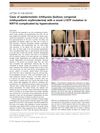 October 2011 in “Journal of dermatology”
 A man with a rare skin condition and a new gene mutation developed high calcium levels due to his treatment.
January 2011 in “Shiyong kouqiang yixue zazhi” This study found that dermal papilla cells and bulge stem cells can potentially be used to reconstruct hair follicles, as hair follicle-like structures were observed after culturing under a rat's renal capsule.
April 2010 in “Cancer Research” In this study, Stat3 activation in transgenic mice led to a decrease in stem cells in the hair follicle bulge, suggesting its crucial role in epidermal growth and stem cell maintenance.
June 2006 in “Experimental dermatology” This study found that, while hair follicle bulge stem cells are important for hair follicle survival and epidermal regeneration after wounding, the epidermis maintains itself independently of these cells under normal conditions.
 February 2021 in “Journal of The American Academy of Dermatology”
 This study observed that fibrosis occurs in the bulge region of hair follicles affected by androgenetic alopecia and is correlated with the hair miniaturization process.
387 citations
,
November 2003 in “Journal of Investigative Dermatology” The K15 promoter effectively targets stem cells in the hair follicle bulge.
189 citations
,
July 2009 in “The Journal of clinical investigation/The journal of clinical investigation” This review discusses how research on keratin biology has enhanced the understanding of epidermolysis bullosa simplex and indicates potential new therapeutic approaches, but it presents no new experimental results.
107 citations
,
May 1999 in “Archives of Dermatological Research” In this study, the immunohistochemical and lectin binding profiles of basal cell carcinoma closely resembled those of the outer root sheath of vellus hair follicles, suggesting a potential histochemical relationship.
82 citations
,
November 1985 in “Archives of Dermatology” This case report describes a black male newborn who developed bullae that healed with hypopigmentation, linked to collagenolysis and RER vacuoles potentially containing proteolytic enzymes.
 58 citations
,
June 1987 in “Archives of Dermatological Research”
58 citations
,
June 1987 in “Archives of Dermatological Research” This study found that epidermal and fibroblast growth factors increased proliferation of human hair bulb papilla cells and root sheath fibroblasts in vitro, while hydrocortisone decreased it and minoxidil had no effect.
 46 citations
,
April 2014 in “PLOS ONE”
46 citations
,
April 2014 in “PLOS ONE” This study found that compromised antioxidant activity in gray hair follicles affects both mature melanocytes and their immature precursors, linked to down-regulation of melanogenesis-related genes.
44 citations
,
January 2017 in “Journal of Investigative Dermatology” This study identified KLHL24 as a new gene linked to a subtype of epidermolysis bullosa simplex, highlighting its role in unresolved cases by involving a degradation-resistant truncated protein impacting keratin turnover.
40 citations
,
November 2021 in “International Journal of Molecular Sciences” This review highlights the role of keratin mutations in epidermolysis bullosa simplex and the resulting chronic inflammation, but it presents no new experimental findings.
 39 citations
,
January 2015 in “Annals of dermatology/Annals of Dermatology”
39 citations
,
January 2015 in “Annals of dermatology/Annals of Dermatology” This review discusses three newly identified forms of epidermolysis bullosa related to mutations in DST-e, EXPH5, and ITGA3, offering insights into their genetic and clinical characteristics but reports no new clinical results.
33 citations
,
October 2014 in “Veterinary Dermatology” This review discusses the molecular biology, diagnosis, and pathology of epidermolysis bullosa in animals and reports no new clinical findings.
 32 citations
,
April 2013 in “Anais Brasileiros de Dermatologia”
32 citations
,
April 2013 in “Anais Brasileiros de Dermatologia” This article reviews the diagnosis and management of inherited epidermolysis bullosa and reports no new clinical findings; it emphasizes the importance of clinical and histopathological evaluation.
26 citations
,
June 2004 in “Clinical Genetics” This study describes a case of epidermolysis bullosa simplex where maternal somatic and germline mosaicism was identified, highlighting the significance for genetic counseling in sporadic cases.
25 citations
,
October 1975 in “Journal of Cutaneous Pathology” This study found that in alopecia areata, hair bulbs are blocked in an early growth stage due to impaired metabolic function in the surrounding connective tissue, hindering hair growth.