 10 citations
,
January 2011 in “Case reports in dermatological medicine”
10 citations
,
January 2011 in “Case reports in dermatological medicine” This report documented a successful and sustained hair restoration surgery using follicular unit transplantation for temporal triangular alopecia, lasting over six years.
 May 2022 in “Annals of Oncology”
 This study found that photobiomodulation may accelerate hair regrowth one month after chemotherapy in breast cancer patients, but no significant differences were observed at two and three months post-therapy.
 April 2017 in “Journal of Dermatological Science”
 This study found that B cells have dual roles in tumor immunity, with regulatory B cells potentially hindering immune responses against tumors in the melanoma mouse model.
 October 2022 in “Journal of ophthalmology”
 This review discusses the implementation and mechanisms of photobiomodulation therapy in various medical fields, including ophthalmology, and reports no new clinical results.
 January 2017 in “International journal of science and research”
 This review discusses treatment options for trichotillomania, focusing on cognitive-behavioral interventions and promising developments in combined pharmacotherapy and therapy approaches, but reports no new findings.
July 2025 in “Indian Dermatology Online Journal” This study reports a unique case of trichotillomania incognita in an adult female that mimicked female pattern hair loss, highlighting the importance of trichoscopy and histology for accurate diagnosis.
October 2006 in “Urology” The study found that different criteria led to different patient groups in the CombAT study compared to the MTOPS study.
March 2022 in “Oncology Times” In this study, tebentafusp-tebn improved overall survival in patients with metastatic uveal melanoma compared to standard therapies, despite higher rates of significant adverse events.
24 citations
,
September 2019 in “Experimental cell research” This study found that BMP2 increased PTEN expression and induced autophagy, promoting hair follicle stem cell differentiation in both in vitro models and a mouse wound model.
 56 citations
,
March 2010 in “Journal of Dermatology”
56 citations
,
March 2010 in “Journal of Dermatology” This review provides a synopsis of 53 cases of temporal triangular alopecia, noting its frequent detection in early childhood and potential association with congenital diseases, but it reports no new clinical findings.
 176 citations
,
January 2003 in “Journal of Investigative Dermatology”
176 citations
,
January 2003 in “Journal of Investigative Dermatology” This review summarizes the roles of bone morphogenetic proteins in the development and regulation of normal and diseased skin, but it does not provide new clinical results.
 77 citations
,
January 1980 in “Carcinogenesis”
77 citations
,
January 1980 in “Carcinogenesis” This study found that TPA was significantly more effective than mezerein in inducing dark basal keratinocytes in mouse skin, which may be important in early tumor promotion stages.
January 2023 in “Indian Dermatology Online Journal” This case report identifies a 23-year-old man with congenital triangular alopecia, a non-scarring alopecia characterized by preserved follicles and vellus hair, for which unnecessary interventions should be avoided.
 January 2024 in “JCEM case reports”
 In this clinical case report, a man with Birt Hogg Dube syndrome presented with parathyroid cancer, the first such case according to the authors, highlighting a potential link between Folliculin gene mutations and parathyroid cancer development.
5 citations
,
June 2022 in “Biophysical Journal” This study used a probabilistic Boolean network model to explore hair follicle cell fate regulation and predicted that varying TGF-β levels, in coordination with BMP and TNF, can influence either apoptosis or cell proliferation during different follicle growth stages.
18 citations
,
April 2016 in “Molecular Genetics and Genomics” This study suggests that thymosin beta 4 may regulate hair growth by influencing VEGF and MMP-2 levels through the Wnt/β-catenin/Lef-1 signaling pathway in mouse models.
 September 2023 in “bioRxiv (Cold Spring Harbor Laboratory)”
 This study describes the use of a genetically engineered mouse model, mTurquoise2-Col4a1, to fluorescently label collagen IV and observe basement membrane dynamics during skin development, revealing its stability and pliability during rapid growth phases.
 June 2023 in “British journal of dermatology/British journal of dermatology, Supplement”
 This case report describes a 15-year-old girl with features of Becker naevus syndrome, highlighting the importance of DNA analysis from skin to confirm the diagnosis after 9 years of symptoms.
 1 citations
,
January 2013 in “International Journal of Trichology”
1 citations
,
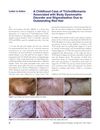
January 2013 in “International Journal of Trichology” A girl with red hair developed hair-pulling and body image disorders after being bullied for her hair color.
December 2014 in “Journal of Biomedical Research” In a mouse model of peripheral vascular disease, this study found that recombinant thymosin β4 treatment increased expression levels of certain proteins, promoting angiogenesis.
July 2024 in “Skin Appendage Disorders” This study reviews literature showing that trichotillomania significantly reduces quality of life and emphasizes that effective treatment requires an interdisciplinary approach involving dermatology and psychiatry to address its psychiatric component.
21 citations
,
February 1988 in “Toxicology” This study found that high doses of TCB caused severe toxicity in cotton top marmoset monkeys, with clinical and histological changes similar to those in humans and other primates exposed to PCBs.
 80 citations
,
June 2000 in “Modern Pathology”
80 citations
,
June 2000 in “Modern Pathology” Long-standing benign tumors can become cancerous, especially in people with weakened immune systems.
110 citations
,
April 2009 in “Cell Motility and the Cytoskeleton” This review discusses the intracellular activity of β-thymosins and their role in modulating the actin cytoskeleton, but it reports no new experimental results.
 July 2023 in “Journal of Microbiology and Biotechnology”
 This study found that oral administration of Terminalia bellirica enhanced hair growth in testosterone-suppressed conditions in both human cell and mouse models, outperforming finasteride, a current commercial hair loss treatment.
 83 citations
,
January 2001 in “American journal of clinical dermatology”
83 citations
,
January 2001 in “American journal of clinical dermatology” This review discusses the clinical features of trichotillomania and the challenges in its diagnosis and treatment, reporting no new clinical findings while highlighting the need for specialized therapy and better therapeutic options.
40 citations
,
May 2005 in “Journal of Cell Science” In this study, transgenic mice expressing a truncated form of latent transforming growth factor-β-binding protein exhibited altered hair cycles due to increased active transforming growth factor-β, impacting keratinocyte proliferation and hair cycle phases.
9 citations
,
January 2007 in “Journal of dermatological treatment” This study found that applying 2.5% testosterone gel increased facial terminal hairs in young males with beta-thalassemia major and was well tolerated.
 1 citations
,
November 2002 in “Journal of dermatology”
1 citations
,
November 2002 in “Journal of dermatology” This study investigated the histogenetic relationship between basal cell carcinoma and hair follicles, revealing specific staining patterns of a monoclonal antibody in different skin tissues.
221 citations
,
July 2012 in “Proceedings of the National Academy of Sciences of the United States of America” This study found that the circadian clock in mouse skin regulates cell proliferation and affects sensitivity to UVB-induced DNA damage, with potential implications for understanding human skin cancer risk.