March 2005 in “Journal of the American Academy of Dermatology” Recognizing minor skin lesions can help identify serious cancer syndromes.
 September 2023 in “Journal of the American Academy of Dermatology”
 This study discusses calcinosis cutis and alopecia totalis, highlighting the need for thyroid disease screening in children with alopecia areata, especially those with a history of Down syndrome or signs of potential thyroid dysfunction.
June 2025 in “Indian Journal of Dermatology” This article reports a case of late onset linear and unilateral basaloid follicular hamartoma in an elderly male, highlighting the clinical presentation, histopathological findings, and planned treatment approach.
 October 2023 in “Indian dermatology online journal”
 This report describes a case study of a 23-year-old female exhibiting multiple trichodiscomas, a type of benign tumor of the hair follicular discs common in familial cases and potentially linked to Birt-Hogg-Dube syndrome, though genetic testing was not performed due to financial constraints.
 21 citations
,
September 2015 in “Journal of the European Academy of Dermatology and Venereology”
21 citations
,
September 2015 in “Journal of the European Academy of Dermatology and Venereology” This review examines the diagnostic significance of yellow and orange colors in skin lesions and concludes that their role is often underrepresented in the literature.
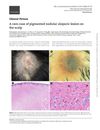
This study reported the case of a 30-year-old man with a bluish-grey scalp nodule that developed over a previously stable hairless plaque, revealing histopathological features consistent with epithelioid cell nests and spindle-shaped dermal melanocytes embedded in collagen.
 June 2006 in “British Journal of Dermatology”
 The document reports unique growth lines in a child after Stevens-Johnson syndrome, skin reaction from parsnips and sun in a girl, and itchy skin with xanthomas in a boy with Alagille syndrome.
 1 citations
,
April 2016 in “British Journal of Dermatology”
1 citations
,
April 2016 in “British Journal of Dermatology” Buschke-Ollendorff syndrome is a rare genetic disorder causing skin and bone changes, with some cases also showing ADHD or developmental delays.
 14 citations
,
June 2013 in “Anais Brasileiros de Dermatologia”
14 citations
,
June 2013 in “Anais Brasileiros de Dermatologia” This report found follicular red dots in patients with scalp pigmentary disorders, suggesting they might be linked to the scalp's vascular structure and may have implications for conditions like discoid lupus erythematosus.
15 citations
,
November 2009 in “Journal of Comparative Pathology” Epidermolysis bullosa in calves was not caused by mutations in the keratin genes bKRT5 and bKRT14.
 June 2023 in “International Journal of Research in Dermatology”
 This study observed a high prevalence of severe markers among pediatric alopecia areata patients, identifying AA subtotalis as more frequent, with nail changes and various hair markers suggesting progression to severe forms.
 6 citations
,
January 2017 in “Journal of toxicologic pathology”
6 citations
,
January 2017 in “Journal of toxicologic pathology” This study suggests that the patchy thickening and reddish discoloration in rabbit skin during the hair cycle may be due to large anagen-phase hair follicles compressing the dermis and increased blood vessels causing redness.
73 citations
,
November 2001 in “Journal of Investigative Dermatology Symposium Proceedings” This review examines histochemical and immunohistochemical markers to differentiate apocrine and eccrine sweat glands, highlighting their distinct markers, though it reports no new clinical findings.
 3 citations
,
January 2019 in “Journal of Dermatology”
3 citations
,
January 2019 in “Journal of Dermatology” This letter to the editor discusses the natural course of epidermolysis bullosa simplex with mottled pigmentation in a Japanese family but does not present new clinical results.
 June 2021 in “Journal of The American Academy of Dermatology”
 This study suggests that the "spade sign" is a highly specific histopathologic feature of acne keloidalis, although its absence does not rule out the condition.
8 citations
,
August 2017 in “Skin appendage disorders” Red dots on the upper chest may be an early sign of certain types of hair loss.
 4 citations
,
March 2020 in “BMC Research Notes”
4 citations
,
March 2020 in “BMC Research Notes” In this study of Irish adults with morbid obesity, skin tags were associated with higher blood pressure, HbA1c levels, and a greater prevalence of diabetes and hypertension, indicating increased cardiovascular risk.
 4 citations
,
November 2012 in “Dermatitis”
4 citations
,
November 2012 in “Dermatitis” A man got severe skin irritation after using marking nut sap for hair loss.
 October 2017 in “Journal of medical science and clinical research”
 This study found that obese individuals commonly experienced skin manifestations such as acanthosis nigricans, hyperandrogenism features, and increased cutaneous infections compared to non-obese individuals.
 1 citations
,
November 2023 in “Cureus”
1 citations
,
November 2023 in “Cureus” This study highlights a case of a 12-day-old female with Bloch-Sulzberger Syndrome, underscoring the need for early diagnosis based on skin symptoms to manage potential complications in other organs effectively.
1 citations
,
January 2013 in “Lung India” This letter discusses how differentiating features in clinical and radiological findings can help distinguish pulmonary Langerhans cell histiocytosis and Birt-Hogg-Dube syndrome from lymphangioleiomyomatosis, noting overlapping symptoms but specific distinctive traits.
January 2006 in “International water power & dam construction” This report details a rare case of late-onset, bilateral nevus comedonicus on the eyelids in a 79-year-old man, discussing its clinical presentation and histopathologic features without presenting new research findings.
 January 2009 in “Springer eBooks”
 Skin problems can be a sign of hormone-related diseases.

This study found that in 18 Disney live-action movies, film antagonists were depicted with significantly more dermatologic features, such as periorbital hyperpigmentation and nasolabial folds, compared to protagonists, suggesting filmmakers continue to use skin findings to portray characters as 'bad'.
2 citations
,
May 2006 in “Archives of Pathology & Laboratory Medicine” This case report describes a 40-year-old woman with Birt-Hogg-Dubé syndrome diagnosed with multiple chromophobe renal cell carcinomas, highlighting the importance of recognizing associated dermatologic lesions for early intervention.
6 citations
,
April 2010 in “The American Journal of Surgical Pathology” This report highlights two cases where trichoblastoma in the breast was initially misdiagnosed as malignancy due to diagnostic challenges in needle core biopsies, emphasizing the importance of expert dermatopathologic review.
2 citations
,
January 2002 in “Clinics in Dermatology” This review details the characteristics, associations, and differential diagnoses of vitiligo and reports no new clinical findings.
2 citations
,
August 2004 in “Veterinary Dermatology” This case study in an 8-month-old mixed-breed dog with symptoms and histopathological findings supports a diagnosis of hereditary junctional epidermolysis bullosa, although specific genetic mutations weren't identified.
 5 citations
,
December 2018 in “Journal of The American Academy of Dermatology”
5 citations
,
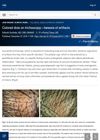
December 2018 in “Journal of The American Academy of Dermatology” This study highlights the importance of recognizing artifacts in trichoscopy, as certain cosmetic products can mimic signs of early androgenetic alopecia.
April 1987 in “Pediatric Research”