 4 citations
,
July 2015 in “Case Reports in Dermatology”
4 citations
,
July 2015 in “Case Reports in Dermatology” This article describes a rare case of syringomas on the scalp in a 56-year-old woman with alopecia, highlighting the importance of scalp biopsy for diagnosing atypical neoplastic lesions and associated conditions.
16 citations
,
May 2017 in “Journal of Clinical Ultrasound” This report describes the sonographic characteristics of a proliferating trichilemmal tumor in the subungual region, identifying it as a heterogeneous mass with echogenic foci, potentially representing keratin and cholesterol.
January 2022 in “Optometric clinical practice” This case report describes a 59-year-old woman with a rare trichoepithelioma on her eyelid, emphasizing the importance for optometrists to differentiate it from basal cell carcinoma.
36 citations
,
December 2004 in “British Journal of Dermatology” This case study reports a peculiar variant of an epidermal cyst in a patient, featuring unique characteristics like brownish, lumpy contents resembling bone marrow.
September 2012 in “British Small Animal Veterinary Association eBooks” This article discusses pigmentation disorders in veterinary dermatology, focusing on the role of melanogenic pigmentation, and reports no new research results.
May 2025 in “International Journal of Trichology” In this case report, the researchers observed scalp alopecia due to metastasis of breast cancer in a woman in her sixties, highlighting that scalp metastases can result in patchy hair loss and, although often accompanied by poor prognosis, can sometimes show comparatively better outcomes.
32 citations
,
July 2001 in “Journal of the American Academy of Dermatology” This article describes a rare case of syringolymphoid hyperplasia with alopecia and anhidrosis in a female patient, emphasizing challenges in diagnosis and treatment unresponsiveness despite the condition's link to mycosis fungoides.
December 2021 in “Pathologica” This case report describes a rare instance of trichogerminoma with unusually numerous mitotic figures and a higher Ki67 proliferative rate, distinguishing it from previously documented cases.
3 citations
,
March 1966 in “Archives of Dermatology” This study found that nevoid basal cell carcinomas originate in the epidermis and the upper part of the hair follicle, showing similarities to nonnevoid basal cell carcinomas.
June 2024 in “Dermatopathology” In this case report, a 74-year-old woman initially diagnosed with androgenetic alopecia was later found to have secondary alopecia neoplastica due to morpheaform basal cell carcinoma of the scalp, illustrating the importance of recognizing subtle clinical features to prevent delayed treatment and potential local destruction.
January 2009 in “Repositório Científico do Instituto Politécnico de Viseu (Instituto Politécnico de Viseu)” This case study found that a skin lesion in a Samoyed dog did not match any single known follicular cyst or neoplasm type described in the literature.
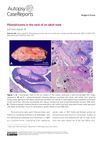 January 2022 in “Autopsy and Case Reports”
 This article describes a case of pilomatricoma in a 22-year-old male with successful surgical excision and no recurrence, highlighting its histopathological features and typical clinical presentation.
 June 2021 in “Asian Journal of Medical Sciences”
 This case study highlights that vitamin B12 deficiency can cause reversible hyperpigmentation, illustrated by a vegetarian female patient whose skin lesions improved after treatment.
June 2025 in “British Journal of Dermatology” In this case study, nail changes and skin lesions helped diagnose a 60-year-old man with advanced cardiac amyloidosis, highlighting the importance of considering amyloidosis in differential diagnoses for similar nail abnormalities and assessing for systemic involvement.
 2 citations
,
January 2021 in “JAAD Case Reports”
2 citations
,
January 2021 in “JAAD Case Reports” This article reviews potential causes for angiolymphoid hyperplasia with eosinophilia, a benign vascular tumor often found in middle-aged adults, and reports no new clinical findings.
1 citations
,
April 2022 in “Clinical Cosmetic and Investigational Dermatology” In this study, a case of lichen amyloidosis on the scalp significantly improved with a 2-month topical treatment using clobetasol propionate/all-trans retinoic acid ointment.
2 citations
,
May 2007 in “Pediatrics in Review” This case study reports a teenage boy with juvenile polyposis syndrome, presenting with microcytic anemia, growth failure, and rectal bleeding, leading to the diagnosis following colonoscopy and histologic examination of colonic polyps.
 3 citations
,
January 2021 in “Skin appendage disorders”
3 citations
,
January 2021 in “Skin appendage disorders” This study concluded that hair pigmentation, as measured by eumelanin-to-pheomelanin ratio, is not a risk factor for developing alopecia areata when compared to androgenetic alopecia patients.
1 citations
,
January 2022 in “Indian dermatology online journal” This case report documents the presentation and diagnosis of a rare bullous pilomatrixoma in a 20-year-old female using fine needle aspiration cytopathology, highlighting diagnostic challenges and features.
 1 citations
,
November 1990 in “International Journal of Dermatology”
1 citations
,
November 1990 in “International Journal of Dermatology” This article reports no new findings; it discusses metastasis of an untreated thin melanoma in a very elderly patient.
 2 citations
,
March 2018 in “The Journal of Dermatology”
2 citations
,
March 2018 in “The Journal of Dermatology” This letter discusses a trichoscopic feature called the color-transition sign for differentiating between alopecia areata incognita and telogen effluvium, and reports no new clinical results.
18 citations
,
February 2001 in “Der Hautarzt” This case study of a 50-year-old woman with myotonic dystrophy and multiple basal cell carcinomas suggests there could be a genetic predisposition for certain cutaneous tumors in such patients.

In this case report, a 65-year-old man's neck lesion was initially misdiagnosed as benign but later identified as trichilemmal carcinoma, with the authors recommending Mohs Micrographic Surgery as the preferred treatment option for this rare condition.
 December 2022 in “Curēus”
 This case report describes a 5-year-old girl with atrichia with papular lesions, whose diagnosis was confirmed through genetic testing identifying mutations in the hairless gene.
7 citations
,
January 2020 in “Dermatology online journal” In this case report, adult-onset porokeratotic eccrine ostial and dermal duct nevus improved with topical tazarotene treatment, as evidenced by dermatoscopic images.
 March 2022 in “Folia Medica Indonesiana”
 This case report described a facial hairline tumor initially diagnosed as a sebaceous cyst but ultimately confirmed as a rare Proliferating Pilar Tumor with focal malignancies upon histopathological examination.
8 citations
,
January 2017 in “Journal of Oral and Maxillofacial Pathology” This report explores the potential cellular origins of keratoacanthoma lesions on the oral mucosa, noting that it reports no new results.
19 citations
,
July 1994 in “International Journal of Dermatology” This case report describes a 9-year-old Korean boy with a calcified nodule on his earlobe, confirmed by histopathologic examination and Von Kossa staining.
 41 citations
,
January 2014 in “Annals of Dermatology”
41 citations
,
January 2014 in “Annals of Dermatology” This study found that dermoscopy showed distinctive patterns for different types of alopecia, supporting its clinical usefulness for diagnosing diseases with small round or oval hairless patches on the scalp.
 1 citations
,
September 2025 in “Journal of Zhejiang University SCIENCE B”
1 citations
,
September 2025 in “Journal of Zhejiang University SCIENCE B” This abstract outlines the current understanding of cutaneous squamous cell carcinoma (cSCC), identifying it as the second most common non-melanoma skin cancer with risk factors like UV exposure and immunosuppression. It highlights cSCC's potential to metastasize and become fatal, affecting 2%-5% of in situ cases.