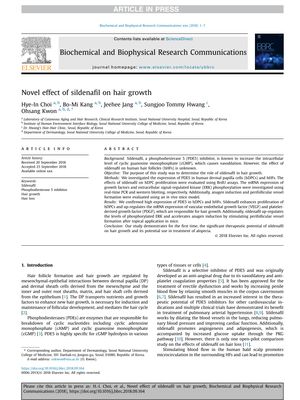
21 citations
,
April 2018 in “Journal of Dermatological Science”
21 citations
,
April 2018 in “Journal of Dermatological Science” This study found that topical cilostazol promotes hair growth, enhances hair follicle activities, and may serve as a potential treatment for alopecia.
 31 citations
,
February 2014 in “Journal of dermatological science”
31 citations
,
February 2014 in “Journal of dermatological science” This study found that placental growth factor (PlGF) enhanced hair shaft elongation and accelerated hair follicle growth, suggesting its potential as a therapeutic target for alopecia.
120 citations
,
May 2012 in “Experimental Cell Research” This study found that VEGF stimulates the proliferation of human hair follicle dermal papilla cells via the VEGFR-2/ERK pathway, without involving p38, JNK, or AKT signaling.
 321 citations
,
December 2009 in “Journal of Dermatological Science”
321 citations
,
December 2009 in “Journal of Dermatological Science” This review discusses the role of dermal cells in hair follicle regeneration and morphogenesis and highlights their potential therapeutic implications, but it reports no new empirical findings.
12 citations
,
January 2006 in “Journal of Dermatological Treatment” This open-pilot study found that topical 1% sildenafil did not show significant hair growth in children with alopecia areata, as outcomes seemed due to spontaneous disease regression.
 219 citations
,
March 2004 in “Journal of The American Academy of Dermatology”
219 citations
,
March 2004 in “Journal of The American Academy of Dermatology” In this 48-week trial, 5% topical minoxidil was more effective than both 2% minoxidil and placebo in promoting hair growth in women with female pattern hair loss, with notable improvements in nonvellus hair count and hair growth assessments.
 30 citations
,
September 2003 in “Experimental Dermatology”
30 citations
,
September 2003 in “Experimental Dermatology” In this study on a murine model, researchers observed that a 5% minoxidil solution reduced stress-induced changes in hair growth, suggesting its potential for managing stress-related hair loss in humans.
854 citations
,
February 2002 in “The journal of investigative dermatology/Journal of investigative dermatology” This review summarizes recent advances in understanding the molecular mechanisms of hair follicle formation and discusses potential future clinical applications for treating hair loss and skin tumors, but it reports no new clinical results.
 231 citations
,
October 1999 in “Journal of Clinical Investigation”
231 citations
,
October 1999 in “Journal of Clinical Investigation” This study found that administering an adenovirus vector to increase Sonic hedgehog gene expression in mouse skin accelerated the transition of hair follicles into the growth phase, promoting hair growth.
 80 citations
,
September 1984 in “Journal of The American Academy of Dermatology”
80 citations
,
September 1984 in “Journal of The American Academy of Dermatology” In this study, 5% topical minoxidil was observed to promote hair regrowth in some patients with androgenic alopecia, while no regrowth was noted in patients with alopecia areata.
 137 citations
,
May 1984 in “Journal of Investigative Dermatology”
137 citations
,
May 1984 in “Journal of Investigative Dermatology” Minoxidil increases blood flow in balding scalps, possibly reversing hair loss.
 78 citations
,
April 1984 in “Archives of Dermatology”
78 citations
,
April 1984 in “Archives of Dermatology” This study found that 1% minoxidil topical solution led to terminal hair regrowth in some patients with alopecia areata, though it was only cosmetically acceptable in less than half of those cases.