9 citations
,
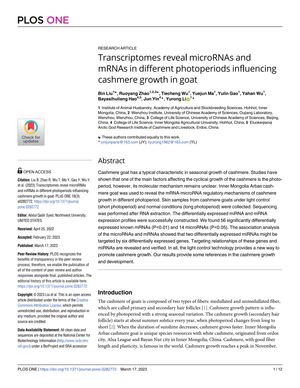
July 2021 in “Frontiers in genetics” This study found that continuous implantation of melatonin in cashmere goats advanced the growth cycle of cashmere by inducing secondary hair follicle development and altering gene expression.
 11 citations
,
June 2021 in “Frontiers in Cell and Developmental Biology”
11 citations
,
June 2021 in “Frontiers in Cell and Developmental Biology” This study found that melatonin may enhance goat cashmere growth by activating Wnt signaling and regulating stem cell pluripotency through mechanisms involving NOGGIN and BMP4 pathways.
 8 citations
,
August 2020 in “Domestic Animal Endocrinology”
8 citations
,
August 2020 in “Domestic Animal Endocrinology” This study found that melatonin treatment improved cashmere production for one cycle in cashmere goats, enhancing fiber quality and follicle activity, but had no effects in the subsequent cycle.
 46 citations
,
March 2019 in “Journal of Pineal Research”
46 citations
,
March 2019 in “Journal of Pineal Research” The study found that melatonin treatment in early postnatal cashmere goats increased both the quantity and quality of cashmere by promoting secondary hair follicle development and enhancing antioxidant enzyme activities.
 32 citations
,
May 2018 in “Cell Cycle”
32 citations
,
May 2018 in “Cell Cycle” This study found that melatonin exposure promoted hair follicle fiber growth in Cashmere goat cultures, potentially influencing pathways related to the microvascular system and extracellular matrix.
 40 citations
,
January 2016 in “PLoS ONE”
40 citations
,
January 2016 in “PLoS ONE” The study found that exposing Arbas Cashmere goats to a short photoperiod significantly increased cashmere production by extending the anagen phase of hair follicles, with gene expression changes identified as contributing factors.
92 citations
,
September 2013 in “Journal of Investigative Dermatology” This study found that peripheral clock genes, particularly BMAL1 and Period1, modulate human hair follicle cycling, suggesting their potential as therapeutic targets for affecting hair growth.
 116 citations
,
May 2013 in “Proceedings of the National Academy of Sciences of the United States of America”
116 citations
,
May 2013 in “Proceedings of the National Academy of Sciences of the United States of America” This study discovered that the circadian clock influences hair follicle regeneration, making hair grow faster in the morning and causing more radiation-induced hair loss in the morning compared to the evening.
 209 citations
,
September 2008 in “Dermatologic Therapy”
209 citations
,
September 2008 in “Dermatologic Therapy” This review discusses the role of androgens in hair follicle regulation and suggests that a better understanding could enhance treatments for conditions like hirsutism and alopecia, but does not present new findings.
 53 citations
,
November 2006 in “Journal of Endocrinology”
53 citations
,
November 2006 in “Journal of Endocrinology” This study found that prolactin plays a direct role in regulating the timing of hair growth cycles in mice by affecting the skin, rather than through other endocrine factors.