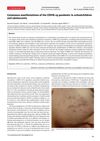
 January 2023 in “Acta dermatovenerologica Alpina, Pannonica et Adriatica (Tiskana izd.)”
 This review details skin conditions in children and adolescents related to the SARS-CoV-2 pandemic, emphasizing mask-related acne and various cutaneous manifestations linked to infection and vaccination, with most being mild or nonspecific.
March 2022 in “Biomedical Journal of Scientific & Technical Research” This review discusses therapeutics for mitochondrial dysfunction and reports no new clinical findings.
 November 2020 in “Bali Medical Journal”
 This review discusses the potential of PRP treatment for alopecia areata, highlighting reported hair growth improvements but notes the need for randomized clinical trials to confirm efficacy.

This book overview summarizes advances in integrative dermatology without presenting any new research findings.
 September 2018 in “International Journal of Advanced Community Medicine”
 This source describes the development of a new cream combining salicylic acid and retinol, assessed for its potential to alleviate itching in dermatitis and treat acne vulgaris, with stability and patch testing indicating no irritation or allergic reactions.
 January 2018 in “SOJ microbiology & infectious diseases”
 This review outlines the changing landscape of psoriasis vulgaris treatment with biologics, which offer benefits but also have increasingly recognized adverse effects, without presenting new clinical results.
 September 2017 in “Pediatric Dermatology”
 The document concludes that an experimental drug may help wound healing in Epidermolysis Bullosa, links Hydroa vacciniforme to EBV, discusses diagnosing hair loss disorders, finds many children with eczema have allergies, reviews the safety of a skin medication in children, notes side effects of a Duchenne's treatment, and identifies a marker for pediatric mastocytosis.
 April 2015 in “Journal of Evolution of Medical and Dental Sciences”
 This study found that patients with autoimmune skin diseases showed a statistically significant occurrence of hearing disabilities, suggesting the need for audiological evaluations in these patients.
 January 2015 in “Indian Journal of Medical Biochemistry”
 Men with early balding should be checked for metabolic syndrome, as there's a link between the two.
 March 2012 in “Journal of The American Academy of Dermatology”
 Hand-foot-mouth disease may cause nail loss in children.
 March 2012 in “Journal of The American Academy of Dermatology”
 Higher levels of certain nerve-related proteins are linked to hair loss in women with scalp pain.
 May 2009 in “The American Journal of Dermatopathology”
 This abstract contains only journal subscription and informational content and does not present any research findings.
 June 2008 in “Springer eBooks”
 The document concludes that permanent hair loss conditions are complex, require early specific treatments, and "secondary permanent alopecias" might be a more accurate term than "secondary cicatricial alopecia."
 February 2008 in “Expert Review of Dermatology”
 This review explores how seborrheic dermatitis impacts patients' quality of life but does not present new research findings; it highlights a need for further studies on influencing factors.
 September 2006 in “Plastic and Reconstructive Surgery”
 This study observed a 31% decrease in antidepressant use among patients already using such medication before cosmetic surgery, suggesting a potential influence of cosmetic procedures on antidepressant needs.
 September 2006 in “Plastic and Reconstructive Surgery”
 This study observed a 31% decrease in antidepressant use among patients who were preoperatively taking such medication, suggesting cosmetic surgery may influence antidepressant needs.
 September 2006 in “Plastic and Reconstructive Surgery”
 This study found a 31% decrease in antidepressant use following cosmetic surgery, suggesting that such procedures may influence medication use by improving self-esteem.
 January 2006 in “Journal of Rural Medicine”
 This review discusses recent Japanese research on trichotillomania and compares it with international studies, reporting no new clinical results.
 July 2003 in “Journal of Cutaneous Medicine and Surgery”
 Certain drugs can cause lupus, stopping these drugs is the main treatment. NB-UVB phototherapy clears psoriasis faster when applied three times a week. Monoclonal antibodies and oral pimecrolimus are effective in treating psoriasis. Smoking and drinking are linked to psoriasis in men. No direct link between low iron and hair loss was found. Vaccines are effective against genital herpes and human papillomavirus type 16.
 July 2003 in “Journal of Cutaneous Medicine and Surgery”
 Blood pressure drugs can cause skin lupus, early treatment is key for baby herpes and diabetic foot ulcers, a certain vaccine works against genital herpes and HPV in women, more frequent light therapy helps psoriasis, smoking and drinking can worsen psoriasis, a cream clears up a type of skin cancer, and low iron levels don't cause chronic hair loss.
 July 2003 in “Journal of Cutaneous Medicine and Surgery”
 Various skin conditions can be treated effectively with different methods, such as discontinuing certain drugs, using specific vaccines, applying creams, and changing lifestyle habits like smoking and drinking.
 July 2003 in “Journal of Cutaneous Medicine and Surgery”
 The document concludes that various treatments for skin conditions are effective, but some require further research, and certain factors like gender and lifestyle can influence disease outcomes.
 July 2003 in “Journal of Cutaneous Medicine and Surgery”
 Stopping certain drugs can improve skin conditions, arsenicosis affects over half of a Bangladeshi village, males are more vulnerable, and certain treatments are effective for warts, acne, and psoriasis. Smoking and drinking are linked to psoriasis in men, a cream helps with a type of skin cancer, and low iron levels don't directly cause chronic hair loss in women.
 July 2003 in “Journal of Cutaneous Medicine and Surgery”
 High blood pressure drugs often cause skin lupus, stopping the drug usually helps. A vaccine helps prevent genital herpes and HPV-16. More frequent light therapy clears psoriasis faster. No link was found between low iron and chronic hair loss.
 July 2003 in “Journal of Cutaneous Medicine and Surgery”
 Treating psoriasis with UVB light three times a week is faster than twice a week, and certain medications and lifestyle factors affect psoriasis treatment outcomes.
 July 2003 in “Journal of Cutaneous Medicine and Surgery”
 Skin problems are common in Bangladesh due to arsenic, prompt treatment of diabetic foot ulcers is crucial, maternal transmission causes most neonatal herpes, treatments for pediatric vasculitis are effective, the chickenpox vaccine works, more frequent UVB therapy helps psoriasis, certain jobs increase hand dermatitis risk, monoclonal antibodies treat psoriasis well, lifestyle affects psoriasis, alefacept improves psoriasis, imiquimod cream partially clears basal cell carcinoma, and iron may not help chronic hair loss.
 July 2003 in “Journal of Cutaneous Medicine and Surgery”
 Blood pressure drugs can cause skin lupus, but it improves after stopping the drug. The glycoprotein D vaccine works against genital herpes in some women, and the HPV-16 vaccine reduces HPV-16 infection and related diseases. More frequent light therapy clears psoriasis faster. A cream called imiquimod effectively treats a type of skin cancer. Iron supplements don't necessarily help with chronic hair loss in women.
 July 2003 in “Journal of Cutaneous Medicine and Surgery”
 Some medications can improve skin conditions, while lifestyle factors like smoking and drinking may worsen them; treatments like monoclonal antibodies and imiquimod cream show promise for certain skin diseases.
 January 1989 in “Side effects of drugs annual”
 This chapter reviews studies on the side effects of cytostatics and immunosuppressive drugs, detailing various toxicities such as cardiovascular, pulmonary, and neurotoxicity, but provides no new clinical results.
 August 2016 in “InTech eBooks”
 This source highlights the diverse scope of facial plastic and reconstructive surgery, noting the specialty's adaptability to changing trends and ethnic preferences for aesthetic outcomes, without reporting specific study results.