1 citations
,
April 2016 in “Journal of the American Academy of Dermatology” Autoimmune conditions can be linked to trichoepitheliomas, with treatment focusing on cosmetic concerns.
 2 citations
,
February 2019 in “Anais brasileiros de dermatologia/Anais Brasileiros de Dermatologia”
2 citations
,
February 2019 in “Anais brasileiros de dermatologia/Anais Brasileiros de Dermatologia” Tufted folliculitis is common in patients with folliculitis decalvans.
 1 citations
,
December 2017 in “Acta biomedica scientifica”
1 citations
,
December 2017 in “Acta biomedica scientifica” This study observed that 30% of women with polycystic ovary syndrome had androgenic alopecia, suggesting it is a prevalent but unreliable marker of hyperandrogenism.
 May 2020 in “Research Square (Research Square)”
 This study found that trichilemmal carcinoma shares genetic changes with other skin cancers, suggesting a similar pathogenesis, particularly in those with aggressive clinical courses linked to TP53 mutations.
20 citations
,
February 2015 in “Anais brasileiros de dermatologia/Anais Brasileiros de Dermatologia” This case report describes a 6-year-old girl diagnosed with monilethrix despite no familial history and treated with a topical minoxidil trial.
July 2025 in “Clinical Case Reports” In this case report, a 17-year-old male with a specific TRPS1 gene mutation presented with sparse, soft hair, short thumbs and toes, misaligned teeth, and distinctive bone abnormalities in the fingers and toes as observed through X-ray analysis.
 April 2025 in “Clinical Dermatology Review”
 In this study, researchers reported that dermatoscopy effectively differentiates between various types of alopecia and scalp disorders, offering a fast, minimally invasive diagnostic method that improves the standard of care and reduces the necessity for scalp biopsies.
 5 citations
,
January 2014 in “Journal of Cutaneous and Aesthetic Surgery”
5 citations
,
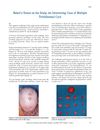
January 2014 in “Journal of Cutaneous and Aesthetic Surgery” A woman had 13 non-cancerous cysts on her scalp successfully removed in one surgery.
This study measured the force required to pluck anagen and telogen hair from volunteers, suggesting that trichotillometry could assess hair strength in alopecia patients and evaluate treatment efficacy.
3 citations
,
January 2017 in “Dermatology online journal” This case report describes the diagnosis of monilethrix in a 2-year-old boy using trichoscopy, highlighting its rarity and the challenge of diagnosing it without a family history.
3 citations
,
January 2016 in “Case reports in dermatological medicine” This report discusses a case of localized hypertrichosis that developed after an elderly male with Alzheimer's disease started oral rivastigmine therapy, suggesting a potential link between the drug and hair growth.
April 2012 in “Neuropediatrics” This article reviews the genetic and phenotypic characteristics of Trichothiodystrophy and discusses the associated DNA repair defects, but does not report new clinical findings.
 June 2012 in “Springer eBooks”
 Eating disorders can cause various hair problems, and while hair loss in these disorders is linked to metabolic syndrome, treatment focuses on specific medications and lifestyle changes for the syndrome.
March 1997 in “The Lancet” Hirsutism is abnormal male-pattern hair growth in females due to excess androgens.
 2 citations
,
January 2008 in “Journal of The American Academy of Dermatology”
2 citations
,
January 2008 in “Journal of The American Academy of Dermatology” Trichoscopy is a helpful and quick method to diagnose hair loss without shaving.
January 2020 in “Revista Dermatológica Centro Uraga” This article describes how recognizing distinct trichoscopic features aids in diagnosing various dermatological conditions and hair loss, but it reports no new clinical findings.
 January 2018 in “Springer eBooks”
 Congenital triangular alopecia is a harmless, non-spreading hair loss condition often seen in young children.
August 2025 in “Brazilian Journal of Hair Health” This study found that 29.6% of patients seeking treatment for hair loss meet the criteria for hair-related body dysmorphic disorder, significantly higher than in general dermatology patients.
 July 2024 in “International Journal of Dermatology Venereology and Leprosy Sciences”
 This review highlights the increasing use of trichoscopy, a noninvasive and well-tolerated diagnostic tool, to aid in the accurate diagnosis and management of various pediatric hair and scalp conditions, such as alopecia and other abnormalities.
4 citations
,
August 1991 in “The Journal of Dermatology” This case report describes a rare pedunculated follicular hamartoma on the nasal septum of a 77-year-old Japanese male, emphasizing its unique clinical and pathological features.
December 2025 in “Pomeranian Journal of Life Sciences” This case report describes a man who developed localized acquired hypertrichosis due to inflammation and local pressure from over 20 years of working in mining, finding no statistical difference in hair thickness between his shoulders.
 23 citations
,
April 2017 in “Clinical, Cosmetic and Investigational Dermatology”
23 citations
,
April 2017 in “Clinical, Cosmetic and Investigational Dermatology” This review discusses the importance of recognizing and treating psychiatric conditions in dermatology patients, offering practical recommendations for dermatologists to manage psychocutaneous diseases effectively, but reports no new clinical results.
42 citations
,
September 1985 in “British Journal of Dermatology” This study found that trichothiodystrophic hair shows reduced and disoriented protein deposition in follicles, with both the cuticle and cortex affected, providing localized structural insights into keratin abnormalities.
 March 2021 in “CRC Press eBooks”
 This review discusses the various trichoscopic features of androgenetic alopecia and alopecia areata, noting white dots in advanced cases as indicators of poor prognosis, but reports no new clinical results.
2 citations
,
January 1987 in “PubMed” This study reported three related cases of woolly hair syndrome transmitted as a dominant autosomal trait, characterized by fine, frizzy hair and general hair thinning.
 April 2024 in “Dermatovenerologiâ, kosmetologiâ”
 In this study, telogen effluvium, a common form of hair loss linked to changes in the hair cycle, is examined with a focus on diagnostic methods and effective treatment options, noting that 34.2% of patients experience trichodynia.
 October 2004 in “European Neuropsychopharmacology”
 This article reviews studies on younger men using finasteride for hair loss, finding persistent sexual and nonsexual side effects like erectile dysfunction and depression, and reports lower neurosteroid levels in affected individuals.
1 citations
,
September 2024 in “Veterinary Dermatology” In this study, clinicians are advised to perform trichography regularly on Pomeranians with HCA, as significant hair abnormalities, especially TN, may affect hair quality; further research is needed to understand the underlying mechanisms and treatment options.
This source reports that telogenic hair loss, while not leading to complete baldness, significantly impacts patients' quality of life due to its effects on their psychoemotional state; no standardized treatment currently exists, so therapy focuses on addressing trigger factors and psychological well-being.
 April 2023 in “JOJ dermatology & cosmetics”
 In this study, researchers highlighted the complexity of managing psychocutaneous disorders, emphasizing the need for a multidisciplinary approach involving dermatologists, psychiatrists, family physicians, and social support to address associated psychiatric diagnoses, risk factors like suicide, and ensure effective treatment.