 129 citations
,
January 2009 in “International Journal of Trichology”
129 citations
,
January 2009 in “International Journal of Trichology” This study found that trichoscopy criteria can distinguish female androgenic alopecia from chronic telogen effluvium, with specific features achieving 98% diagnostic specificity.
 January 2023 in “Skin appendage disorders”
 The case study reports a patient with acute telogen effluvium in the donor region post-hair transplant, highlighting trichoscopic findings that aid in diagnosis and reassuring the self-resolutive nature of this condition.
33 citations
,
December 1982 in “Developmental Medicine & Child Neurology” The authors reviewed cases of six children with both hair-shaft abnormalities and neurological disorders, noting that such hair defects may indicate neurological conditions, including potentially treatable metabolic errors.
5 citations
,
May 2015 in “JRSM open” If a child is losing a lot of eyelashes and it keeps happening, doctors should look carefully at their health history because it might be a sign of a different health problem.
 1 citations
,
April 2015 in “Current problems in dermatology”
1 citations
,
April 2015 in “Current problems in dermatology” The document concludes that the trichogram is a useful tool for diagnosing hair loss and suggests semi-organ cultures for practical trichological research.
 1 citations
,
January 2013 in “International Journal of Trichology”
1 citations
,
January 2013 in “International Journal of Trichology” A girl with red hair developed hair-pulling and body image disorders after being bullied for her hair color.
 January 2025 in “Dermatology Review”
 The authors report a rare case of trichilemmal carcinoma in the thigh of a 71-year-old, emphasizing the importance of complete surgical excision to prevent recurrence and support patient prognosis.
January 2023 in “Journal of Clinical and Diagnostic Research” This study in Chennai, India, found that while some trichoscopic patterns are specific, many overlap across different scalp dermatoses, highlighting the importance of dermatologists staying informed about the latest findings.
 3 citations
,
January 2021 in “Skin appendage disorders”
3 citations
,
January 2021 in “Skin appendage disorders” This case report describes how trichoscopy helped diagnose tinea capitis disguised as female pattern hair loss in cases of endothrix infection, highlighting its usefulness in avoiding misdiagnosis.
 December 2024 in “Journal of Skin and Stem Cell”
 This review discusses the role of trichoscopy in diagnosing and managing various alopecia types, highlighting its ability to detect specific patterns in both scarring and non-scarring forms, thus aiding in treatment decisions and reducing biopsy necessity.
 December 2025 in “SAS Journal of Medicine”
 This case report highlights the importance of considering trichofolliculoma in the differential diagnosis of scalp lesions, with histopathological examination essential for accurate diagnosis.
 6 citations
,
January 2007 in “Actas dermo-sifiliográficas/Actas dermo-sifiliográficas”
6 citations
,
January 2007 in “Actas dermo-sifiliográficas/Actas dermo-sifiliográficas” This study found that topical application of triiodothyronine (T3) can induce the transition of hair follicles from the telogen to the anagen phase in mice and stimulate hair shaft growth in vitro.
 December 2020 in “TURKDERM”
 This case report describes a 3-year-old boy diagnosed with temporal triangular alopecia, emphasizing the importance of clinical and dermoscopic examination for correct diagnosis due to the condition's rarity and risk of misdiagnosis.
 46 citations
,
April 2009 in “Journal of Dermatological Case Reports”
46 citations
,
April 2009 in “Journal of Dermatological Case Reports” This study established standard trichoscopy norms for adult white females, providing benchmarks for hair thickness, percentage of thin hairs, and pilosebaceous units with single hair across different scalp areas.
 September 2024 in “Archiv Euromedica”
 In this review, the authors concluded that trichoscopy is a quick, non-invasive, and effective method for diagnosing and monitoring non-scarring alopecia, offering a more precise and faster alternative compared to other diagnostic methods for identifying and managing different types of hair loss.
44 citations
,
April 2013 in “Proceedings of the National Academy of Sciences of the United States of America” This study found a significant association between reduced FGF13 levels and X-linked congenital generalized hypertrichosis, suggesting FGF13's potential role in hair follicle growth and the hair cycle.
 May 2026 in “Journal of Basic and Clinical Health Sciences”
 This study found that certain trichoscopic features, including hair diameter diversity patterns, helped differentiate female androgenetic alopecia from telogen effluvium in women, suggesting their potential use in clinical diagnosis.
 June 2026 in “Indian Journal of Dermatology Venereology and Leprology”
 In this study, researchers found significant associations between trichoscopic features and the severity of androgenetic alopecia in Korean participants, suggesting trichoscopy as a useful tool for early detection and monitoring by identifying indicators like vellus hairs and follicular unit changes.
2 citations
,
February 2013 in “Journal of the Saudi Society for Dermatology & Dermatologic Surgery” This case study describes an acquired localized form of trichorrhexis nodosa resulting from physical-chemical trauma.
133 citations
,
March 1999 in “Journal of Cutaneous Pathology” This study found that keratin 15 expression in trichoepitheliomas and some basal cell carcinomas suggests a link to hair follicle stem cells in the bulge.
 May 2026 in “Journal of Cutaneous and Aesthetic Surgery”
 This study observed that following hair transplantation, patients exhibited prominent perifollicular erythema and scaling one month after surgery, whereas by six months, accentuated follicular ostia and varying hair shaft abnormalities were consistently noted.
 45 citations
,
January 2012 in “International Journal of Trichology”
45 citations
,
January 2012 in “International Journal of Trichology” This study reported that trichoscopy is a more effective diagnostic tool than the trichogram for early diagnosis of FAGA, regardless of hair shaft diversity cut-off levels.
 69 citations
,
January 2015 in “Current problems in dermatology”
69 citations
,
January 2015 in “Current problems in dermatology” This review discusses trichoscopy as a noninvasive, effective technique for diagnosing various hair loss conditions and monitoring treatment, highlighting its potential to reduce scalp biopsy necessity.
 November 2016 in “대한피부과학회지”
 This study found that trichoscopy is effective for diagnosing androgenetic alopecia and alopecia areata, and it can also be used to assess the severity of androgenetic alopecia.
32 citations
,
September 1996 in “Archives of Dermatological Research” 6 citations
,
September 1996 in “Archives of Dermatological Research” 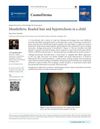 January 2026 in “Cosmoderma”
 In this clinical case study, a 9-year-old girl was diagnosed with monilethrix, a hereditary hair shaft disorder characterized by weak, beaded hair, with management focusing on minimizing hair trauma.
13 citations
,
January 1985 in “International Journal of Dermatology” This study compared trichostasis spinulosa with keratosis pilaris and eruptive vellus hair cysts, finding differences in lesion distribution and microscopic appearance.
 1 citations
,
November 2017 in “Skin appendage disorders”
1 citations
,
November 2017 in “Skin appendage disorders” Ingrown hairs are a common feature in scarring alopecias due to follicular damage.
19 citations
,
March 1999 in “PubMed” This review discusses trichotillomania, its prevalence, and treatment options, emphasizing that many sufferers experience delays in treatment due to secrecy and shame, but reports no new research findings.