 12 citations
,
November 1993 in “International Journal of Dermatology”
12 citations
,
November 1993 in “International Journal of Dermatology” The document explains that hirsutism, often caused by hormonal issues, can be managed with treatment to improve both physical appearance and mental health.
12 citations
,
November 2004 in “Photochemistry and Photobiology” In this study, a superoxide dismutase gel prevented hair graying in mice exposed to photosensitization, suggesting that antioxidants can protect against oxidative damage involved in hair aging.
12 citations
,
April 1998 in “The Journal of Dermatology” This report describes a case of pretibial myxedema in an 18-year-old Japanese woman with Graves' disease, along with a review of 112 similar cases from the Japanese literature.
 12 citations
,
November 1996 in “Australasian journal of dermatology”
12 citations
,
November 1996 in “Australasian journal of dermatology” A kidney transplant patient on cyclosporin experienced unexpected severe hair loss, which improved with treatment adjustments.
 12 citations
,
May 1995 in “Australasian Journal of Dermatology”
12 citations
,
May 1995 in “Australasian Journal of Dermatology” This review reports that while anti-androgen therapy can improve hair loss in up to 50% of women with androgenetic alopecia, it typically only slows the rate of loss rather than promoting new growth.
12 citations
,
August 1988 in “Histopathology” This case report describes a giant pigmented tumor of the scalp in a 47-year-old woman and suggests a possible dual origin involving neural crest differentiation.
 12 citations
,
November 1987 in “Pediatric dermatology”
12 citations
,
November 1987 in “Pediatric dermatology” This report identified longitudinal grooves in the hair shafts of four children, diagnosing them with uncombable-hair syndrome.
12 citations
,
October 1981 in “International Journal of Cosmetic Science” This article discusses the disputed role of scalp micro-organisms in dandruff and notes that effective anti-dandruff treatments often have good antimicrobial activity, but it reports no new clinical results.
12 citations
,
March 1981 in “International Journal of Dermatology” This case study reports that selenium shampoo, bacterial infection with trichomycosis axillaris, and possibly strongyloides larvae may have contributed to acquired hair shaft abnormalities resembling trichorrhexis nodosa in two patients.
 12 citations
,
July 1979 in “International Journal of Dermatology”
12 citations
,
July 1979 in “International Journal of Dermatology” This article reviews the clinical manifestations and contributing factors of acute zinc depletion syndrome, reporting no new results but discussing prevention and treatment strategies.
12 citations
,
October 1947 in “Journal of the Society of Dyers and Colourists” This study found that treatment with mercuric acetate modifies the elastic properties of Lincoln wool fibers more rapidly than human hair, explaining the enhanced unshrinkable quality of wool under certain conditions.
 11 citations
,
April 1990 in “Australasian Journal of Dermatology”
11 citations
,
April 1990 in “Australasian Journal of Dermatology” This study found that 2% minoxidil solution significantly increased non-vellus hair counts and regrowth rates compared to placebo in men with early androgenic alopecia, suggesting it is an effective treatment.
 11 citations
,
November 2005 in “The Journal of Dermatology”
11 citations
,
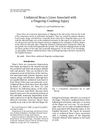
November 2005 in “The Journal of Dermatology” This report presents a unique case where a man developed Beau's lines on all fingers of one hand after a thumb injury, with the lines eventually disappearing as the nails grew.
 11 citations
,
July 2001 in “APMIS. Acta pathologica, microbiologica et immunologica Scandinavica./APMIS”
11 citations
,
July 2001 in “APMIS. Acta pathologica, microbiologica et immunologica Scandinavica./APMIS” This review discusses the role of oestrogens in stimulating linear bone growth and pubertal changes in both boys and girls, highlighting their influence on the growth hormone-insulin-like growth factor axis; it reports no new clinical results.
 11 citations
,
September 1999 in “Journal of the European Academy of Dermatology and Venereology”
11 citations
,
September 1999 in “Journal of the European Academy of Dermatology and Venereology” This review examines various immunomodulatory therapies for cutaneous lymphoma and notes that they are most effective in the disease's early stages.
11 citations
,
April 1997 in “International Journal of Dermatology” This article discusses using topical tretinoin with intralesional triamcinolone acetonide for alopecia areata in northern Saudi Arabia, but it reports no new clinical findings.
11 citations
,
November 1996 in “Pediatric dermatology” This paper reviews trichostasis spinulosa and presents a case in a 13-year-old girl, providing no new clinical research results.
 11 citations
,
September 1992 in “Journal of pineal research”
11 citations
,
September 1992 in “Journal of pineal research” This study found that repeated immunization against melatonin in Australian feral goats temporarily increased cashmere production and altered growth cycles, but these effects diminished after the first year.
11 citations
,
December 1990 in “British Journal of Dermatology” This study observed abnormal extracellular matrix patterns in hair follicles from alopecia areata patients, particularly in the dermal papilla of large anagen follicles and in catagen follicles from lesional sites.
11 citations
,
October 1990 in “The Journal of dermatologic surgery and oncology” This review discusses the potential for new retinoids, topical antiandrogens, and alternative therapies to surpass tretinoin in treating cutaneous aging, but reports no clinical results.
11 citations
,
September 1990 in “Clinical Endocrinology” This study found that girls with prepubertal simple hypertrichosis had significantly higher plasma levels of dihydrotestosterone compared to controls, which does not align with other androgen markers and warrants further investigation.
 11 citations
,
February 1989 in “Journal of veterinary medicine. Series A”
11 citations
,
February 1989 in “Journal of veterinary medicine. Series A” This study observed that congenital hypotrichosis in crossbred cattle is linked to short, curly, dilute-color hair, potentially due to color dilution mutants in European breeds.
 11 citations
,
July 1988 in “International Journal of Dermatology”
11 citations
,
July 1988 in “International Journal of Dermatology” In this study, topically applied 2% minoxidil solution was found to be more effective than placebo for promoting hair regrowth in men with early male pattern baldness over 24 weeks.
11 citations
,
June 1985 in “Journal of cutaneous pathology” This review details pathologic changes in hair follicles, such as infundibular hyperkeratosis and inflammation, but offers no new diagnostic results.
11 citations
,
July 1984 in “Australian Veterinary Journal” This study found that povidone iodine, thiabendazole ointment, captan ointment, and Burroughs Wellcome Ringworm Ointment were effective against Trichophyton equinum var. autotrophicum in horses, but large-scale use may be limited by practicality and cost.
11 citations
,
June 1979 in “British Journal of Dermatology” This study found that the dehydroepiandrosterone hydroxylating enzyme system in hair follicles is similar to the liver monooxygenase system, sharing characteristics such as inhibition by carbon monoxide and dependency on NADPH.
11 citations
,
June 1974 in “Journal of Cutaneous Pathology” In this study, electron microscopy of follicular mucinosis showed severe cytoplasmic degeneration in hair follicles, with myelin figures and onion-like lamellar structures, but no indications of mucin release through degeneration or degradation were found.
10 citations
,
January 2020 in “Journal of Materials Chemistry B” This study developed a biodegradable nanofibrous biofilm that attracts skin-related cells and accelerates blood vessel formation, potentially improving skin wound healing.
10 citations
,
March 1997 in “Pediatric Dermatology” This case report describes a patient with trichothiodystrophy presenting with autism, mental retardation, and seizures, characterized by distinct hair abnormalities under microscopy.
10 citations
,
September 1994 in “International Journal of Dermatology” This case report describes three Iranian men with gradual reddish-brown pigmentation on their cheeks and preauricular areas since childhood, unresponsive to sunblocks and topical steroids.