 November 2021 in “International journal of research - granthaalayah”
 This study presents additional data suggesting that the absence of nerve endings in certain segments of human hair follicles influences the asymmetrical distribution of electrical charges, as indicated by no precipitation of Potassium Ferricyanide crystals.
 December 2023 in “PubMed”
 This study found that both single- and double-spin PRP preparation methods significantly increased thrombocyte counts and improved hair parameters in males with androgenetic alopecia, with the single-spin method showing a more significant increase in thrombocyte count.
16 citations
,
January 1977 4 citations
,
September 2015 in “JAAD case reports” This article reviews the characteristics and inheritance patterns of keratosis follicularis spinulosa decalvans, but it does not present new clinical findings, noting the disease's complex and poorly understood pathogenesis.
4 citations
,
December 2018 in “International Journal of Research -GRANTHAALAYAH” This study reports that in vitro experiments suggest a new biomagnetic cross-talk between red blood cells and human hair could be a factor in red blood cell deformation.
 43 citations
,
September 2001 in “Scanning”
43 citations
,
September 2001 in “Scanning” Hair treatments like bleaching increase friction by exposing tiny pores on the hair surface.
3 citations
,
April 2002 in “Animal Science” This study found that intradermal spermidine injections stimulated cell proliferation and increased fibre length growth rate in wool follicles of Merino lambs, without significantly affecting fibre diameter.
This study found that human hair exhibits significant deformation in its intermediate filaments under strain, with recovery taking about 1000 minutes, suggesting a self-healing period post-mechanical stress. Additionally, cuticle scales deform much less than the cortex, and the Poisson ratio aligns with soft matter properties.
 418 citations
,
September 2012 in “Nature”
418 citations
,
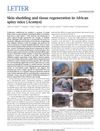
September 2012 in “Nature” This study reports the first instance of skin autotomy in mammals, specifically in African spiny mice, and suggests they may possess a greater regenerative capacity than previously understood, possibly offering insights for regenerative medicine.
12 citations
,
October 1947 in “Journal of the Society of Dyers and Colourists” This study found that treatment with mercuric acetate modifies the elastic properties of Lincoln wool fibers more rapidly than human hair, explaining the enhanced unshrinkable quality of wool under certain conditions.
 10 citations
,
November 1984 in “Journal of Colloid and Interface Science”
10 citations
,
November 1984 in “Journal of Colloid and Interface Science” The study found that the Marangoni effect causes the uneven wetting of surfactant-coated hair due to the surfactant moving into the water.
3 citations
,
August 2018 in “Zenodo (CERN European Organization for Nuclear Research)” This study introduced a tabletop optical microscopy technique to measure the biomagnetic field reach of human hair follicles using Prussian Blue Stain with iron particles.
This study found that the NuMA protein's microtubule-binding domain is essential for proper spindle orientation and differentiation in keratinocytes, affecting skin and hair development in mice.
 May 2020 in “JOJ Dermatology & Cosmetics”
 This report describes a rare case of Trichostasis Spinulosa on the heel, an uncommon location for this type of lesion.
 7 citations
,
November 2018 in “International Journal of Research -GRANTHAALAYAH”
7 citations
,
November 2018 in “International Journal of Research -GRANTHAALAYAH” This study introduces a tabletop technique demonstrating that endogenous biomagnetic fields from human hair can induce red blood cells agglutination and Rouleaux formations.
 November 2011 in “Advanced Materials Research”
 This study found that adding hair fibers to friction materials increased their friction coefficient stability and impact strength while decreasing wear rates, with 1% hair fiber content notably improving performance.
19 citations
,
March 2016 in “British journal of dermatology/British journal of dermatology, Supplement” In this study, evidence that trichodysplasia spinulosa-associated polyomavirus targets follicular keratinocytes was observed in a pediatric case, suggesting these cells as the primary viral target.
 1 citations
,
September 2021 in “International journal of research - granthaalayah”
1 citations
,
September 2021 in “International journal of research - granthaalayah” This study demonstrated that hair shaft bipolarity is triggered by a gap in follicle electromagnetic fields, potentially impacting blood coagulation through an observed positive electric field.
April 2019 in “The journal of investigative dermatology/Journal of investigative dermatology” This study found that manipulating both gene expression and matrix stiffness in mice can alter hair regeneration after skin wounding, highlighting key factors in regenerative biology.
 12 citations
,
December 2009 in “Amino Acids”
12 citations
,
December 2009 in “Amino Acids” In this study, topical application of α-methylspermidine during the telogen phase in mice induced hair growth by increasing the polyamine pool and mimicking the anagen phase's characteristics.
 9 citations
,
January 1989 in “Sen'i Gakkaishi”
9 citations
,
January 1989 in “Sen'i Gakkaishi” This study found that moisture sorption properties of wool and hair fibers from various animals were similar, despite different structural features, with sorbed water being more ordered than liquid water.
1 citations
,
December 2022 in “Skin Research and Technology” This article provides guidelines and indices for a three-point cantilever bending test to measure mechanical properties of hair treated with both conventional and naturally-derived styling polymers, reporting no new experimental results.
4 citations
,
January 2025 in “Annals of the New York Academy of Sciences” This review explores how spiny mice (Acomys spp.) exhibit unique regenerative healing abilities, with findings indicating that these rodents use specialized injury response mechanisms and proregenerative pathways to enhance tissue repair and regeneration compared to scar-forming mammals.
 4 citations
,
July 2018 in “International Journal of Research -GRANTHAALAYAH”
4 citations
,
July 2018 in “International Journal of Research -GRANTHAALAYAH” This paper introduces a new microscopy technique to measure biomagnetic fields of human hair follicles using Prussian Blue Stain mixed with iron particles, but it reports no new clinical results.
April 2026 in “Reviews in Medical Virology” This review discusses recent updates on trichodysplasia spinulosa, focusing on its seroepidemiology, mechanisms, and treatment options, and reports no new clinical results.
January 2026 in “Eng—Advances in Engineering” This study developed a biodegradable nonwoven textile using a starch-based biopolymer and fruit extracts, resulting in materials that are stronger, more hydrophilic, and capable of releasing beneficial compounds over 72 hours, positioning them for potential use in medical, healthcare, and cosmetic applications.
 January 2006 in “Seibutsu Butsuri”
 Curly and straight hair differ in how their internal fibers are arranged.
7 citations
,
May 2007 in “Nutrition Journal” This study found that due to variability in measurements, hair pluckability is not a reliable indicator of adult nutritional status, although it may hold potential in certain emergency situations if improved for consistency.
5 citations
,
February 1998 in “Polymer” Human hair keratin has a 40% α-helix structure that changes to a random coil in 8 M urea.
8 citations
,
January 2014 in “Indian Dermatology Online Journal” This article presents a case of trichostasis spinulosa, a common but often unrecognized disorder, diagnosed through dermoscopic examination of black macules revealing bundled vellus hairs, with the patient declining treatment.