567 citations
,
October 2007 in “Clinical and investigative medicine” This study described a new assay for measuring cortisol in hair and found it may serve as a useful biomarker for long-term cortisol exposure, correlating with 24-hour urine cortisol levels in non-obese subjects.
27 citations
,
November 2015 in “American Journal of Primatology” This review discusses the use of stable isotope analysis in primate hair to study feeding behavior and reports no new results; the authors call for methodological refinement in field and lab procedures.
 2 citations
,
December 2021 in “Scientific reports”
2 citations
,
December 2021 in “Scientific reports” In this study, scalp hair sweating was a significant predictor of hair cortisol levels in healthy adults, while BMI and perceived stress, although associated, did not significantly predict cortisol levels.
 1 citations
,
July 2022 in “PLOS ONE”
1 citations
,
July 2022 in “PLOS ONE” This study found that in Lichen Planopilaris, the Microbacteriaceae family was negatively correlated with IL-23 expression, suggesting a role in the disease's inflammation and microbiota composition.
 1 citations
,
January 2013
1 citations
,
January 2013 In this study conducted in Ilam province, Iran, researchers found that 19.35% of red foxes and 17.85% of jackals were infested with at least one type of ectoparasite, primarily Ctenocephalides canis.
 23 citations
,
September 2014 in “Journal of The American Academy of Dermatology”
23 citations
,
September 2014 in “Journal of The American Academy of Dermatology” This study reports that a robotic device effectively harvests hair follicles with a 95.1% yield in Korean patients undergoing hair restoration surgery.
 July 2026 in “Bratislavské lekárske listy/Bratislava medical journal”
 This study found that patients with telogen effluvium who delayed hair washing or collected shed hair were more likely to have higher clinical severity and increased disease-related economic burdens, suggesting these behaviors can aid clinical assessments.
67 citations
,
May 2013 in “Therapeutic drug monitoring” This study explores the complexities of interpreting single drug exposure in hair, emphasizing factors like drug distribution variability and suggests methods to validate single exposure findings in forensic cases.
 12 citations
,
January 2015 in “Indian Journal of Dermatology, Venereology and Leprology”
12 citations
,
January 2015 in “Indian Journal of Dermatology, Venereology and Leprology” This case report describes a 67-year-old woman with frontal fibrosing alopecia and her daughter with lichen planopilaris, noting identical HLA D types which suggest a phenotypical link between these conditions.
 October 2023 in “The Journal of Dermatology”
 This study developed and validated the Hair-Shedding Visual Scale for Asian Women, finding it to be an effective tool for identifying FPHL and TE.
 3 citations
,
July 2015 in “European Journal of Dermatology”
3 citations
,
July 2015 in “European Journal of Dermatology” This abstract discusses the role of advanced glycation end-products in aging-related skin damage, but does not provide new findings on their impact on alopecia.
 29 citations
,
December 2019 in “Transfusion and Apheresis Science”
29 citations
,
December 2019 in “Transfusion and Apheresis Science” This review discusses platelet-derived bio-products for tissue regeneration in various medical fields and reports no new clinical results; it highlights the need for a standardized classification to compare clinical outcomes effectively.
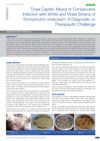 3 citations
,
January 2015 in “Journal of clinical and diagnostic research”
3 citations
,
January 2015 in “Journal of clinical and diagnostic research” This case report described a seven-year-old with tinea capitis, which improved clinically after six weeks of griseofulvin treatment, changing the fungal strain from Trichophyton violaceum white variant to violet strain.
January 2025 in “Case Reports in Veterinary Medicine” In this case study, a female European bison calf developed generalized bacterial dermatitis caused by *Staphylococcus aureus*, which improved after targeted treatment, highlighting the need for timely diagnosis and disease management in wildlife conservation.
 July 2023 in “Frontiers in Veterinary Science”
 This study found that exogenous melatonin binds to the nuclear receptor RORα in Inner Mongolia cashmere goats, stimulating secondary hair follicle development and promoting villus growth.
January 2011 in “Companion Animal” This paper reviews the pathogenesis of dermatophytosis in cats and discusses diagnostic methods and treatment needs without reporting new clinical results.
 68 citations
,
February 2019 in “Urology”
68 citations
,
February 2019 in “Urology” Hormonal treatment in transgender women reduces semen quality, but stopping treatment may improve it.
14 citations
,
October 2022 in “Journal of the American Heart Association” This study found that among older men, lower calculated free testosterone was significantly associated with a higher risk of heart failure, suggesting a possible role of testosterone deficiency in heart failure incidence.
 3 citations
,
August 2021 in “Clinical, Cosmetic and Investigational Dermatology”
3 citations
,
August 2021 in “Clinical, Cosmetic and Investigational Dermatology” This study analyzed teledermatology usage in mainland China during early 2020, finding that eczema, acne, and atopic dermatitis were the most common conditions treated and varied by age group.
 3 citations
,
July 2019 in “Experimental Dermatology”
3 citations
,
July 2019 in “Experimental Dermatology” This study reported that polyamine levels, especially N-acetyl polyamines, were higher in the vertex region of the scalp than in the occipital region in patients with male and female pattern hair loss.
 February 2026 in “Reports — Medical Cases Images and Videos”
 This retrospective case series reported that pediatric patients with alopecia totalis and subtotalis experienced significant hair regrowth after treatment with the JAK inhibitor upadacitinib, with mild acne as the most common side effect; however, larger studies are needed to establish its efficacy and safety conclusively.
 December 2024 in “Journal of Student Research”
 In this study, the researchers observed that using a shampoo containing hibiscus extract every two days was more effective at reducing hair loss among a small group of cosmetology students compared to using it every three days.
 April 2023 in “Journal of Investigative Dermatology”
 This study reports distinctive clinical, trichoscopic, and histopathological features of fibrosing alopecia in a pattern distribution among Chinese patients, suggesting possible racial differences compared to previous studies primarily involving Caucasians.
 14 citations
,
January 2001 in “Clinical chemistry”
14 citations
,
January 2001 in “Clinical chemistry” This article discusses the potential use of hair fibers to noninvasively measure polyamine concentrations as a marker of tumor growth, but reports no new clinical findings.
 February 2025 in “La Pediatria Medica e Chirurgica”
 In this case study, a 12-year-old boy with Cushing's Disease experienced a complex diagnostic journey; ultimately, a left-side ACTH-secreting microadenoma was identified and treated with gamma knife therapy, normalizing hypercortisolism but resulting in growth hormone deficiency.
In this study, the fixed oil extracted from Apeiba tibourbou seeds showed potential analgesic and anti-inflammatory properties, with prominent constituents including omega-3 and omega-6 fatty acids.
 30 citations
,
October 2010 in “Journal of The American Academy of Dermatology”
30 citations
,
October 2010 in “Journal of The American Academy of Dermatology” This review examines the debated link between iron deficiency and nonscarring scalp alopecia in women, offering no new clinical results but emphasizing the need for further research and well-designed trials.
1 citations
,
March 2022 in “Irish Journal of Medical Science” This study suggests that the Gabrin sign and hypertension in male patients are associated with a worse prognosis for COVID-19.

This paper introduces a framework attributing Post-SSRI, Post-Finasteride, Post-Retinoid, and an unnamed sexual dysfunction syndrome to downregulated estrogen receptor activity, potentially guiding future treatments in sexual medicine.
April 1992 in “Pediatrics in Review” This review discusses diagnostic methods for superficial fungal infections in children and does not report new clinical results; the authors note the ease and simplicity of these diagnostic approaches.