 1 citations
,
September 2024 in “Scientific Reports”
1 citations
,
September 2024 in “Scientific Reports” This study observed that bacterial communities on scalp hair collected through non-invasive swabbing showed similar diversity and composition to those obtained by cutting or removing hair, suggesting that swabbing is an effective method for microbiome analysis on hair.
44 citations
,
June 2018 in “Journal of Visualized Experiments” This paper presents a culturally informed protocol designed to improve the collection of hair samples from African Americans for cortisol measurement, illustrating its application with community-based study data.
January 2024 in “Metabolites” This review highlights the importance of standardizing pre-analytical procedures for collecting and extracting samples from uncommon biological specimens like breast milk and sweat in clinical metabolomics, to enhance diagnostic and biomarker discovery efforts while minimizing contamination and bias.
4 citations
,
February 2019 in “American Journal of Human Biology” This study suggests that collecting hair samples from all scalp regions may be a viable alternative for measuring cortisol in individuals with Afro-textured or extremely short hair, aligning results with traditional methods.
January 2026 in “Psychoneuroendocrinology” Self-collected hair samples can measure stress but may need adjustments for accuracy.
August 2024 in “STAR Protocols” This study details a step-by-step protocol for preparing mammalian skin samples, including hair follicles, for spatial transcriptomics to overcome challenges inherent in applying this technique to the skin.
 January 2023 in “Advances in pharmacology and clinical trials”
 This review highlights that human hair is a valuable biological matrix for clinical and toxicological analyses, demonstrating its applicability in detecting various active substances from different pharmacological classes.
March 2024 in “American journal of veterinary research” This study found that clippers are the safest and most efficient tool for collecting hair samples from companion dogs, with no impact on cortisol concentration compared to scissors.
8 citations
,
October 2023 in “Frontiers in Immunology” This study explores the potential connection between circulating cytokines and immune skin diseases, offering insights that may enhance understanding of their causes, diagnosis, and treatment approaches.
11 citations
,
August 2014 in “Journal of Animal Science” This study found that nasal swab DNA collection was more convenient and yielded higher quality and quantity DNA samples than blood collection in both Angus cattle and yaks.
 January 2023 in “Research Square (Research Square)”
 This study found that glycated proteins in untreated scalp hair may serve as a non-invasive marker for blood glucose control, but its applicability is limited by factors like cosmetic treatments and sample collection challenges.
 1 citations
,
November 2021 in “Drug Testing and Analysis”
1 citations
,
November 2021 in “Drug Testing and Analysis” This collection from the 2021 Manfred Donike Workshop outlines advancements in doping detection, highlighting new test methods and challenges, with a focus on steroidal substances, peptide hormones, and gene doping analysis.
 May 2024 in “Pakistan Journal of Health Sciences”
 This study found that people with chronic telogen effluvium had lower hair and serum iron levels and higher serum copper levels compared to healthy controls.
3 citations
,
October 2025 in “Dentistry Journal” This study investigated different centrifugation systems and found that low-speed protocols and certified centrifuges produced better-quality platelet-rich fibrin and recommended using FDA-approved glass tubes for safe and effective regenerative outcomes.
 April 2026 in “PsyArXiv (OSF Preprints)”
 This study found that among young adults, willingness to provide hair and fingernail samples for cortisol measurement was similar, with discomfort around sampling as the main barrier; informational videos did not significantly alter participant willingness.
64 citations
,
April 1972 in “American Journal of Clinical Nutrition” Hair chromium levels reflect nutritional status after standard washing.
3 citations
,
June 2019 in “Asian Journal of Medical Sciences” This study found that explant transfers of human umbilical cord Wharton's jelly-derived mesenchymal stem cells can yield cells for five consecutive times, optimizing primary cell production and reducing costs.
 1 citations
,
August 2006 in “International forensic science and investigation series”
1 citations
,
August 2006 in “International forensic science and investigation series” Hair testing is a reliable method for detecting workplace drug use when done with proper sample preparation and confirmation.
 30 citations
,
June 2017 in “Talanta”
30 citations
,
June 2017 in “Talanta” This review discusses the critical parameters for MALDI IMS sample preparation in skin analysis and highlights its applications in wound healing, neoplasia, and infection research, but reports no new clinical results.

This review discusses the use of umbilical cord blood in regenerative medicine, focusing on collection, banking processes, and ethical considerations, without presenting new clinical results.
January 2026 in “Western Journal of Nursing Research” This study found that collecting hair samples for cortisol analysis is feasible in community-dwelling individuals with longstanding multiple sclerosis, although no significant correlation between hair cortisol levels and perceived chronic stress was observed, highlighting the complexity of stress measurement in this population.
1 citations
,
January 2021 in “Journal of the American Academy of Dermatology” This study found that bullous lupus erythematosus lesions in cutaneous lupus erythematosus showed distinctive histopathology with neutrophilic predominance and were associated with severe disease and higher extracutaneous involvement.
 7 citations
,
September 2024 in “Scientific Reports”
7 citations
,
September 2024 in “Scientific Reports” This study suggests that sebum samples can be effectively stored and transported with less stringent requirements than liquid samples, making them suitable for remote or at-home collection before clinical analysis.
 1 citations
,
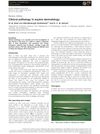
June 2016 in “Equine Veterinary Education”
1 citations
,
June 2016 in “Equine Veterinary Education” This article discusses various diagnostic techniques for investigating equine skin diseases and reports no new clinical results.
 1 citations
,
January 2023 in “International journal of all research education and scientific methods”
1 citations
,
January 2023 in “International journal of all research education and scientific methods” This review highlights how forensic drug analysis in hair using modern instrumental techniques offers advantages such as easy sample collection and chronological tracking of drug use, emphasizing its value for law enforcement and other applications.
 October 2024 in “Journal of the Endocrine Society”
 In this retrospective chart review, researchers observed that estrogen monotherapy effectively suppressed testosterone levels below 50ng/dL in all transfeminine patients studied, particularly those using injectable formulations, though the small sample size and ongoing data collection limit these findings.
 5 citations
,
May 2019 in “Anais Brasileiros de Dermatologia”
5 citations
,
May 2019 in “Anais Brasileiros de Dermatologia” This article discusses the connection between prenatal androgen exposure, marked by the second-to-fourth digit ratio, and seborrheic dermatitis, but reports no new experimental findings.

This study reports that hair samples can be used to track chronic hormone levels, revealing stress, reproductive, and sodium regulation patterns in wildebeest related to environmental factors.
 33 citations
,
January 2017 in “Conservation physiology”
33 citations
,
January 2017 in “Conservation physiology” This study found that measuring reproductive hormone levels in brown bear hair may effectively support non-invasive genetic sampling, though larger samples or more sensitive techniques are needed for broader application.
21 citations
,
January 2020 in “Conservation Physiology” This study found that cortisol concentrations were significantly higher in hair samples with follicles compared to those without, suggesting potential confounding in stress assessments using different hair sampling methods.