 1 citations
,
January 2018 in “Acta dermato-venereologica”
1 citations
,
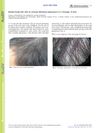
January 2018 in “Acta dermato-venereologica” A teenager's hair with alternating white and dark bands, known as Pili annulati, is a genetic condition that is usually harmless and often considered attractive.
2 citations
,
February 2000 in “International Journal of Dermatology” This article presents four case reports of men with porphyria cutanea tarda and hepatitis C, highlighting associations with polysubstance abuse, primarily alcohol.
2 citations
,
December 2025 in “Nano Letters” This study developed a tannin-modified cellulose-polypyrrole dressing that accelerates wound healing by enhancing granulation tissue, optimizing collagen, and stimulating angiogenesis, while providing antibacterial protection against S. aureus and E. coli.
 2 citations
,
September 1980 in “Experientia”
2 citations
,
September 1980 in “Experientia” Polyethylene alanine caused hair loss in young lab animals but not in adults, with hair regrowth occurring within 20 days.
October 2025 in “Environment International” This study reports that prenatal and prepubertal exposure to organochlorine compounds and perfluoroalkyl substances may affect pubertal development at age 12, with observed changes in development patterns in both girls and boys, highlighting the need for further research.
 42 citations
,
February 2017 in “Dermatologic surgery”
42 citations
,
February 2017 in “Dermatologic surgery” This study found that VYC-15L (Juvéderm Volbella XC) was safe and effective for enhancing lip and perioral areas, achieving higher lip fullness improvement and fewer severe injection site reactions compared to NASHA, with effects lasting up to one year.
 23 citations
,
November 2021 in “Journal of Bionic Engineering”
23 citations
,
November 2021 in “Journal of Bionic Engineering” This study found that PCL-Col/ZnO fibrous scaffolds enhanced wound healing and exhibited antibacterial properties, making them promising for use as a wound dressing.
 June 2023 in “International Journal of Pharmaceuticals Nutraceuticals and Cosmetic Science”
 This review compiles recent findings on the pharmacokinetics, pharmacodynamics, and pharmacogenomics of Valproate, highlighting potential new uses, benefits, and risks, but reports no new clinical results.
1 citations
,
September 2024 in “Porto Biomedical Journal” This case report illustrates the diagnostic challenges and importance of early detection in primary vitreoretinal lymphoma, highlighting a successful treatment outcome with systemic chemotherapy in preventing CNS progression.
2 citations
,
September 2024 in “World Journal of Clinical Cases” This case report describes how autologous platelet-rich plasma treatment led to complete healing of a chronic wound in a 72-year-old male patient after other standard treatments failed.
5 citations
,
September 1989 in “Pediatric dermatology” Persistent papular plaques on children's faces need better understanding and treatment.
80 citations
,
August 2022 in “Materials Today Bio” This study developed a double-network hydrogel using polyacrylamide and catechol-chitosan to enhance mechanical properties and promote drug release, aiding in inflammation regulation and wound healing for chronic wounds with challenging microenvironments.
19 citations
,
December 2022 in “Regenerative Biomaterials” This study found that gelatin–polycaprolactone/silk fibroin composite membranes with line micropatterns enhanced wound healing in rats by promoting cell alignment, angiogenesis, and increased α-SMA production.
 February 2025 in “International Journal of Morphology”
 In this study conducted on mouse fetuses, valproic acid was found to reduce Sonic Hedgehog expression in the skin and hair follicles, but the inclusion of vitamin E helped mitigate this effect, supporting its potential role in managing valproic acid-induced changes.
 January 2024 in “International Journal of Scientific Research in Science and Technology”
 This review analyzes Platelet-Rich Plasma therapy for facial aesthetics, discussing its principles, efficacy, safety, and future research directions, but reports no new clinical results.
 December 2020 in “International Journal of Research in Pharmaceutical Sciences”
 This review analyzes the mnemonic MY PCOS, exploring diagnosis and treatment strategies for the metabolic, cosmetic, and reproductive complications of polycystic ovary syndrome, without reporting new clinical findings.
49 citations
,
January 2024 in “Regenerative Biomaterials” In this study, a novel electrospun dressing patch made with radially oriented PHBV nanofibers and loaded with berberine was shown to significantly accelerate diabetic wound healing in mice, achieving 100% wound closure in 18 days while also demonstrating improved mechanical and anti-inflammatory properties.
September 2024 in “Journal of Investigative Dermatology” VIP reduces hair pigmentation by decreasing melanin production.
January 2025 in “SSRN Electronic Journal” This study found that a mitoxantrone, vincristine, and prednisolone regimen effectively treated recurrent breast cancer with a 70% response rate, though it was associated with significant myelosuppression.
This study reported that women with stress urinary incontinence experienced significant symptom improvement at one and three months following autologous platelet-rich plasma injections, highlighting this minimally invasive treatment as effective and safe.
 April 2016 in “Plastic and reconstructive surgery. Global open”
 This article from the PRS Global Open and ASPS Education Network does not present any new research findings; it likely serves as an introductory or descriptive overview.
 4 citations
,
September 2021 in “Hormone and Metabolic Research”
4 citations
,
September 2021 in “Hormone and Metabolic Research” This study found that VDR polymorphisms, particularly ApaI and FokI variants, are associated with hormonal and metabolic disturbances in women with PCOS, with notable variations across different ethnicities.
December 2025 in “Zagazig University Medical Journal” This review discusses polydioxanone threads as a promising, minimally invasive treatment for androgenetic alopecia in both males and females, but notes that further research is needed to optimize protocols and outcomes.
 April 2017 in “Plastic and Reconstructive Surgery – Global Open”
 In this study, researchers developed a 3D-printed vascular model to analyze how different shear stresses influence cell behavior and promote cellular organization around neovessels, offering insights into tissue engineering for wound reconstruction.

This study evaluated the effect of intralesional injections of lyophilized Platelet Derived Growth Factors in 42 patients with Peyronie's disease and found significant reductions in penile curvature and plaque size, along with improvements in Peyronie's Disease Questionnaire scores, suggesting a potential treatment role.
1 citations
,
November 2023 in “Polymers” This review examines how incorporating various polymers and active ingredients into polyurethane dressings can enhance their properties and adaptability for better wound repair and regeneration, suggesting a promising direction for developing advanced functional dressings.
 April 2026 in “Mathematics”
 This study used a probabilistic framework to show that platelet-rich plasma preparation results in significant variability in platelet dose due to factors like injected volume and concentration factor.
July 2026 in “Research Square” 5 citations
,
January 2024 in “Fermentation” This study found that fermenting porcine and equine placentas with a specific lactic acid bacterial strain enhanced the moisturizing abilities and cell proliferation properties compared to traditional placental extracts, suggesting their potential for cosmetic applications.