 November 2019 in “Harper's Textbook of Pediatric Dermatology”
 This index of Harper's Textbook of Pediatric Dermatology, Fourth Edition, provides no clinical results or new findings.
 October 2019 in “Journal of Evolution of Medical and Dental Sciences”
 This case report describes a 56-year-old male with chronic watery diarrhea, hyperpigmentation, and alopecia, in whom colonoscopy revealed multiple polypoidal lesions from the distal transverse colon to the rectum.
 July 2018 in “British Journal of Dermatology”
 Hair regrowth was seen in 83% of children with alopecia, immune system plays a role in the condition, and various treatments showed effectiveness for hair and nail disorders.
 July 2017 in “British Journal of Dermatology”
 The document concludes that scalp conditions have various causes and can present in many different ways.
 January 2017 in “Springer eBooks”
 The document explains various skin conditions and their treatments.
 January 2017 in “Acta dermato-venereologica”
 The congress showed that psychological therapy can help skin condition patients, social media affects acne stigma, education improves atopic dermatitis, and patient satisfaction in dermatology is high, especially with good doctor engagement.
 January 2016 in “Skin appendage disorders”
 The document discusses various nail and hair disorders and their treatments.

Robotic-assisted hair transplant is effective and less painful, but needs more evaluation for long-term results.
 March 2014 in “Journal of The American Academy of Dermatology”
 Vitamin D deficiency is common in temporary hair loss, and stress is often a suspected cause.
 March 2014 in “Journal of The American Academy of Dermatology”
 Tavaborole is a safe and effective toenail fungus treatment, with the 5% solution being the best option.
 February 2013 in “Journal of The American Academy of Dermatology”
 Hair loss is a common, often overlooked side effect of hormone treatments for breast and prostate cancer.
 February 2013 in “Journal of The American Academy of Dermatology”
 There is no significant link between insulin resistance and certain hair disorders like idiopathic hirsutism and androgenic alopecia.
 February 2013 in “Journal of The American Academy of Dermatology”
 Hair loss is a common but often unreported side effect of cancer treatments, especially for breast and prostate cancers.
 February 2013 in “Journal of The American Academy of Dermatology”
 Hair loss is a common side effect of hormone treatments for cancer.
 January 2013 in “Journal of dermatology”
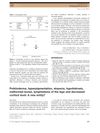
 This letter to the editor raises the possibility of a new medical entity characterized by symptoms such as poikiloderma, hyperpigmentation, alopecia, malformed bones, lymphedema, and decreased cortisol, but provides no clinical results.
 February 2009 in “Springer eBooks”
 Pregnancy can cause more body and scalp hair growth and make nails brittle, but these changes often revert after giving birth.
August 2021 in “Indian dermatology online journal” This study reported an unusual case of nail matrix involvement and trachyonychia in a child with juvenile pityriasis rubra pilaris, showing significant improvement with topical therapy and oral biotin.

This study found that polycystic ovary syndrome was the most common cause of hirsutism among premenopausal Algerian women.
 13 citations
,
September 2011 in “Archives of dermatology”
13 citations
,
September 2011 in “Archives of dermatology” This case report describes a 3-year-old male with X-linked ichthyosis and associated neurologic abnormalities, identifying an unusual cortical development malformation and suggesting that abnormal hair banding may assist diagnosis.
 33 citations
,
March 2006 in “Seminars in cutaneous medicine and surgery”
33 citations
,
March 2006 in “Seminars in cutaneous medicine and surgery” This article illustrates various hair shaft defects and suggests that dermatologists can diagnose most of them using light microscopy and polarization without needing advanced imaging techniques.
6 citations
,
October 2006 in “International Journal of Dermatology” This article discusses central trichoptilosis with onycholysis but provides no new clinical results.
Trichorrhexis nodosa causes hair to break easily, often affecting young to middle-aged black women.
 81 citations
,
June 2012 in “European journal of human genetics”
81 citations
,
June 2012 in “European journal of human genetics” This review outlines a diagnostic framework for clinicians to distinguish different types of inherited ichthyoses and suggests further testing and treatment strategies, but reports no new clinical results.
 December 2025 in “IP Indian Journal of Clinical and Experimental Dermatology”
 Hair shaft disorders often indicate genetic or systemic issues and are managed by minimizing damage.
20 citations
,
April 2000 in “Experimental dermatology” This study observed that overexpression of the enzyme ODC in transgenic mice caused hair loss and skin changes similar to human papular atrichia, suggesting that ODC might be involved in a critical hair follicle function pathway.
28 citations
,
July 1980 in “British Journal of Dermatology” This study describes a case of generalized trichorrhexis nodosa and finds that defects in alpha-keratin chain formation and low cystine levels in hair may contribute to the condition.
1 citations
,
January 2018 in “Jornal Brasileiro de Patologia e Medicina Laboratorial” This case report describes a 10-year-old girl with monilethrix, detailing hereditary autosomal dominant traits and distinctive nodular hair shaft abnormalities observed in her family through clinical examination and microscopic analysis.
April 1977 in “Pediatric Research” 6 citations
,
January 2015 in “Indian Dermatology Online Journal” This case report describes a unique presentation of porokeratotic eccrine ostial and dermal duct nevus with lesions on the dorsum of the hand and a focal lichenoid infiltrate, differing from typical palm and sole involvement.
58 citations
,
November 2004 in “The journal of investigative dermatology/Journal of investigative dermatology” This study found that mutations in the Foxn1 gene in nude mice affect not only hair but also nail structure and differentiation, offering insights into nail hypergranulosis pathogenesis relevant to human nail diseases.