March 2021 in “Annals of King Edward Medical University” This report details a case of a 3-year-old child with Clouston syndrome, a rare inherited disorder affecting nails, skin, and hair, highlighting the need for supportive management due to the absence of treatment options.
11 citations
,
December 2015 in “Indian journal of dermatology, venereology, and leprology” Dermoscopy quickly and accurately diagnosed a rare hair disorder in a 12-year-old girl.
Trichorrhexis nodosa causes hair to break easily, often affecting young to middle-aged black women.
23 citations
,
January 1964 in “Archives of Dermatology” This report describes a child with ulerythema ophryogenes marked by eyebrow hair absence and progressive skin atrophy, whose condition did not improve despite elevated vitamin A levels via injections.
September 2021 in “CRC Press eBooks” This article discusses trichotillomania and trichoteiromania, focusing on their clinical presentation, main trichoscopic features, and similarities in hair loss patterns but reports no new research findings.
March 1999 in “Annals of the Academy of Medicine Singapore” This article reviews trichotillomania, highlighting its prevalence, common treatment options, and challenges such as secrecy and delayed treatment, but reports no new clinical results.
 6 citations
,
July 2011 in “Journal of Plastic Reconstructive and Aesthetic Surgery”
6 citations
,
July 2011 in “Journal of Plastic Reconstructive and Aesthetic Surgery” This case report describes a successful eyebrow reconstruction using hair follicle micrografts in a patient with dormant keratosis pilaris atrophicans, demonstrating potential for this technique in similar conditions.
 1 citations
,
December 2017 in “Acta biomedica scientifica”
1 citations
,
December 2017 in “Acta biomedica scientifica” This study observed that 30% of women with polycystic ovary syndrome had androgenic alopecia, suggesting it is a prevalent but unreliable marker of hyperandrogenism.
January 1999 in “대한피부과학회지” This study found that trichotillomania was more common in younger people, particularly females, and was characterized by increased catagen hair without perifollicular inflammation.
12 citations
,
October 2001 in “British Journal of Ophthalmology” This paper suggests intralesional cidofovir as a potentially effective treatment for SCC with no systemic toxicity observed, but surgical excision remains the standard for its curative outcomes and thorough evaluation.
4 citations
,
April 1983 in “The Journal of Dermatology” This case report describes a 15-year-old Japanese girl with juvenile hypothyroidism who developed hypertrichosis and hyperkeratosis due to a keratin plug inhibiting hair growth on her back and arms.
4 citations
,
April 2012 in “The journal of investigative dermatology/Journal of investigative dermatology” This study developed a mouse model lacking keratin 16 to replicate palmoplantar lesions, which may help uncover the molecular mechanisms driving these lesions in pachyonychia congenita and focal non-epidermolytic palmoplantar keratoderma.
 7 citations
,
August 2008 in “Cases Journal”
7 citations
,
August 2008 in “Cases Journal” This article reports a case of a 14-month-old child with a constriction ring syndrome caused by tightly wrapped hair, highlighting the importance of early recognition and treatment to prevent serious complications.
1 citations
,
January 2009 in “The Open Dermatology Journal” This case report describes a patient with diffuse large B cell lymphoma who experienced temporary Beau’s lines and onycholysis while undergoing R-CHOP chemotherapy, which resolved two months after treatment ended.
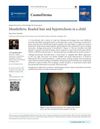 January 2026 in “Cosmoderma”
 In this clinical case study, a 9-year-old girl was diagnosed with monilethrix, a hereditary hair shaft disorder characterized by weak, beaded hair, with management focusing on minimizing hair trauma.
July 2025 in “International Journal of Trichology” This case study reported on a 6-year-old boy with frictional alopecia in the lower limbs, likely linked to his habit of cross-legged sitting and occasional rubbing, highlighting the condition's rarity in pediatric cases and emphasizing the need for further research in this age group.
61 citations
,
April 1980 in “Journal of the American Academy of Dermatology” This case study describes a young woman with a unique syndrome combining lamellar ichthyosis, neuroectodermal and mesodermal defects, and hair with trichoschisis and low sulfur content.
2 citations
,
April 2008 in “Advances in therapy” This report of four pediatric alopecia cases highlights the varied patterns and treatments, noting that differentiating alopecia from trichotillomania is crucial due to their different management approaches.
 11 citations
,
July 1999 in “Plastic and Reconstructive Surgery”
11 citations
,
July 1999 in “Plastic and Reconstructive Surgery” This study reported successful outcomes in over 40 patients undergoing reparative surgical techniques for previously unsuccessful hair restoration, with significant improvements in appearance despite potential challenges like limited donor hair and scalp scarring.
 August 2021 in “Acta medica Philippina”
 This case study highlights how trichoscopy helped differentiate between diffuse alopecia areata and trichotillomania in an 11-year-old girl, demonstrating its importance in distinguishing hair disorders with similar presentations.
 October 2024 in “Dermatology Practical & Conceptual”
 In this study, the authors evaluated 200 Egyptian children with focal non-cicatricial alopecia, finding that alopecia areata (42%) and tinea capitis (40.5%) were the most prevalent causes. Trichoscopy identified unique features for each condition, enhancing diagnosis and management.
3 citations
,
September 2016 in “Pediatric Dermatology” This case study reports that hypertrichosis, although not always present, may be an important diagnostic clue for superficial epidermolytic ichthyosis in a young child.
75 citations
,
September 1985 in “Archives of dermatology” This report of ichthyosis follicularis in two boys discusses the challenges of distinguishing it from similar disorders, noting its rarity and unclear inheritance pattern without providing new clinical results.
8 citations
,
January 2014 in “Indian Dermatology Online Journal” This article presents a case of trichostasis spinulosa, a common but often unrecognized disorder, diagnosed through dermoscopic examination of black macules revealing bundled vellus hairs, with the patient declining treatment.
19 citations
,
July 2004 in “Australasian Journal of Dermatology” In this case study, a 74-year-old woman improved her scalp hair condition by reducing chronic rubbing, leading to hair regrowth without ongoing abnormalities after behavior modification.
20 citations
,
April 2000 in “Experimental dermatology” This study observed that overexpression of the enzyme ODC in transgenic mice caused hair loss and skin changes similar to human papular atrichia, suggesting that ODC might be involved in a critical hair follicle function pathway.
February 2022 in “Actas Dermo-Sifiliográficas” This abstract presents a clinical case of a woman with traction alopecia and discusses trichoscopic findings without reporting any new research results.
 1 citations
,
April 2020 in “Asian Journal of Medicine and Biomedicine”
1 citations
,
April 2020 in “Asian Journal of Medicine and Biomedicine” This article reports a case of hair tourniquet syndrome in a child's toe, successfully treated surgically, and emphasizes the need for healthcare providers to be aware for early detection and treatment.
14 citations
,
May 1979 in “International Journal of Dermatology” In this study, trichostasis spinulosa was observed in 51 patients with lesions on the nose, where some follicles contained up to 86 hairs each, possibly influenced by endocrine factors and actinic rays.
44 citations
,
July 2013 in “Journal of the American Academy of Dermatology” This review discusses various genetic and acquired conditions associated with poliosis circumscripta and reports no new clinical results.