 1 citations
,
March 2024 in “Ophthalmic Plastic and Reconstructive Surgery”
1 citations
,
March 2024 in “Ophthalmic Plastic and Reconstructive Surgery” In this case study, a 34-year-old woman with a rare presentation of pilomatrixoma involving alopecia and skin hypopigmentation showed no improvement in these symptoms despite a 3-month trial of topical steroid treatment, highlighting a potential association between pilomatrixoma and microinflammation.
April 2023 in “The Medical Journal of Australia” In this case report, a five-year-old girl with a bald patch was diagnosed with congenital triangular alopecia, a localized non-scarring condition that typically remains unchanged and lacks effective treatment.
January 2014 in “ACTA SCIENTIAE VETERINARIAE” This case report describes a cat with localized scleroderma (morphea-like) that did not show clinical resolution or spontaneous remission after treatment, differing from previously documented cases.
January 2025 in “Dermatology Online Journal” The man's hair loss and skin papules were diagnosed as atrichia with papular lesions, not alopecia areata universalis.
January 1996 in “Studia iuridica” This study identified two novel point mutations in the hHb6 gene associated with monilethrix, suggesting these mutations could serve as diagnostic markers for this genetic hair disorder.

This chapter offers detailed histopathologic insights into various pilosebaceous unit diseases, discussing diagnosis without reporting new results.
78 citations
,
July 1984 in “Journal of Investigative Dermatology” January 2026 in “JDDG Journal der Deutschen Dermatologischen Gesellschaft” This case report describes a five-year-old boy diagnosed with nevus comedonicus syndrome, a rare skin condition, characterized by asymptomatic skin lesions and a congenital cataract of the right eye, without inflammation or typical signs of related conditions.
April 2024 in “Anais Brasileiros de Dermatologia” 
This case study reports the first known instance of basal cell carcinoma developing at the site of repeated microneedling for androgenetic alopecia, suggesting further research is needed to assess the long-term safety of such devices.
 August 2025 in “International Journal of Contemporary Pediatrics”
 This case report presents a rare subtype of hypomyelinating leukodystrophy linked to a PYCR2 gene mutation, emphasizing exome sequencing's value in diagnosing undiagnosed childhood HLDs with atypical symptoms.
 11 citations
,
September 2016 in “Journal of virological methods”
11 citations
,
September 2016 in “Journal of virological methods” In this study, rabies virus antigens were detected in the outer root sheath of the follicle-sinus complex in the muzzle skin of rabid dogs, suggesting its usefulness as an alternative diagnostic specimen.
July 2022 in “European Journal of Dermatology” In this study, researchers found that patients with psoriasis had a higher probability of achieving and maintaining a clinical response using brodalumab compared to ustekinumab over 52 weeks, as measured by a multistate modelling approach based on absolute PASI scores.
2 citations
,
April 2012 in “American Journal of Dermatopathology” This report describes two cases of nevus lipomatosus superficialis with the unusual feature of dilated hair follicles, emphasizing the need for precise histopathological diagnosis to differentiate from similar conditions.
 July 2023 in “bioRxiv (Cold Spring Harbor Laboratory)”
 This study developed a 3D ovarian cancer model using microtumours, which effectively mimics minimal residual disease and supports the identification of new drug targets like perhexiline for treatment-resistant cells.
 3 citations
,
April 2016 in “International Journal of Dermatology”
3 citations
,
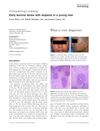
April 2016 in “International Journal of Dermatology” This article presents a clinicopathologic challenge involving early leonine facies with alopecia in a young man and reports no new clinical results.
 8 citations
,
September 2016 in “The American Journal of Dermatopathology”
8 citations
,
September 2016 in “The American Journal of Dermatopathology” This study found that eccrine duct dilation is significantly more frequent in cicatricial alopecias compared to noncicatricial alopecias, possibly due to the scarring process.
 33 citations
,
March 2006 in “Seminars in cutaneous medicine and surgery”
33 citations
,
March 2006 in “Seminars in cutaneous medicine and surgery” This article illustrates various hair shaft defects and suggests that dermatologists can diagnose most of them using light microscopy and polarization without needing advanced imaging techniques.
 8 citations
,
June 2016 in “Journal of Cutaneous Pathology”
8 citations
,
June 2016 in “Journal of Cutaneous Pathology” This report describes two rare cases of desmoplastic melanoma presenting as alopecia neoplastica, highlighting a potential diagnostic pitfall for clinicians examining patients with scar-like alopecia.
 July 2024 in “Dermatology Practical & Conceptual”
 This article discusses the diagnostic challenges between certain neonatal scalp conditions and highlights the potential of line-field confocal optical coherence tomography to provide detailed, non-invasive skin examination, without presenting new clinical findings.
54 citations
,
January 1995 in “Human Molecular Genetics” This study mapped monilethrix, a hereditary hair and nail disorder, to the type II keratin cluster on chromosome 12q, marking the first primary human hair disorder localization and implicating defects in "hard" keratins.
 46 citations
,
January 2020 in “Research”
46 citations
,
January 2020 in “Research” This review discusses the design, properties, and potential applications of smart microneedles, with no new clinical results presented.
1 citations
,
August 2024 in “Pediatric Dermatology” In this report, researchers describe an unusual case of congenital pili multigemini, a hair follicle disorder, presenting on the eyebrow of a female infant, highlighting its rarity and atypical location.
 April 2023 in “Journal of Investigative Dermatology”
 This study found that longer disease duration in psoriasis patients was significantly associated with increased incidence of cerebral atrophy, suggesting a potential need for central nervous system screening in these patients.
 1 citations
,
December 2014 in “Scanning”
1 citations
,
December 2014 in “Scanning” This study used multiphoton microscopy to successfully visualize rabbit skin microstructure, highlighting its noninvasive potential for future skin research related to diseases and wound healing.
2 citations
,
February 2025 in “Advanced Healthcare Materials” This study developed microfluidics-based 3D microtumors to model minimal residual disease in ovarian cancer, highlighting their alignment with patient-derived MRD and response to a fatty acid oxidation inhibitor.
 2 citations
,
June 2020 in “Dermatology and therapy”
2 citations
,
June 2020 in “Dermatology and therapy” In this case report, narrowband-UVB phototherapy successfully treated a rare instance of Graham Little-Piccardi-Lassueur syndrome, a variant of lichen planopilaris, as investigated through non-invasive imaging techniques.
May 2025 in “Apollo Medicine” This study found that trichoscopy can be a helpful, noninvasive tool for identifying specific patterns that correlate with the clinical activity and severity of alopecia areata, enhancing its diagnosis and monitoring.
 April 2026 in “American Journal of Dermatopathology”
 This study identified a new dermoscopic feature, plexiform erythema, in lichen planopilaris lesions, suggesting it may indicate active disease and the potential need for more aggressive treatment.
 2 citations
,
November 2018 in “Modern Applied Science”
2 citations
,
November 2018 in “Modern Applied Science” This study proposed a method to automatically detect and replace hair in dermoscopy images, demonstrating high sensitivity and specificity in melanoma diagnostics.