 1 citations
,
July 2024 in “Indian Journal of Case Reports”
1 citations
,
July 2024 in “Indian Journal of Case Reports” This article presents a case study of a 16-year-old male with GAPO syndrome, characterized by growth retardation, alopecia, pseudoanodontia, and optic atrophy, who sought dental treatment for missing teeth.
16 citations
,
January 2010 in “Journal of Korean medical science/Journal of Korean Medical Science” This case report presents the first genetically confirmed case of acrodermatitis enteropathica in Korea, identifying compound heterozygous mutations in the SLC39A4 gene in an 8-month-old boy.
February 2026 in “Journal of Paediatrics and Child Health” This source highlights that gastric trichobezoar, although rare in children under 3, should be suspected in cases of chronic vomiting and gastric masses, with surgical removal as definitive treatment; multidisciplinary intervention is crucial to prevent serious complications and recurrence.
April 2019 in “Journal of Investigative Dermatology” This study found that the gut microbiota in alopecia areata patients showed distinct dysbiosis, with an overrepresentation of Firmicutes and underrepresentation of Bacteroides, aligning with patterns seen in other autoimmune disorders.
 10 citations
,
August 2012 in “Current Problems in Pediatric and Adolescent Health Care”
10 citations
,
August 2012 in “Current Problems in Pediatric and Adolescent Health Care” This review explores hair signs related to nutrition disorders, such as thin and dyspigmented hair, without presenting new clinical findings; the authors highlight unknowns regarding underlying causes.
 6 citations
,
January 2018 in “Acta dermatovenerologica Alpina, Pannonica et Adriatica (Tiskana izd.)”
6 citations
,
January 2018 in “Acta dermatovenerologica Alpina, Pannonica et Adriatica (Tiskana izd.)” This case report describes the successful surgical removal of a trichobezoar in an 8-year-old girl, which extended from her stomach into the duodenum.
 8 citations
,
January 2018 in “Middle East Journal of Digestive Diseases”
8 citations
,
January 2018 in “Middle East Journal of Digestive Diseases” This case report describes a middle-aged man with alopecia universalis and ulcerative colitis, where hair regrowth occurred following treatment with azathioprine and mesalamine.
January 2018 in “Journal of Diabetic Association Medical College.” This case study reports a two and a half-month-old with biotinidase deficiency who showed rapid seizure improvement with biotin treatment after presenting with convulsions and neurological symptoms.
This case report describes a six-year-old child with congenital biotinidase deficiency whose symptoms, including breathlessness, alopecia, and hearing loss, were reversed with biotin supplementation.
 32 citations
,
December 1969 in “The Lancet”
32 citations
,
December 1969 in “The Lancet” This study found a significant shift to the telogen phase in the hair growth of children with classical marasmus compared to normal children, suggesting a connection to the chronicity of the condition.
 June 2012 in “Springer eBooks”
 Eating disorders can cause various hair problems, and while hair loss in these disorders is linked to metabolic syndrome, treatment focuses on specific medications and lifestyle changes for the syndrome.
 December 2022 in “Gastroenterology”
 This report describes a case of Cronkhite-Canada syndrome diagnosed in a 54-year-old man with symptoms including gastrointestinal polyps, alopecia, skin hyperpigmentation, and severe diarrhea, who experienced significant symptom improvement with azathioprine.
29 citations
,
July 1996 in “Acta Paediatrica” This study found that an 11-month-old Japanese infant developed biotin deficiency while on a Japanese amino acid formula without biotin, which was resolved with biotin supplementation.
8 citations
,
September 1981 in “Zentralblatt für Veterinärmedizin Reihe A” In this animal study, pigs on a biotin-deficient diet showed significant hair loss, weak and brittle claws, and skin lesions after 8–10 weeks, with tissue necrosis observed microscopically after 15 weeks.
4 citations
,
June 1980 in “American Journal of Clinical Nutrition” Malnutrition can change hair color due to altered copper and zinc levels.
 20 citations
,
September 2005 in “Clinics in Dermatology”
20 citations
,
September 2005 in “Clinics in Dermatology” This review discusses the skin manifestations of metabolic diseases like diabetes and gout, emphasizing their role in diagnosis and monitoring, but it presents no new research findings.
This study investigated the safety and efficacy of IV iron maltoside 1000 in treating iron-deficiency anemia among children with IBD and found a significant increase in hemoglobin levels by 6 weeks, maintained for up to a year, with minimal side effects reported.
 3 citations
,
November 2020 in “Cleveland Clinic Journal of Medicine”
3 citations
,
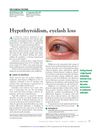
November 2020 in “Cleveland Clinic Journal of Medicine” Eyelash loss can be a sign of thyroid problems.
This review discusses loose anagen hair syndrome in children, characterized by non-scarring alopecia and increased hair shedding, and reports no new results; topical minoxidil may be used as a treatment.
3 citations
,
June 2023 in “American Journal of Forensic Medicine & Pathology” This case report documents a rare fatal instance of Rapunzel syndrome in a child, highlighting the use of postmortem CT and MRI to reveal trichobezoar-related bowel obstructions and perforations as the cause of death.
1 citations
,
November 2015 in “International Educational Scientific Research Journal” This study found that most participants were unaware that their symptoms could be related to zinc deficiency, highlighting a lack of awareness about zinc's importance in health.
 January 2003 in “Annals of Dermatology”
 This case report describes a hair structure abnormality associated with iron deficiency anemia, which improved after iron supplementation ceased hair loss and corrected the hair shaft abnormality.
 2 citations
,
August 2012 in “Journal of the American Academy of Dermatology”
2 citations
,
August 2012 in “Journal of the American Academy of Dermatology” This correspondence describes two patients with both epidermolysis bullosa simplex, Dowling-Meara type, and loose anagen hair syndrome, an association not previously reported in the literature.
 August 2013 in “Gastroenterology”
 This case report highlights a 60-year-old patient's diagnosis with Cronkhite-Canada syndrome, characterized by gastrointestinal polyps, diarrhea, weight loss, brittle nails, alopecia, and skin changes, which showed improvement with treatment.
1 citations
,
April 2024 in “The Journal of Dermatology” This case study reports that a woman with epidermolysis bullosa acquisita experienced severe cicatricial alopecia and total nail loss after discontinuing treatment for two years, highlighting the potential for serious effects if the condition is not managed.
November 2018 in “Journal of dermatology & cosmetology” This manuscript reports on the first case of perforating necrobiosis lipoidica in Colombia, marking the 19th documented case worldwide.
 13 citations
,
February 2004 in “Clinical and Experimental Ophthalmology”
13 citations
,
February 2004 in “Clinical and Experimental Ophthalmology” This report describes the clinical and histopathological features of lipoid proteinosis in a brother and sister with lid lesions, highlighting the importance of recognizing such lesions for diagnosis.
70 citations
,
February 2009 in “Biological Trace Element Research” 1 citations
,
December 2013 in “International Journal of Dermatology” This correspondence article discusses the association between acquired silky African hair, malnutrition, and chronic diseases but reports no new research findings.
 3 citations
,
June 2020 in “Cutis”
3 citations
,
June 2020 in “Cutis” This review discusses the link between nutritional deficiencies and cutaneous diseases, outlining risk factors, disease presentations, diagnostic processes, and supplementation in undernourished patients, but reports no new results.