 November 2025 in “SKIN The Journal of Cutaneous Medicine”
 This study aims to assess the real-world effectiveness of baricitinib, a JAK inhibitor, for promoting regrowth of nasal, genital, and beard hair in patients with severe alopecia areata, expanding on findings from the BRAVE-AA clinical trial. Results are not reported.
 June 2026 in “Journal of health economics and outcomes research”
 This study found that ritlecitinib 50 mg offered a lower cost per responder than baricitinib 2 or 4 mg for treating severe alopecia areata at Weeks 24 and 52, potentially influencing reimbursement decisions.
29 citations
,
April 2020 in “Biomolecules” This review discusses the potential biomedical and clinical applications of brassinosteroids, highlighting their observed antiviral, anticancerous, and other bioactivities in animal test systems, but reports no new findings.
1 citations
,
July 2026 in “Dermatology and Therapy” In this study, JAK inhibitors for treating alopecia areata and atopic dermatitis were generally well tolerated in a real-world setting, with most adverse events being mild or moderate and rare serious cases resembling the general population incidence.
 June 2026 in “Journal of health economics and outcomes research”
 In this study, researchers found that ritlecitinib 50 mg offered a lower cost per responder than baricitinib 2 or 4 mg at both 24 and 52 weeks for treating severe alopecia areata, suggesting potential implications for reimbursement or formulary decisions.
 September 2023 in “PubMed”
 This study reviewed baricitinib's efficacy and safety for treating alopecia areata and found that more patients achieved significant hair regrowth with baricitinib compared to placebo in two phase III trials. Mild to moderate side effects were reported, with additional study suggested for long-term effects.
August 2026 in “Clinical Case Reports” In this case report, a patient with diffuse alopecia areata experienced complete hair regrowth after treatment with oral abrocitinib, with no adverse effects observed.
September 2002 in “Oncology Times” This study presented at the ASCO Annual Meeting reported that the epidermal growth factor receptor antibody ABX-EGF showed preliminary efficacy in renal cell cancer patients, with tolerable side effects, while bortezomib demonstrated clinical benefit in a significant proportion of multiple myeloma patients.
 June 2023 in “Fundamental & clinical pharmacology”
 This research highlights that while JAK inhibitors are effective for various inflammatory conditions, studies raise concerns about increased risks of venous and arterial thromboembolism, and cancer, particularly with tofacitinib and baricitinib, leading to European guidelines recommending caution in high-risk patients.
 December 2023 in “Journal of Ayub Medical College Abbottabad”
 In this study, Ritlecitinib was reported as a newly approved treatment for alopecia areata that can be used in patients aged 12 and older; after 24 weeks, it resulted in 80% or more scalp hair coverage in treated patients compared to a placebo.
 January 2016 in “대한피부과학회지”
 This case report describes two patients experiencing a bortezomib-induced skin eruption as multiple plaques on the trunk, with the lesions resolving spontaneously in about a week.
 October 2024 in “Journal of the European Academy of Dermatology and Venereology”
 This study reported that ritlecitinib 50 mg and baricitinib 4 mg showed similar efficacy in treating severe alopecia areata, with no significant difference in hair regrowth outcomes at Week 24, but there remains considerable uncertainty and a need for further research.
September 2025 in “Journal of Skin and Stem Cell” This narrative review reports that baricitinib, a first-generation JAK inhibitor, has shown effectiveness in treating alopecia areata and atopic dermatitis and holds promise for other chronic dermatoses, marking a significant advancement in dermatological immunotherapy according to the summarized findings.
 November 2024 in “SKIN The Journal of Cutaneous Medicine”
 This study reports that ritlecitinib was prescribed to a diverse group of patients, including adolescents and adults with and without prior treatment for Alopecia Areata, in the first three months after FDA approval, potentially expanding care options for this condition.
 September 2023 in “Journal of The American Academy of Dermatology”
 This announcement discusses the recent FDA approval of baricitinib for treating severe alopecia areata in adults and reports no new clinical results.
1 citations
,
September 2025 in “JAAD reviews.” This review discusses the condition alopecia areata and summarizes its available treatments, mentioning three recently approved Janus kinase inhibitors, but reports no new clinical results.
 November 2021 in “World Family Medicine Journal /Middle East Journal of Family Medicine”
 This review discusses evidence from recent clinical trials showing inclisiran effectively lowers LDL cholesterol levels in patients with cardiovascular disease, leading to its use in the UK despite not being approved by the FDA.
June 2025 in “British Journal of Dermatology” This study details a case of a 20-year-old woman with APECED syndrome and alopecia areata who experienced complete scalp hair regrowth and improved quality of life after nine months of ruxolitinib treatment, highlighting the drug's effectiveness for severe AA linked to AIRE gene mutation.
In an outpatient cardiology center, this study found that introducing the AHA/ACC ABI screening protocol significantly increased the frequency of ABI ordering by 31.6% for symptomatic patients.
April 2025 in “Anais Brasileiros de Dermatologia” Abrocitinib effectively treats severe alopecia areata with significant improvement and no side effects.
 3 citations
,
April 2002 in “The American Journal of Medicine”
3 citations
,
April 2002 in “The American Journal of Medicine” The document concludes that early diagnosis of Balint's syndrome is crucial for effective treatment and that understanding drug interactions, like between ritonavir and statins, is important for patient care.
16 citations
,
January 2020 in “Annals of the rheumatic diseases” In this study, baricitinib improved the resolution of arthritis or rash in patients with systemic lupus erythematosus, but outcomes for skin involvement like alopecia were not reported.
 January 2025 in “SKIN The Journal of Cutaneous Medicine”
 This study of baricitinib in adults with severe alopecia areata found that after initial success, 10.9% of participants lost treatment response by Week 152. Factors like longer disease duration and severe baseline symptoms were more common in those losing response.
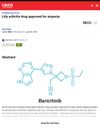 June 2022 in “C&EN global enterprise”
 This source notes that Olumiant (baricitinib), a rheumatoid arthritis drug by Eli Lilly and Company, has been approved as the first systemic treatment for severe alopecia areata.
 42 citations
,
April 2021 in “Journal of clinical pharmacology”
42 citations
,
April 2021 in “Journal of clinical pharmacology” This review discusses baricitinib's applications for various inflammatory disorders and highlights its promising efficacy alongside potential adverse effects, advocating for further research before it becomes a standard treatment.
September 2024 in “Annals of Medicine and Surgery” In this review, the authors highlight the FDA approval of Ritlecitinib, the first oral treatment specifically for moderate to severe alopecia areata in patients aged 12 and older, marking a significant advancement in managing this condition.
 November 2023 in “Annales de dermatologie et de vénéréologie, FMC”
 In this study, researchers found that among adults with severe alopecia, continued treatment with baricitinib for 104 weeks maintained hair regrowth effectively in those who responded at 52 weeks, with improved outcomes noted in some initially non-responders receiving 4 mg.
 July 2025 in “The Journal of Dermatology”
 This study identified common and unexpected adverse events associated with ritlecitinib in real-world use, providing insights into its safety profile for treating severe alopecia areata.
 October 2025 in “Actualización en Medicina de Familia”
 This review discusses several new pharmacological products, including those for cardiovascular prevention and overactive bladder, but notes challenges in defining their therapeutic roles and provides safety updates on existing medications; it reports no new clinical results.

This study found that baricitinib, a selective Janus kinase inhibitor, led to significantly improved scalp coverage in alopecia areata patients over 36 weeks compared to placebo, though adverse effects like acne and urinary tract infections were reported.